


Automatic accounting software for solo founders
Amounts last verified on September 21st 2026
Michel Myara is co-founder and product designer at looch, where he designs the ecosystem small businesses use to get paid and manage spend while keeping penny-perfect books.
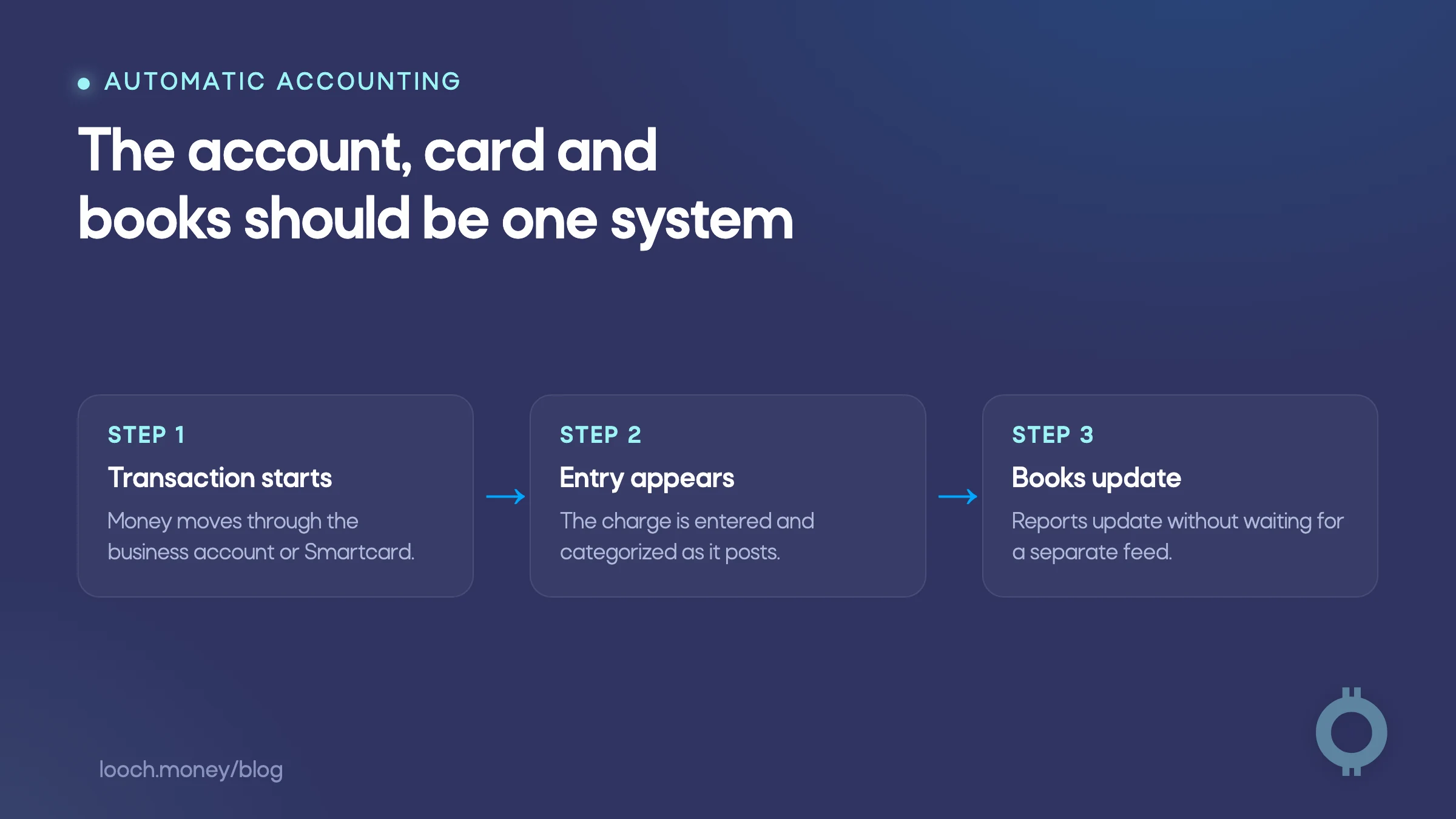
For a solo founder, accounting is automatic only when the account, the card and the books are one system

The best automatic accounting software for solo founders removes the bookkeeping step instead of making a founder supervise it. QuickBooks Simple Start and QuickBooks Solopreneur each cost $38/month, while Xero charges $25/month for Early and $55/month for Growing, where “Auto-reconcile bank transactions” begins. Wave puts automatic bank imports and categorization in Pro at $19/month. looch accounting is free on looch accounts, and each 1099 filing costs $2. A service with a named person costs more: Collective’s S Corp plan is $349/month and includes a dedicated account manager.
That distinction matters to solopreneurs and freelancers who want the books to run without supervising a separate feed.
Last verified: September 28th, 2026.
looch puts the business account, Smartcards, payments and books in one system. It forms companies, provides no-fee business accounts, accepts payments and keeps the books, with accounting free on looch accounts. That’s different from connecting a separate bank account to a ledger and waiting for a feed to copy transactions across.
looch is operated by Simplicity Fintech Inc, a financial technology company, not a bank. Simplicity Fintech Inc partners with Stripe Payments Company for money transmission services and account services with funds held at Fifth Third Bank N.A., Member FDIC. looch Smartcards Visa® Commercial Cards are powered by Stripe and issued by Celtic Bank.
“Automatic” describes three different accounting models
A bank feed with rules is automatic after you’ve taught it
QuickBooks describes its automated bookkeeping plainly: It “learns how you categorize income and expenses and then automatically matches and records transactions from then on.” The first decisions still come from you, and later suggestions need review when a transaction doesn’t match the pattern.
Xero includes “Reconcile bank transactions” on every plan, but its AI-powered “Auto-reconcile bank transactions” starts with Growing. Wave reserves automatic imports, merging and categorization for Pro. FreshBooks includes “Automated Bank Import” on every plan, while its features page separately advertises automated expense categorization.
In each case, the account, card and ledger remain separate systems. Automation begins after a feed delivers the transaction.
A done-for-you service is automatic because someone else does it
Collective’s LLC plan costs $199/month and includes automated monthly bookkeeping. Its S Corp plan adds the dedicated account manager, payroll and the annual business tax return.
Intuit Expert Full Service Bookkeeping is a separate QuickBooks add-on. It categorizes transactions and handles the account work each month, but its public pages don’t list a price and say tax preparation or filing isn’t included.
Wave Advisors starts at $149/month. These services can remove work from the founder’s plate, but the automation comes from assigning that work to someone else.
Lettuce sits between software and a managed back office. It provides its own business bank account and Visa debit card, then automatically categorizes expenses. Its Pro plan costs $299/month when billed monthly or $249/month when billed annually and is positioned for existing S corps earning $70K+.
Accounting built into the account is automatic because there’s no feed
With looch accounts and Smartcards, the transaction and its accounting entry originate in the same system. Every Smartcard charge is tagged and categorized the moment it posts. Invoice payments, bill payments, transfers and personal expenses are entered automatically.
There’s no separate account feed to break, delay a transaction or create a duplicate. The result is one system for moving money and producing the books. Learn how that model fits into an all-in-one financial platform for a small business.
The tools automate different parts of the job
| tool | monthly price | what is automatic | what still needs you | bookkeeper included |
|---|---|---|---|---|
| looch | $0/month on looch accounts; $2 per 1099 filed; external accounts cost $10/month each | Smartcard charges are entered and categorized as they post; invoice payments, bill payments, transfers and personal expenses are entered automatically; financial reports are generated from the books | Add a missing receipt, memo or category when required; pick or correct the category on an unusual charge; the income tax return and quarterly estimates remain the founder’s or a preparer’s job | No; looch is software only, and no human bookkeeper is included |
| QuickBooks Solopreneur or Simple Start | $38/month each | A bank feed, learned categorization and matched transactions; Solopreneur also includes unlimited receipts and mileage | Provide the first categorizations and review later matches | No; Intuit Expert Full Service Bookkeeping is a separate add-on with price on request, and tax filing isn’t included |
| Xero Early or Growing | $25/month or $55/month; Early is capped at 20 invoices and 5 bills a month | Bank transaction matching, Smart Document Capture and W-9 plus 1099 management; AI-powered automatic matching starts on Growing | Manually handle the matching step on Early and review proposed matches | No; free expert setup help is available |
| Wave Starter or Pro | Free or $19/month, with Pro also offered at $190/year | Pro automatically imports, merges and categorizes bank transactions and sends late-payment reminders | Starter leaves transaction entry to you; 1099 filing isn’t listed on the pricing page | No; Wave Advisors starts at $149/month |
| FreshBooks Lite or Plus | $23/month or $43/month; Lite supports 5 billable clients and Plus supports 50 | Automated bank imports on every plan; automated expense categorization; receipt data capture and double-entry reports on Plus | Review imported activity, work within the client limit and arrange tax filing | No; its Accounting Partner Program can match you with a professional |
| Lettuce Grow or Pro | Grow costs $83/month billed annually; Pro costs $299/month or $249/month billed annually | Expenses are automatically categorized; taxes are set aside when you’re paid; Pro includes real-time tax-optimized bookkeeping, monthly payroll and automatic quarterly tax payments | Pro is built for existing S corps earning $70K+; Grow includes year-end tax reconciliation but no entity return; Pro includes entity tax prep and filing and quarterly estimated tax payments; the personal return is an add-on at an additional $500 billed annually | Not stated; LettuceHead AI assistant is included |
| Collective LLC or S Corp | $199/month or $349/month; annual billing saves 15% | Automated monthly bookkeeping and quarterly tax estimates; S Corp adds Form 2553, Form 1120-S and payroll | Pay for a managed back office that remains separate from the business account | S Corp includes a dedicated account manager; LLC includes an AI Assistant |
Short-term promotional prices are omitted because they expire or reset. The regular price is the useful number for deciding what the system will cost after an introductory offer ends.
Some accounting decisions still need a person
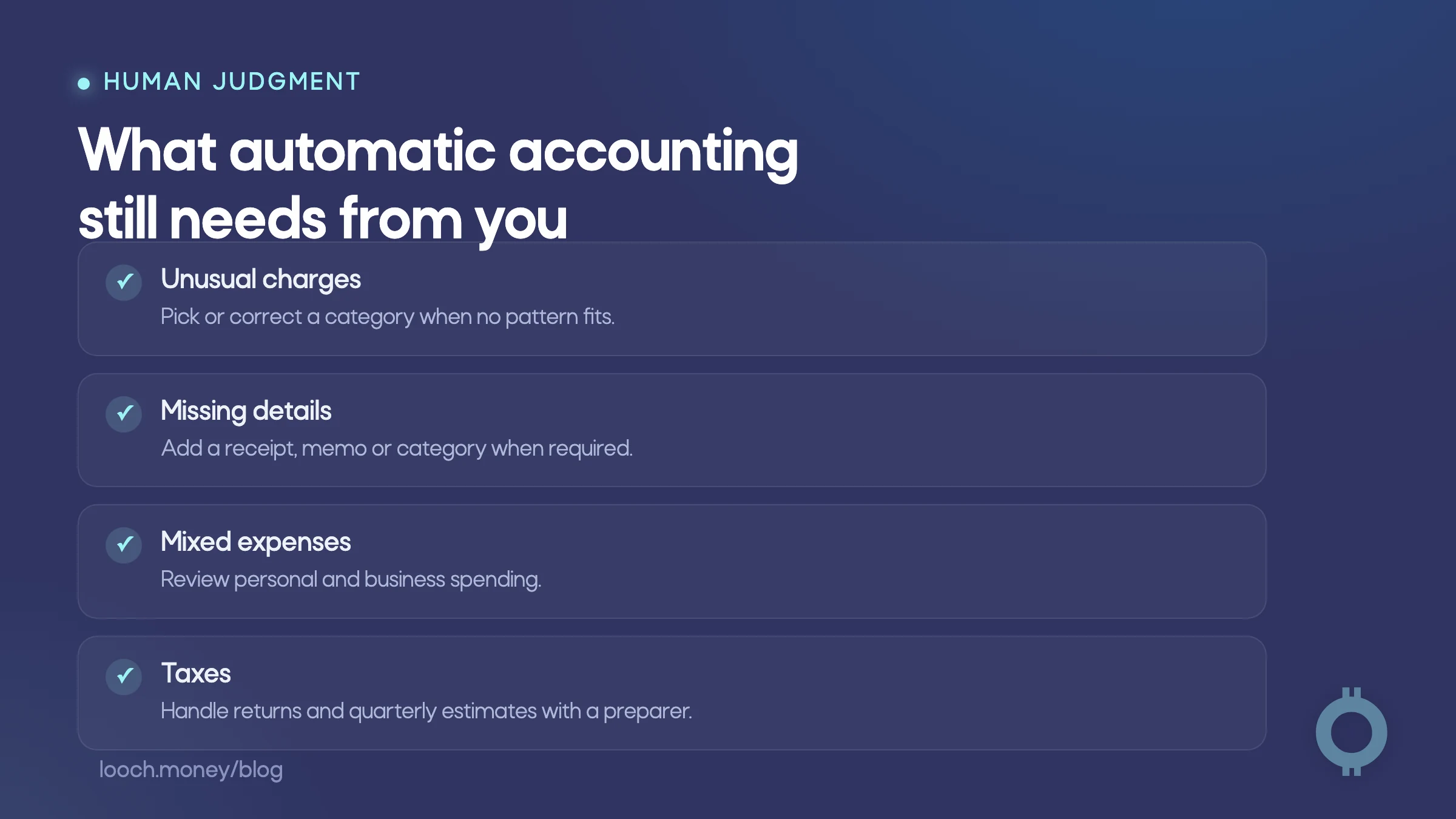
Automation is strong at repetitive work. Judgment is where a founder or accountant still matters.
An unusual one-off purchase, owner draw, refund or mixed personal and business expense may not fit an existing rule. Even accounting automation vendors acknowledge that these transactions can require judgment.
Receipts and memos also need to come from somewhere. A looch Smartcard can auto-lock when a receipt, memo or category is missing. That moves the task to the moment of spending instead of leaving a mystery for month-end.
Tax work has its own scope. Quarterly estimates depend on the founder’s total situation, so use the estimated tax payment guide to understand the decision rather than assuming a category engine has handled it.
Contractor reporting also takes a decision about who and what is reportable. looch can file a 1099 using the contact’s email address once that decision is made. Read the step-by-step 1099 filing guide and the difference between Form 1099-NEC and Form 1099-MISC.
If you’re deciding whether automation is enough, use the separate guide to work out whether you still need a bookkeeper.
looch removes the separate bookkeeping step on looch accounts
A looch Primary Business account has no monthly fee, and accounting on looch accounts is free. A Smartcard is a Visa Commercial Card that can spend from any looch account. Virtual and physical Smartcards are available.
Every Smartcard charge is entered and categorized as it posts. Spending limits, merchant controls, category controls, weekday-only spending and auto-cancel dates can shape the transaction before it happens. The card can also lock when required information is missing.
The same accounting suite enters invoice payments, bill payments, transfers and personal expenses. Unlimited invoicing, including recurring invoices, is included. The books produce profit and loss, accounts receivable, accounts payable, balance sheet, statement of cash flow, general ledger and trial balance reports.
looch describes these as CPA-quality books. Founders moving from QuickBooks or Xero can use the migration tool to bring their accounting into looch.
If you keep an outside bank account or credit card, an accounting-enrolled external account costs $10/month per account. Its activity is entered and categorized to the same standard as activity in a looch account.
See the complete looch accounting and account pricing, or learn how Smartcards enter and categorize spending as it happens. For the day-to-day experience, read the guide to running accounting from your phone.
A business must be eligible for a looch profile before this model fits. Any US-registered LLC or corporation with an EIN and a qualifying US street address can open a looch profile. A registered agent, virtual office, PO box or commercial mail receiving agency (CMRA) address doesn’t qualify, as explained in the guide to opening a fintech account for a foreign-owned LLC.
Payroll isn’t available in looch today. It’s listed as coming soon.
Another tool is better when its specialty matters more
Choose QuickBooks when your accountant requires it or you carry inventory. QuickBooks Plus costs $140/month and includes inventory features. The broader plan ladder also fits businesses expecting more complex workflows. See the honest QuickBooks comparison.
Choose Xero when your accountant works in Xero or you need a shared accounting file. Growing adds automatic bank transaction matching and removes Early’s invoice and bill limits. See how the products differ in the Xero comparison.
Choose Wave when the priority is a free ledger and you’re comfortable entering activity yourself. Wave Starter is free. QuickBooks also offers a free plan with 1 connected bank, 2 invoices per month, 1 user, no accountant access and no mobile app. Read the Wave comparison.
Choose FreshBooks when client billing is the center of the business. Its plans emphasize proposals, invoices, client limits and receipt capture. That can be a better shape for someone selling time through projects or retainers. See the FreshBooks comparison.
Choose Lettuce when you run an established S corp and want payroll and quarterly tax payments inside the service. Its Pro plan is explicitly designed for that model and income range.
Choose Collective when you want a managed back office and a named person. Its S Corp plan includes payroll, the annual business tax return and a dedicated account manager. You pay more because the service includes human work, not because its bank feed is more automatic.
Choose QuickBooks or Xero when several entities or an outside finance team need a conventional accounting workflow. looch is strongest for a founder who wants money movement and accounting in one system. A traditional ledger can be the better fit when the workflow centers on accountants working across several files.
Frequently asked questions
What accounting software works best for a solo founder who wants it automatic?
looch is the strongest fit when the founder can run money through looch accounts and Smartcards, because each charge is entered and categorized where it posts instead of arriving through a separate feed. QuickBooks, Xero, Wave and FreshBooks can automate imports and recurring patterns, but they still depend on a bank feed and review. Lettuce and Collective fit founders who want tax or back-office services bundled around the accounting.
Sources
- looch home, checked September 28th, 2026
- looch pricing, checked September 28th, 2026
- looch Smartcards, checked September 28th, 2026
- looch Start, checked September 28th, 2026
- looch guide to fintech accounts for foreign-owned LLCs, checked September 28th, 2026
- QuickBooks pricing, checked September 28th, 2026
- QuickBooks Solopreneur, checked September 28th, 2026
- Intuit Expert Full Service Bookkeeping, checked September 28th, 2026
- Xero pricing, checked September 28th, 2026
- Wave pricing, checked September 28th, 2026
- FreshBooks pricing, checked September 28th, 2026
- FreshBooks features, checked September 28th, 2026
- Brex accounting automation guide, checked September 28th, 2026
- Lettuce pricing, checked September 28th, 2026
- Lettuce guide to bookkeeping software for solos, checked September 28th, 2026
- Collective plans and pricing, checked September 28th, 2026


