


Do you need a bookkeeper? A founder’s decision guide
Amounts last verified on August 30th 2026
Michel Myara is co-founder and product designer at looch, where he designs the ecosystem small businesses use to get paid and manage spend while keeping penny-perfect books.
You need a bookkeeper when the work needs human judgment

You don’t need a bookkeeper because every business is supposed to have one. You need one when your finances are complex enough that a person’s judgment, cleanup work, or reporting expertise is worth paying for.
For a simple business with current books, the better question is not “Do I need a bookkeeper?” It is: “What work would I be hiring them to do?” If the answer is routine transaction entry and categorization, software may already cover it. If the answer is tax planning, inventory, cleanup, or investor-ready reporting, hire the right professional.
That distinction matters because founders often hire for a vague feeling of being behind. A better decision starts with the actual job.
Bookkeeping records the work, while accounting interprets it
A bookkeeper handles the daily financial record. They log transactions, categorize income and expenses, keep records organized, and prepare the information a business needs to understand its activity.
An accountant uses that information for higher-level work, such as tax filing, financial analysis, and planning. The exact division of work varies by firm and business, but the core distinction is consistent: Bookkeeping records what happened. Accounting helps you decide what to do about it.
Business News Daily’s explanation of accountant and bookkeeper roles and Xero’s overview of accounting and bookkeeping both make the same useful point. These are related jobs, not interchangeable ones.
That is why software can reduce the need for routine bookkeeping without replacing a CPA. It can handle repetitive financial recordkeeping. It can’t give tax advice, assess a complicated structure, or stand behind a filing as your tax professional.
Bookkeeper cost depends on the kind of work you are buying
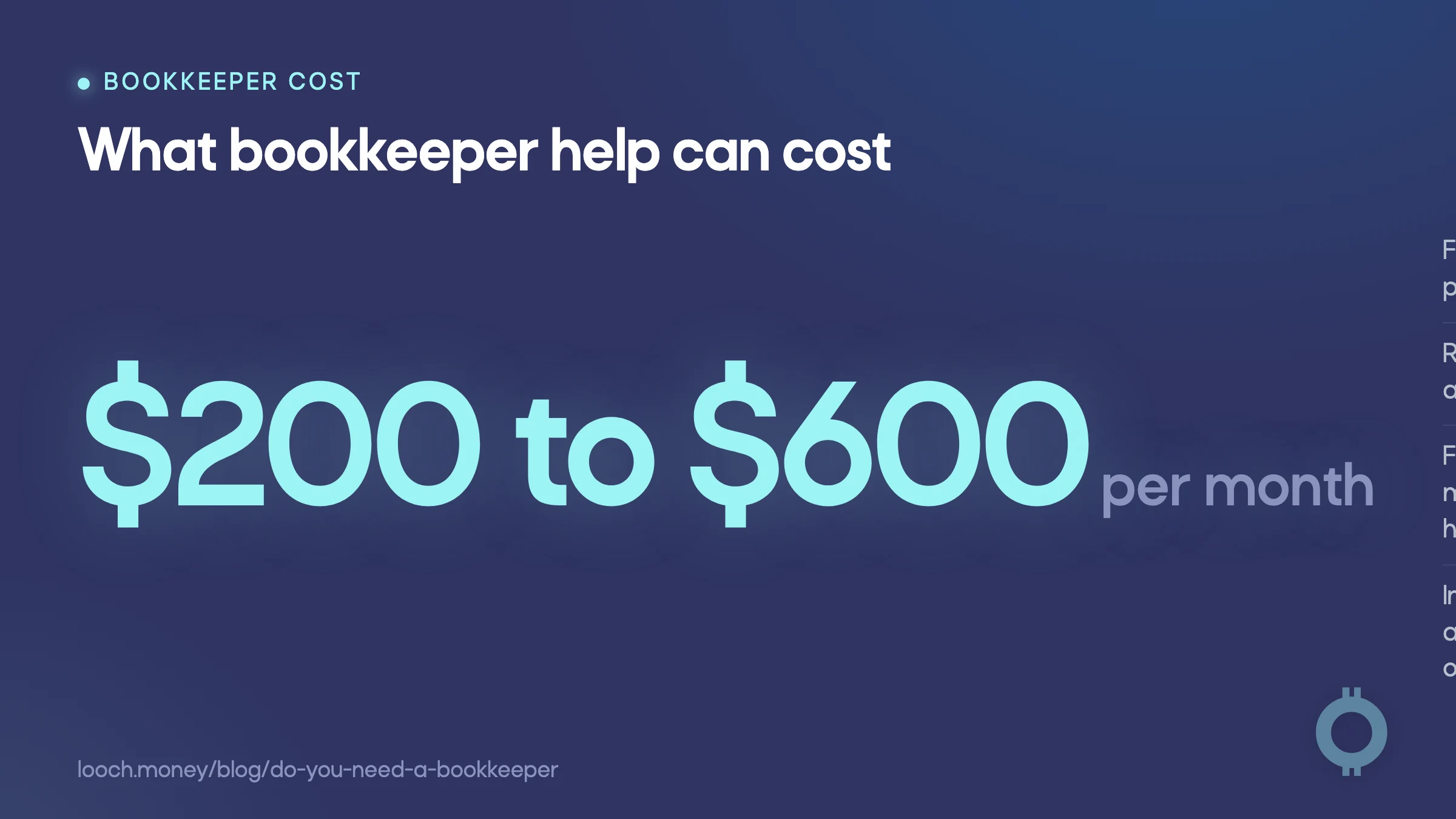
Bookkeeper cost is not one number. It depends on whether you need occasional help, a monthly service, or an employee who owns the work internally.
| Type of help | What the current cost range looks like | When it tends to fit |
|---|---|---|
| Freelance bookkeeper | Freelance bookkeepers typically charge $30 to $90 per hour, with reported averages around $43 per hour. The federal median pay for bookkeepers was about $23.66 per hour in 2024. | A defined cleanup project, periodic review, or limited ongoing work. |
| Outsourced or online service | Outsourced and online bookkeeping services usually run $200 to $600/month for basic needs, rising to $1,000 to $2,500 or more as your transaction volume, payroll, and accounts payable grow. | A business that wants recurring support without an in-house hire. |
| In-house bookkeeper | In-house bookkeepers are the priciest path, often $50,000 or more in annual salary plus benefits. | A business with enough volume and complexity to justify a dedicated role. |
Those ranges are useful as a decision tool, not as a promise of what any provider will charge. See QuickBooks’ guide to bookkeeping costs, NerdWallet’s bookkeeping pricing overview, and Haven’s discussion of bookkeeper rates for the source context behind the ranges.
The practical takeaway is straightforward: Paying a few hundred dollars a month can be sensible when it buys expertise you need. It’s harder to justify when it pays someone to repeatedly enter work that your financial system should already capture.
Complex businesses should hire targeted professional help
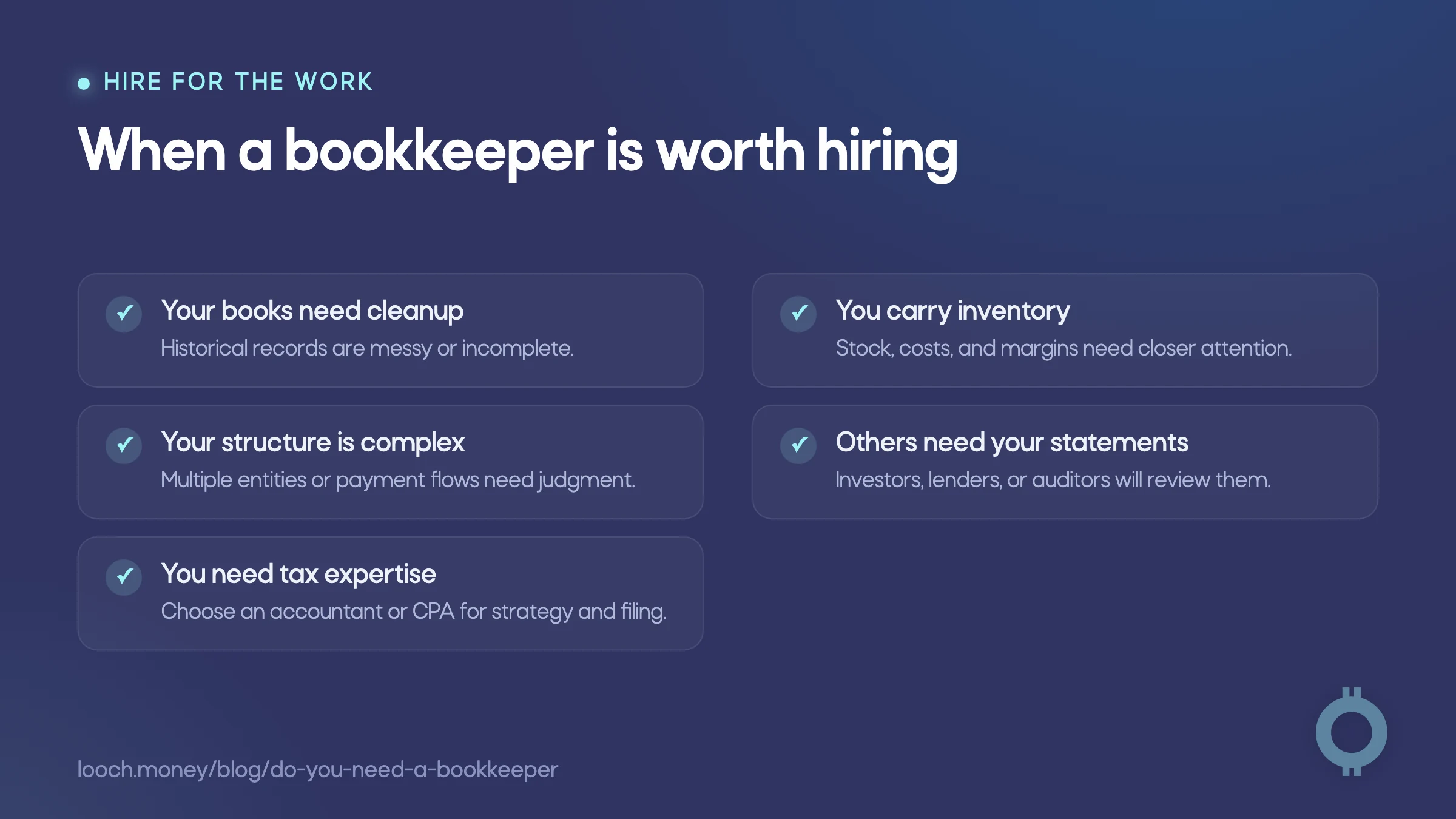
Software is not a substitute for every finance need. You should seriously consider a bookkeeper, accountant, or CPA when the work calls for expertise beyond routine records.
Your structure is complex. Multiple entities, intercompany transfers, layered ownership, or unusual payment flows need someone who can see the full picture and set up the records correctly.
You carry inventory. Cost of goods, stock movement, and margins create work that goes beyond basic income and expense categorization.
Other people need to rely on your statements. Investors, lenders, and auditors may expect records prepared and reviewed to a standard that can withstand scrutiny.
Your historical books are messy. A cleanup project is real work. A good professional can identify gaps, organize records, and establish a better process going forward.
You need tax strategy or filing help. That is accountant and CPA territory. Do not expect bookkeeping software to replace professional tax judgment.
In these situations, the right answer is often not a full-time bookkeeper. It may be an accountant for a specific project, a CPA for tax planning, or a bookkeeper who maintains an established process. Buy the expertise your business actually needs.
Simple businesses can let real-time accounting carry the routine work
This is where looch is different from a separate formation tool, business account, card platform, and accounting system. looch is designed so the financial activity of a small business can be entered and categorized as it happens, rather than collected into a pile for someone to sort later.
With looch, that includes:
- Automatic transaction tagging: Money moving through your business is categorized as it happens.
- Real-time accounting: Your books stay current while you operate, not after a manual catch-up session.
- CPA-quality books: The financial record is built for the accountant who may need it later.
- AI-powered 1099 calculation and filing: looch calculates your 1099s and files them for $2 per filing. Read our guide to filing 1099s for the broader process.
That doesn’t mean looch replaces a CPA. It means you may not need to pay a separate bookkeeper for the routine recording work if your business is straightforward and your money already moves through a system that keeps the books current.
If you are moving from another accounting tool, looch includes a migration tool from QuickBooks or Xero. Our comparisons of looch and QuickBooks and looch and Xero explain where those established tools may still be a better fit, especially if you need deeper accounting workflows or already have a process built around them.
The decision comes down to the work left undone
Ask yourself these questions before you hire.
Are my finances simple enough to understand? A single entity without inventory, complicated ownership, or outside reporting demands is often a good candidate for software-led bookkeeping.
Is routine financial activity already captured as it happens? If income, expenses, and card spending are already entered and categorized, you aren’t starting every month with a manual data-entry problem.
Do I need advice, cleanup, or compliance expertise? If you do, hire a professional for that job. Do not hire someone broadly because the word “bookkeeper” feels like the default answer.
For a new founder, the cleanest time to solve this is before the first transaction. You can form your business and open no-fee business accounts with looch Start, then run payments, spend, and accounting in the same app. See the current product details on the looch pricing page, or visit the looch homepage to see how the system fits together.
A bookkeeper can be an excellent investment. But when the only missing work is routine recordkeeping, the better investment may be a system that doesn’t leave the work waiting for someone else.


