


How to file 1099s: Cost, deadlines, and a faster way
Amounts last verified on August 30th 2026
Michel Myara is co-founder and product designer at looch, where he designs the ecosystem small businesses use to get paid and manage spend while keeping penny-perfect books.
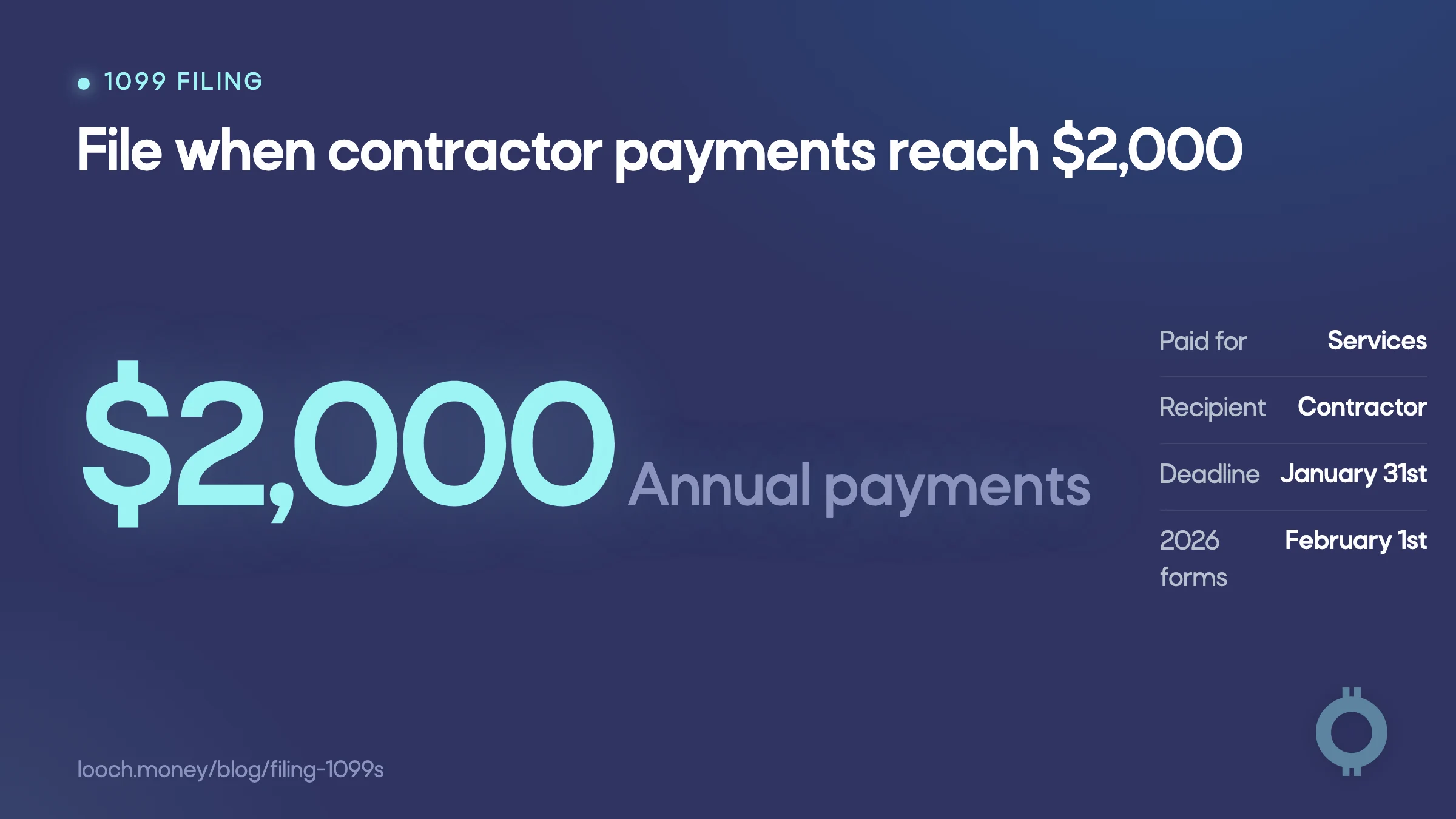
File a 1099-NEC when contractor payments reach $2,000

If you paid an independent contractor at least $2,000 for services in the course of your business, file a Form 1099-NEC. Send it to the contractor and file it with the IRS by January 31, or the next business day when that date falls on a weekend. For tax year 2026 forms, that is Monday, February 1st, 2027. (irs.gov)
That’s the short answer to how to file 1099s. The harder part is having complete contractor details, accurate payment totals, and a clear view of which payments belong on the form before January arrives.
You generally file a 1099-NEC when all of the following are true:
- The person is not your employee.
- You paid them for services performed for your trade or business.
- Your total payments to that person reached at least $2,000 for the year.
The IRS identifies $2,000 as the threshold for payments made after December 31, 2025. (irs.gov) The long-standing $600 threshold applied through the end of 2025, and the IRS notes that the newer figure may be adjusted for inflation beginning in 2027. (irs.gov)
Form 1099-NEC has one filing deadline for both jobs. The IRS copy and the contractor copy are due on the same day. That differs from some other information returns, where the filing timeline can vary by form and filing method. If you paid rent, royalties, or certain attorney payments rather than contractor service fees, you may need another form. See 1099-NEC vs 1099-MISC for the distinction.
If you have 10 or more information returns to file, the IRS requires electronic filing. (irs.gov)
Pay a contractor $2,000 or more for services, and a 1099-NEC is due to them and the IRS by January 31. For tax year 2026 forms, that means Monday, February 1st, 2027.
The manual work happens before you fill out the form
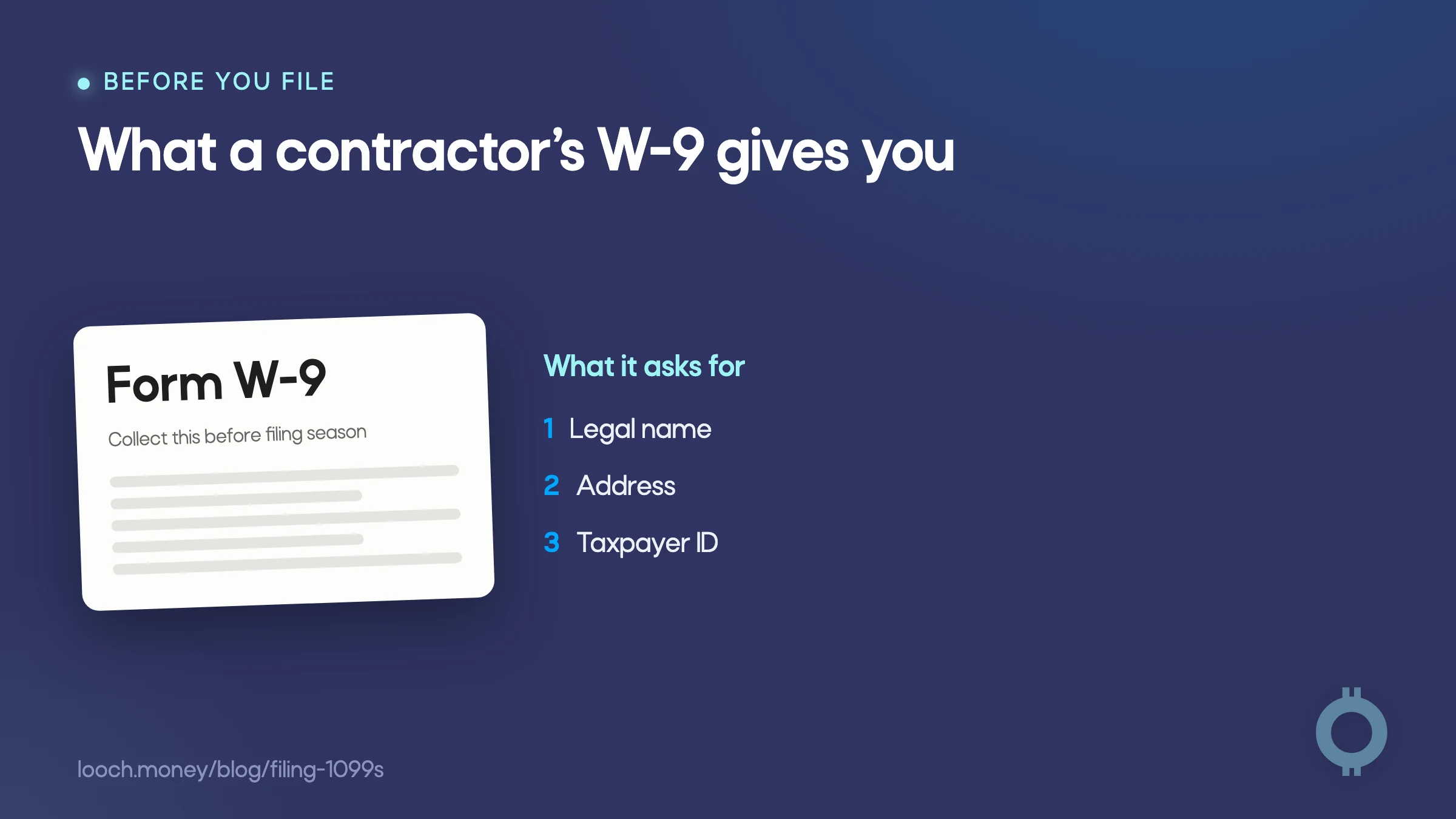
A 1099-NEC is easy to recognize when every contractor has a current Form W-9 and every payment already sits in clean books. Most filing problems begin earlier.
Start by collecting a Form W-9 from each contractor. It gives you the legal name, address, and taxpayer ID needed for the form. Then total payments by contractor across the year, identify who cleared the threshold, prepare each 1099-NEC, deliver the recipient copy, and file the IRS copy.
Each step has a predictable failure point:
- Separate payments hide the total. A contractor paid in several batches may not look reportable until you add the year together.
- Different payment types get mixed together. Pulling contractor payments from bank and card activity by hand leaves room for omissions and incorrect totals.
- The tax form is missing or outdated. Incorrect contractor details can create filing and backup withholding problems later.
- January becomes a deadline scramble. The filing task arrives when many businesses are already closing books and handling new-year work.
Not every contractor relationship uses a W-9. For example, a foreign-owned single-member LLC documents itself differently. Our guide to W-8BEN-E or W-9 explains when that distinction matters.
Late 1099 filing penalties can apply twice
Filing with the IRS and furnishing a recipient copy are separate duties. Missing both can mean two separate penalties for the same form.
For tax year 2026 forms due in the 2027 filing season, the IRS penalty tiers are:
| Filing timing | Penalty per form |
|---|---|
| Up to 30 days late | $60 |
| After that through August 1 | $130 |
| After August 1 or not filed | $340 |
| Intentional disregard | $690, with no maximum |
The applicable caps and reasonable-cause rules matter too, particularly if you have several contractors. The full IRS guidance is in Revenue Procedure 2025-32. (irs.gov) For a closer look at the tiers and what happens when both obligations are missed, read the 1099 late filing penalty guide.
The point is not to panic-file. It’s to avoid treating January as the moment you first figure out who you paid.
1099 filing costs depend on who does the preparation
A CPA, bookkeeper, accounting platform, or dedicated e-file service can all be the right choice. The tradeoff is usually between professional judgment, ongoing subscription cost, and how much of the contractor data you need to assemble yourself.
| Filing route | Published pricing example | What the price covers |
|---|---|---|
| CPA firm | $140 for the first 1099 plus $60 for each additional form | Preparing forms, mailing recipient copies, and filing with the government. (mkatzcpa.com) |
| Annual filing service | $375 for federal 1099 filing for up to 5 contractors, plus $15 for each additional contractor | Annual federal filing service. (taxhappens.com) |
| QuickBooks Contractor Payments | $25/month for 20 contractors with unlimited 1099 e-filing, plus $2/month for each additional contractor | 1099 e-filing as part of a subscription, rather than a standalone per-form service. (quickbooks.intuit.com) |
| Dedicated e-file services | $2.99 per form for the first 20 at one service, and $2.75 per form for the first 10 at another | State filing and recipient mailing may cost extra. (tax1099.com, taxbandits.com) |
An accountant can be worth the cost when your books need cleanup, contractor classification is unclear, or the filing involves an unusual situation. A dedicated e-file service can also work well when you already have clean payment totals and current tax forms.
The recurring problem for a small business is not usually finding a place to submit a form. It’s building the accurate list of forms to submit.
looch calculates from the activity already in your books
looch takes a different approach to 1099 filing. The useful work starts before filing season.
looch AI scans your transactions and payment methods to determine what to include. Instead of sorting through a year of bank and card activity in January, you have a system that can identify contractor totals and reportable payments from the activity already entered and categorized in your books.
When it is time to submit, instant 1099 filing costs $2 per filing. See current product pricing on the looch pricing page.
That doesn’t make looch the best fit for every business. If you need tax advice, have a prior-year correction, face multi-state questions, or need help deciding whether someone should be treated as an employee, speak with a qualified tax professional. Filing software shouldn’t replace professional judgment in a genuinely complex case.
For routine contractor payments, looch removes the manual handoff between bookkeeping and filing. Your activity is already organized, your contractor totals are easier to review, and the filing cost stays $2 per form.
If you’re building the business now, looch Start lets you form your business and move into no-fee business accounts, payments, Smartcards, and real-time accounting in one app. You can also see how that day-to-day workflow works in our guide to accounting from your phone, or explore the full looch product.
The best time to make 1099 filing easier is before January. Keep contractor information current, keep payments organized, and use a filing workflow that starts with the books you already have.


