


Fintech accounts for a foreign-owned US LLC: Who accepts
Amounts last verified on September 21st 2026
Michel Myara is co-founder and product designer at looch, where he designs the ecosystem small businesses use to get paid and manage spend while keeping penny-perfect books.
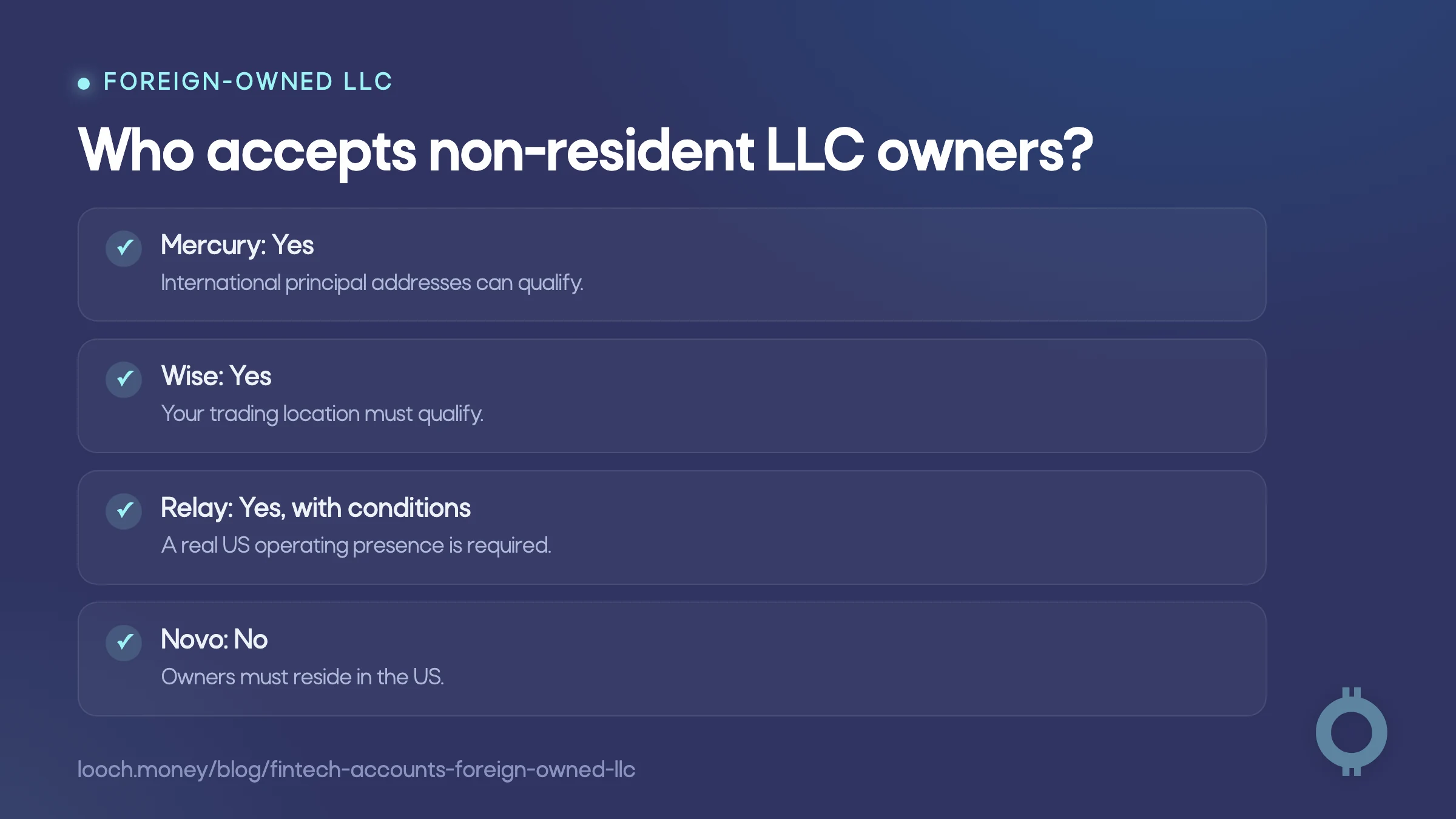
Mercury, Wise and looch take a foreign-owned US LLC, Novo does not

For fintech accounts for a foreign-owned US LLC, Mercury and Wise publish clear paths for non-resident owners. Any US-registered LLC or corporation with an EIN and a qualifying US street address can open a looch profile with no-fee, FDIC insurance-eligible¹ accounts. A registered agent, virtual office, PO box, or commercial mail receiving agency (CMRA) address doesn’t qualify. looch Start can form the LLC and get the EIN for $249 all-in, and an EIN without an SSN or ITIN typically takes about 4 days.
Novo publishes a clear no. Relay accepts non-US owners, but every beneficial owner needs a physical US address. The deciding factor’s often not citizenship. It’s whether you can show a real business address that the provider accepts, alongside formation records, an EIN document, and identification for the people behind the company.
Requirements answer. The published competitor rules require a US-formed and registered business, identification for each beneficial owner with 25% or more ownership, and a person with operating control. Mercury and Wise accept non-resident owners. Novo’s last published rule requires US-resident owners. Any US-registered LLC or corporation with an EIN and a qualifying US street address can open a looch profile without an SSN or ITIN. A registered agent, virtual office, PO box, or commercial mail receiving agency (CMRA) address doesn’t qualify.
Last verified: September 28th, 2026.
| Requirement | Mercury | Relay | Novo | Wise | looch |
|---|---|---|---|---|---|
| Non-resident owner accepted | Yes | Yes, with conditions | No | Yes | Yes, for a US-registered LLC or corporation with an EIN and a qualifying US street address |
| SSN required | No | Confirm before applying | Yes, every 25% owner | Only if an owner lives in the US or holds a US passport | No for a looch profile created on an LLC’s EIN |
| Business address rule | US or international principal place of business | US operating presence | US residential address | Trading address, with restrictions | A qualifying US street address |
| Commonly rejected address types | Registered agent, PO box, UPS Store | PO boxes, virtual mailboxes | Not published | Restricted trading-address types | Registered agent, virtual office, PO box, CMRA |
| Passport accepted as identification | Yes for international applicants | For non-US citizens | Accepted as identification, doesn’t replace an SSN | Yes for non-US owners | Not published |
| Country screening | Based on where the founder lives | Based on citizenship or residency | Not published | Based on where you live | Not published |
| Operating-presence test | Existing or planned US operations | US operating presence | US-resident owner required | Availability depends on location | US-registered entity, EIN, and qualifying US street address |
| Best fit | A company with international founders and a qualifying address | A business with a credible US operating presence | A US-resident owner who meets Novo’s requirements | A business whose locations fit Wise’s availability rules | A US-registered LLC or corporation with an EIN and a qualifying US street address |
This is a requirements reference, not a recommendation. Provider rules change. The linked source pages are the place to check again before you submit an application.
The best business bank account for a non-resident-owned US LLC is the one whose address rule you meet
None of these providers is a bank, according to its own disclosures. The best business bank account for a non-resident-owned US LLC is therefore the account whose provider accepts your entity, your owners, and your address, in that order.
| Provider | Best for | What the owner needs | Monthly fee, base plan | Where it falls short |
|---|---|---|---|---|
| Mercury | A founder living abroad whose LLC has a real principal place of business, US or international | Passport for international applicants; no registered agent, PO box, or UPS Store address; founder’s country of residence isn’t on its prohibited list | $0 | Doesn’t form the LLC or get the EIN; MSBs, crypto exchanges, cannabis, adult entertainment, internet gambling, and trusts are excluded |
| Relay | An LLC with a genuine US operating presence whose every beneficial owner has a physical US address | Passport number in place of an SSN; physical US address for every beneficial owner, with no PO box or virtual mailbox | $0 | The address rule applies to every beneficial owner; citizenship or residency in a prohibited country blocks the application |
| Wise | A business whose owners’ home country and trading location fit Wise’s availability list | Photo ID for non-US owners; a physical trading address, not a registration agency or virtual address; the business can’t be from Nevada or a US territory Wise excludes | Check wise.com | It’s a money service business, not an FDIC-insured bank; availability depends on where you live |
| Novo | A US-resident owner with an SSN who wants no-fee checking | US residency and an SSN, under the rule Novo published as of August 19th, 2026; its help center has since closed | No monthly fee | It’s not an option for a non-resident owner under its last published rule |
| looch | A founder who wants the LLC formed, the EIN obtained without an SSN or ITIN, and a profile with accounts, Smartcards, payments, and books in one app | A US-registered LLC or corporation, an EIN, and a qualifying US street address | No monthly fee | A registered agent, virtual office, PO box, or commercial mail receiving agency (CMRA) address doesn’t qualify |
A founder with no qualifying US street address may be better served by Mercury, which permits an international principal place of business, or Wise when the country and trading location fit. An owner group whose members can each show a physical US address may prefer Relay’s account structure. A US-resident owner with an SSN may consider Novo under its last published rule.
A company holding a large raise that needs coverage above $250,000¹ should read the looch vs Mercury comparison and looch vs Relay comparison, which explain their respective sweep programs. looch fits when the LLC still has to be formed or when you want formation, EIN support, a profile with accounts, Smartcards, payments, and real-time accounting in one app. It’s not the answer if you need a provider to accept a registered agent, virtual office, PO box, or commercial mail receiving agency (CMRA) address.
Mercury makes room for international founders, but not address substitutes
Mercury states that a founder doesn’t need to be a US citizen or resident to apply. Its published eligibility rules require a business formed and registered in the US or a US territory, existing or planned operations in the US, and a principal place of business with a US or international address.
That international-address option’s a real advantage for a founder running a US LLC from abroad. It doesn’t mean every address works. Mercury says residential addresses are accepted, while registered agent addresses, PO boxes, and UPS Store addresses aren’t. A formation address isn’t automatically an operating address.
Mercury’s document list’s straightforward: A formation document, an IRS-issued EIN document, and photo identification. Its guidance lists CP 575, 147C, and a returned SS-4 among acceptable EIN records. The important distinction’s that a submitted SS-4 application isn’t the same thing as an IRS-returned document.
Mercury also requires identification for any owner with at least 25% ownership and for at least one person with operating control. For an international applicant, a passport can satisfy the photo-identification requirement. Mercury’s published requirements don’t say that an SSN or ITIN’s required for that purpose.
Country and business-activity restrictions still apply. Mercury’s prohibited-country rules are based on where a founder lives, not only on citizenship. Its eligibility material also identifies business types it can’t support, and it requires ownership to be traced to the natural people behind a holding structure.
Mercury’s a strong option when you have an international principal address that’s genuinely where the business operates, complete ownership records, and a company structure that fits its program. It’s not a workaround for an LLC whose only address is a registered agent.
Sources: Mercury eligibility, Mercury documents, and Mercury prohibited countries. For a fuller product comparison, see looch vs Mercury.
Relay accepts non-US owners when the business has a real US presence
Relay states that it accepts US-registered businesses owned by non-US citizens or residents when the business has an operating presence in the US. That phrase matters. It makes Relay less suitable for a company that exists only on state records and has no genuine US business footprint.
Relay’s published document requirements ask an LLC for an EIN, business address and phone number, entity-formation records, an industry description, and an operating agreement where applicable. It also asks for information about the people who own and control the business.
For beneficial owners, Relay’s materials list government identification and a Social Security Number or passport number. Photo identification for a non-US citizen is passport only. The physical-address rule still applies to every beneficial owner.
Relay requires a physical US address for beneficial owners and doesn’t accept PO boxes or virtual mailboxes for that purpose. It also seeks information from non-US-resident owners about their income source, whether the business is new or established, personal income, and countries of operation.
Relay’s country rules are also stricter in one important way. Its prohibited-country list’s tied to citizenship or residency. A founder can therefore face a restriction based on citizenship even when living in another country. Mercury’s policy’s framed around residence, so the same founder may have a different result between the two providers.
Relay can be a good fit for a foreign-owned US LLC that has a genuine US operating presence and can document both the business and its owners cleanly. It’s a poor fit if every owner lacks a qualifying US address.
Sources: Relay required documents and Relay prohibited countries. See looch vs Relay for the broader decision between the two products.
Novo is not an option for a non-resident owner
Novo’s rule’s direct. It says it only opens accounts for business owners who reside within the US, and the business must also be registered in the US.
Its owner requirements add an SSN, a valid US residential address, and an active US cell phone number. Novo also says that a beneficial-owner business partner must be able to provide an SSN. Adding a US-based partner doesn’t solve the requirement when the foreign owner still can’t meet it.
Novo has an EIN exception for a narrow type of single-member LLC, but that doesn’t change its owner-residency and SSN requirements. For the foreign-owned LLC this page addresses, the residence rule’s the answer. Don’t spend time assembling an application if the owner can’t meet it.
That rule was published on Novo’s help center and was last verified August 19th, 2026. The help center is closed as of September 28th, 2026. Novo’s current LLC account page states that there are no monthly fees and no minimum balance, but it doesn’t restate the owner rules, so confirm them with Novo before applying.
Source: Novo availability for businesses or owners outside the United States.
Wise treats your trading location as seriously as your registration location
Wise’s structured differently from a business account provider focused solely on a US entity. Its business verification rules focus on where the owners live, where the company’s registered, and where it actually trades.
Wise states that it asks for an SSN from beneficial owners who reside in the US or have a US passport. For non-US beneficial owners, it requests photo identification. It also seeks business details and information about people who directly or indirectly own 25% or more of the company, or who exercise control.
The trading address is the key practical issue. Wise describes it as the primary place of business, where you work every day. A registered agent address isn’t the same thing. Neither is a mail-receiving service. If the business is registered in the US but run from another country, the address you provide needs to describe the real location of work.
Wise says the registered address can be the address of a registration agency or attorney. Its trading address can’t be a registration agency, mail-forwarding service, or virtual address. Wise also says it can’t onboard businesses from Nevada or the US territories named in its verification guidance.
Wise uses an availability list based on where you live. That makes Wise a useful option for founders whose home country and operating setup fit its rules, but not a universal answer for every foreign-owned US LLC.
Sources: Wise verification for US businesses and Wise location availability.
looch offers a no-fee profile to a foreign-owned LLC on its EIN, with one address rule
looch is operated by Simplicity Fintech Inc. Account services are provided in partnership with Stripe, and funds are held at Fifth Third Bank N.A., Member FDIC. looch Smartcards are Visa Commercial Cards powered by Stripe and issued by Celtic Bank.
A qualifying foreign-owned US LLC can open a looch profile with account and routing numbers, no monthly fee on its looch accounts, and FDIC insurance-eligible¹ accounts with pass-through coverage up to $250,000¹. Smartcards spend from any looch account. looch also provides real-time accounting, CPA-quality books, and a migration tool for QuickBooks and Xero.
looch Pay accepts cards and instant pay by bank. Instant pay by bank is money that arrives instantly and is final, priced at 1% (min $1, max $10). Online card acceptance is 3.3% + 30¢, while in-person card acceptance is 3% + 15¢.
Any US-registered LLC or corporation with an EIN and a qualifying US street address can open a looch profile. A registered agent, virtual office, PO box, or commercial mail receiving agency (CMRA) address doesn’t qualify. An LLC profile is created on its EIN, so it doesn’t require an SSN or ITIN.
The profile address must be a qualifying US street address. That’s the real gate for many foreign founders, including founders who already have a valid US entity and EIN.
| Address type | Qualifies for a looch profile |
|---|---|
| US commercial street address | Yes |
| US residential street address | Yes |
| Home address used as a home and business address | Yes |
| Registered agent address | No |
| Virtual office address | No |
| Commercial Mail Receiving Agency address | No |
| PO box address | No |
The important looch-specific distinction’s easy to miss. looch Start can form the entity and obtain the EIN, including when the founder has no SSN or ITIN. It forms a Delaware corporation, Delaware LLC, Wyoming LLC, or Florida LLC, including the state filing fee, EIN, and registered agent for $249 all-in. An EIN without an SSN or ITIN typically takes about 4 days.
The virtual office included with formation’s useful for formation and mail handling, but it’s not a qualifying business street address for the looch profile. Its address serves a different purpose from the US street address required for profile eligibility.
Simplicity Fintech Inc is not a law firm and does not provide legal advice. As part of the looch Start service, Simplicity Fintech Inc acts as a Third-Party Designee to facilitate the application for an Employer Identification Number (EIN). EINs can be obtained directly from the IRS at no cost.
looch’s the right fit when you want formation, EIN support, a financial profile with accounts, Smartcards, payments, and real-time accounting in one app, and you have a qualifying US street address. It’s not the right answer if you need a provider to accept a registered agent, virtual office, PO box, or commercial mail receiving agency (CMRA) address.
Sources: looch pricing and looch Start.
Solve the address before comparing account features
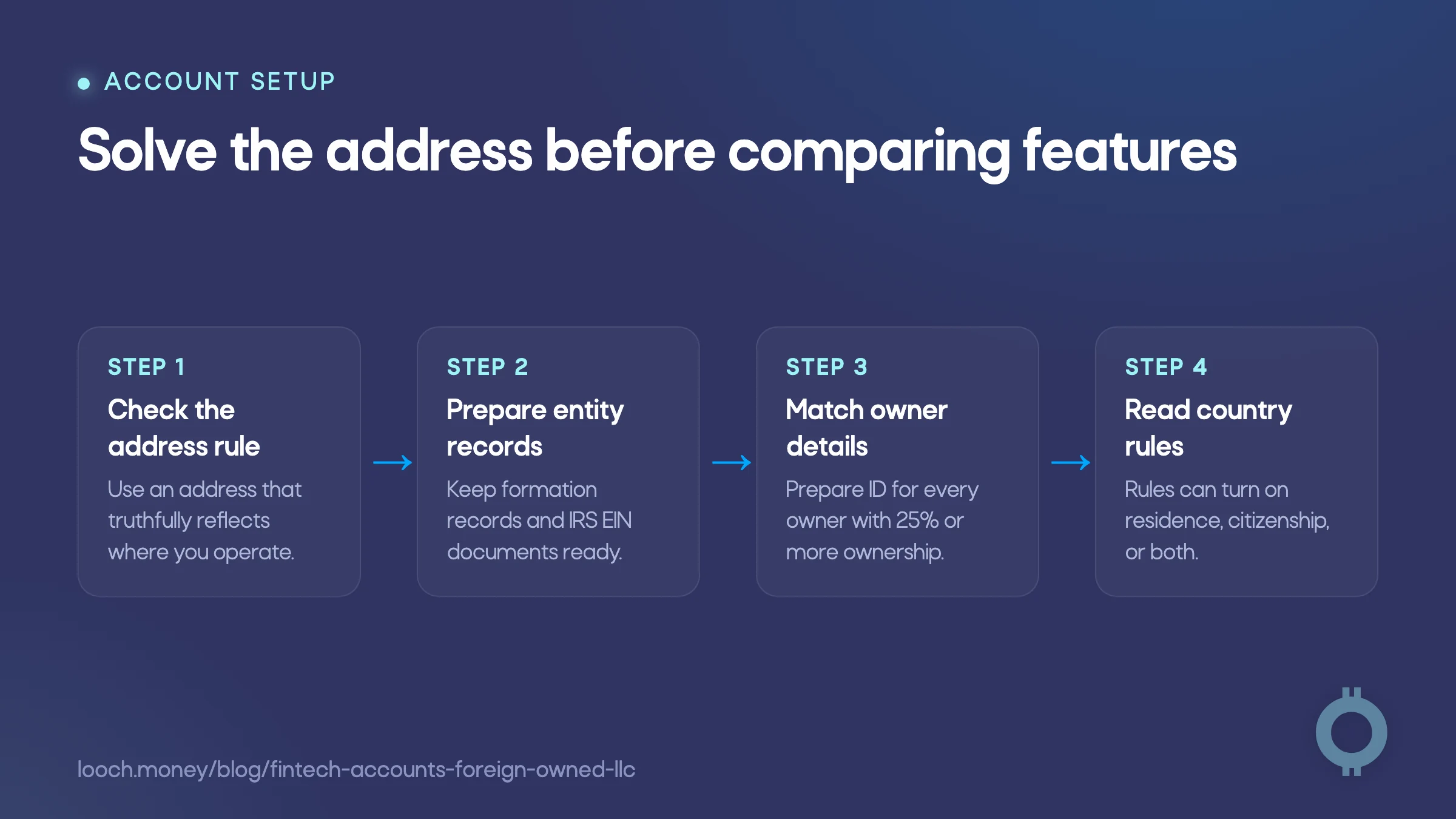
The cleanest way to read these requirements is by the address row, not by provider. Mercury rejects registered agent addresses, PO boxes, and UPS Store addresses. Relay rejects PO boxes and virtual mailboxes and expects a physical US address for beneficial owners. Wise restricts the trading address. A looch profile requires a qualifying US street address, and a registered agent, virtual office, PO box, or CMRA address doesn’t qualify.
That pattern changes the order of work. Don’t start by comparing card controls, transfer features, or software integrations. First determine whether you have an address that truthfully represents where the business operates and meets the provider’s published rule.
| What to prepare | Why it matters |
|---|---|
| A qualifying business or owner address | Address rules can reject an otherwise valid company before product features matter |
| IRS EIN documentation and formation records | These documents establish that the US entity exists and can be identified |
A real residential or commercial street address may qualify where a registered agent address doesn’t. Don’t substitute one for the other. The provider’s assessing the address type, not merely whether it appears in public business records.
The entity and EIN come before every account application
A foreign-owned US LLC needs the entity paperwork and an EIN record before an account application can move forward. That’s why formation and account setup should be planned as one sequence, even when different providers handle each piece.
The IRS allows an EIN application where the responsible party has no SSN or ITIN. The IRS instructions address how that responsible party’s identified on Form SS-4. The document you should keep once the EIN’s issued is the IRS confirmation record, because providers may ask for that record rather than the application you submitted.
For the practical process, see getting an EIN without an SSN. For the broader account-opening rules and the role of identity documents, read opening a US business bank account without an SSN.
looch Start brings formation and EIN support together for $249 all-in. It’s built for founders who need to create the US entity first, then move into a looch profile with accounts, Smartcards, payments, and accounting from the same app. The profile-address requirement still applies after formation, so solve that independently rather than assuming a formation address carries over.
There’s also an ongoing federal obligation to understand. A foreign-owned US single-member LLC generally has a Form 5472 filing requirement, with a $25,000 penalty for failing to file. Read the full context in our Form 5472 guide for foreign founders.
Apply with documents that match the business you describe
A strong application’s consistent from top to bottom. The entity documents, EIN record, ownership details, identification, business description, operating address, and country information should all describe the same real company.
Before applying, use this checklist:
- Confirm that the address is accepted by the provider you chose. Don’t use a registered agent, virtual mailbox, or virtual office where the provider’s rules reject it.
- Keep the EIN confirmation document ready as a file. A returned IRS record’s more useful than an application copy.
- Collect identification for every owner with at least 25% ownership and for the person with operating control.
- Read the provider’s country rules on the day you apply. Country policies can differ by residence, citizenship, or both.
- If a holding company owns the LLC, prepare to identify the natural people behind that structure.
- Describe the US operating presence honestly. A state filing alone doesn’t convert a mail address into an operating location.
The bottom line’s simple. Mercury’s often the clearest account option for an international founder with a qualifying address. Wise can work when the trading location and owner location fit its availability rules. Relay can work when the company has a real US operating presence and its owner-address requirements are met. Novo doesn’t fit a non-resident owner. looch is the one provider on this page that forms the LLC, gets the EIN without an SSN or ITIN, and opens a looch profile when the business is a US-registered LLC or corporation with an EIN and a qualifying US street address. A registered agent, virtual office, PO box, or commercial mail receiving agency (CMRA) address doesn’t qualify.
Sources
- looch pricing and account eligibility
- looch Start formation and EIN details
- Mercury eligibility requirements
- Mercury document requirements
- Mercury prohibited countries
- Relay required documents
- Relay prohibited countries
- Novo’s last published non-resident availability rule
- Wise verification for US businesses
- Wise location availability
Frequently asked questions
Which fintech business accounts accept foreign-owned single-member LLCs?
Mercury and Wise accept foreign-owned single-member LLCs under their published rules. Relay accepts them when the business has a genuine US operating presence and every beneficial owner has a physical US address. Any US-registered LLC or corporation with an EIN and a qualifying US street address can open a looch profile, while Novo doesn’t accept a non-resident owner under its last published rule. A registered agent, virtual office, PO box, or commercial mail receiving agency (CMRA) address doesn’t qualify for a looch profile. Compare the exact conditions in the requirements table above before applying.
What’s the best business bank account for a non-resident-owned US LLC?
None of the providers compared here is a bank, so the best account is the one whose address rule you meet. Mercury fits a founder abroad with a real principal place of business, Relay fits owners who each have a physical US address, and Wise can fit when the owner’s country and trading location are supported. looch fits when you still need the LLC and EIN, or want a profile with accounts, Smartcards, payments, and books in one app with no monthly fee, provided the business is a US-registered LLC or corporation with an EIN and a qualifying US street address. The best-account table above shows where each option fits and where it falls short.


