


Opening a US business bank account without an SSN
Amounts last verified on September 21st 2026
Michel Myara is co-founder and product designer at looch, where he designs the ecosystem small businesses use to get paid and manage spend while keeping penny-perfect books.
No SSN is required to open a US business bank account
A non-US founder can open a US business account without an SSN. Federal customer identification rules allow a passport number and country of issuance to identify a non-US person instead.
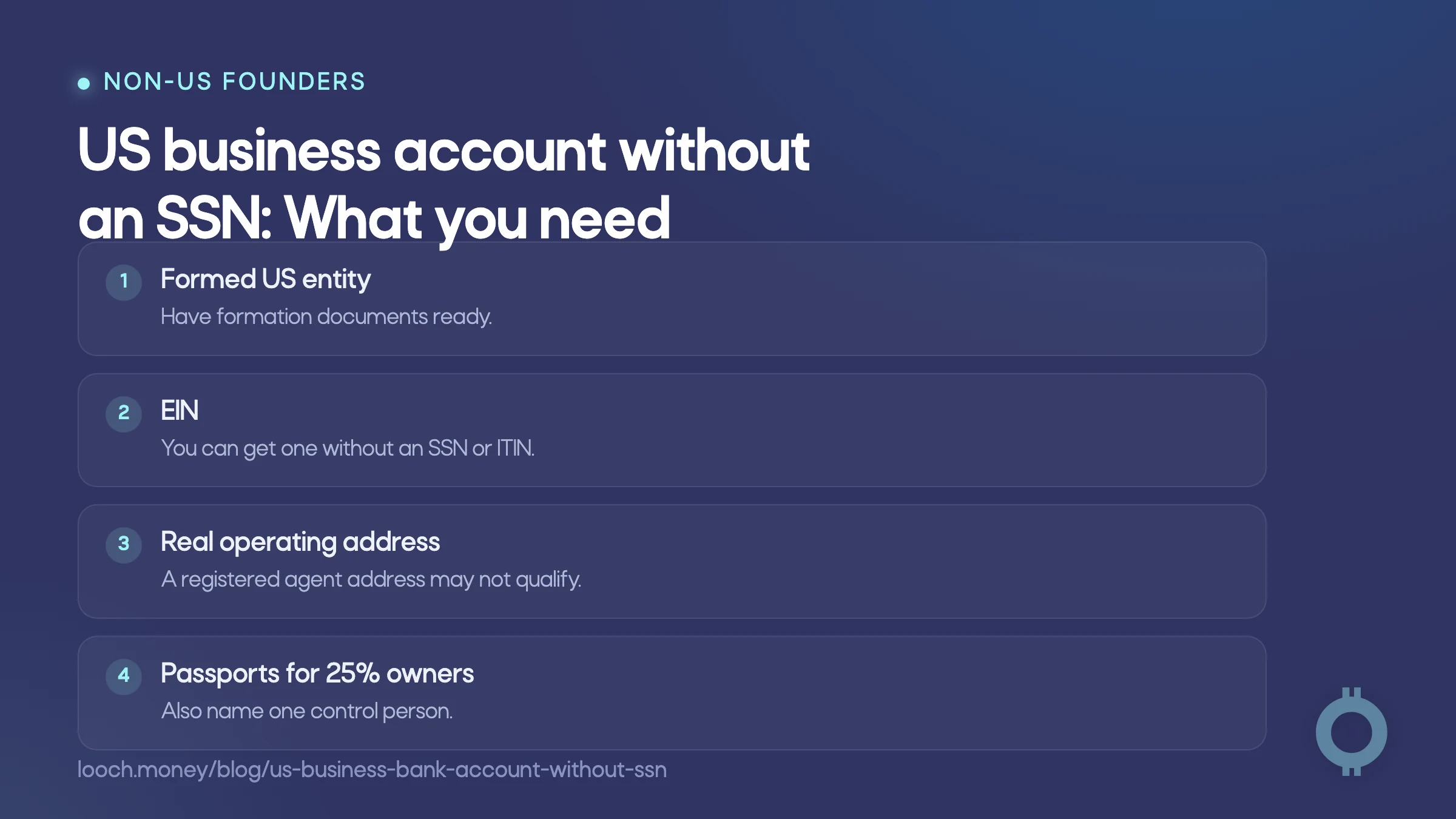
The practical requirement is different: You need a formed US entity, an EIN, and a provider that accepts non-resident founders. Provider policies vary far more than the federal rule.
- Identification: A passport number and country of issuance can satisfy the federal customer identification rule for a non-US person.
- EIN with no SSN or ITIN: A foreign founder can apply for an EIN without either.
- Ownership questions: Banks collect identity details for each owner at 25% or more, plus one control person.
- Provider spread: Bank of America states that foreign business customers cannot apply, while several fintechs document passport-based applications.
- looch’s path: looch Start forms the company for $249 all-in, obtains the EIN without an SSN or ITIN, and typically delivers the IRS CP-575 in the app in about 4 days when the founder has neither. looch Start accepts a founder living anywhere in the world. After approval, the company gets no-fee business accounts with account and routing numbers. Any US-registered LLC or corporation with an EIN and a qualifying US street address can open a looch profile. A registered agent, virtual office, PO box, or commercial mail receiving agency (CMRA) address doesn’t qualify under looch’s account address rule.
Last verified: September 28th, 2026.
Simplicity Fintech Inc is not a law firm and does not provide legal advice. As part of looch Start, Simplicity Fintech Inc acts as a Third-Party Designee to facilitate the EIN application. EINs can be obtained directly from the IRS at no cost.
That provider policy is where most guides fall short. They list banks without checking each provider’s current documentation. Eligibility often lives in help-center pages, and those rules can change without notice.
What federal law actually requires
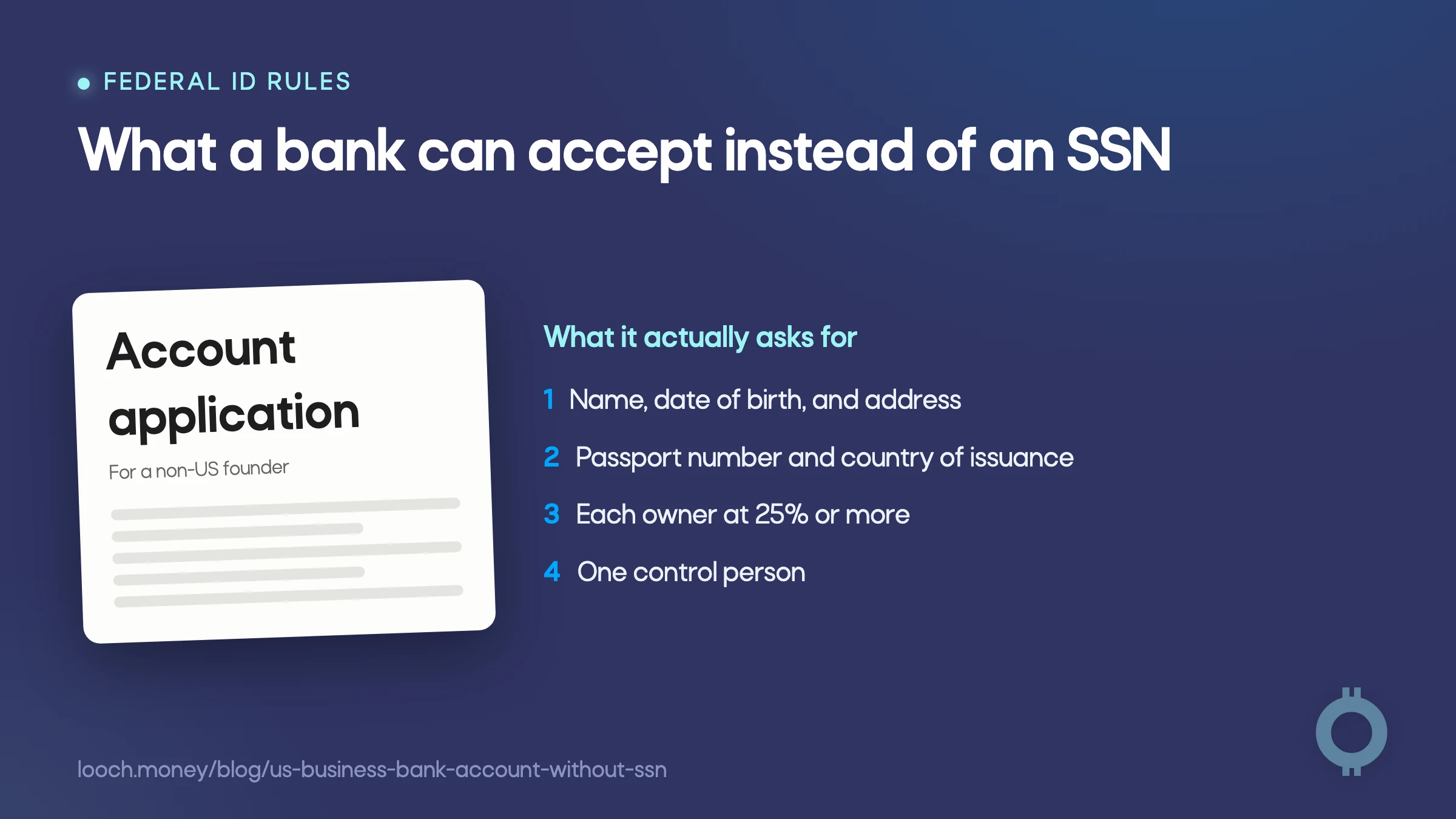
The federal Customer Identification Program rule requires a US bank to collect a person’s name, date of birth, address, and identification number before opening an account. For a non-US person, that identification number can be a taxpayer identification number, a passport number with its country of issuance, an alien identification card number, or another government-issued photo ID. An SSN isn’t the only acceptable form of identification.
Banks also collect beneficial ownership information for the company under a separate rule: Identity details for each individual who owns 25% or more, plus one person who controls the company. Those owners are verified using the same identification elements, so a passport can meet the identification requirement for them too.
FinCEN’s exceptive relief allows a bank to limit this review to the first account you open with it, along with cases where the bank has doubts or conducts its own risk-based review. Banks can choose whether to use that relief, so some may still request the information for every account.
Founders often confuse that bank requirement with beneficial ownership reporting to the government. FinCEN’s final rule ended that reporting requirement for US companies, but it didn’t change what your bank needs to know. Your bank still asks who owns 25%. We track the BOI story, with sources, in our fee and deadline tracker.
So when a provider asks for your passport and your co-founder’s, it’s following its federal rulebook, not singling you out.
Sources: Customer Identification Program rule, Beneficial ownership rule, FinCEN exceptive relief order.
What documents a foreign founder needs to open a US business account
A foreign founder generally needs the company’s formation document, EIN confirmation, operating agreement, ownership details, identification, address evidence, and any provider-specific records.
| Document | Who issues it | Why the provider asks | Sources |
|---|---|---|---|
| Formation document: Articles of Organization, Certificate of Formation, or Articles of Incorporation | The state where the company was formed, through its Secretary of State or equivalent | Proves the entity exists and is registered. Providers ask for state-filed formation documents that confirm registration. | Mercury documents, Relay, Chase, Bank of America |
| EIN confirmation: IRS CP 575, a 147C letter, or the SS-4 returned by the IRS, never the SS-4 application | The IRS | The IRS says the CP 575 is accepted by banks and other institutions as written confirmation of an entity’s EIN. Mercury also names the 147C letter and the SS-4 returned by the IRS, while Wise verifies the company through its EIN. | IRS CP 575 notice, Mercury documents, Wise |
| Operating agreement, signed if the LLC has more than one member | The LLC itself, with signatures from its members | Shows who owns and controls the company. Relay requires a signed operating agreement when an LLC has multiple members, and Chase lists the agreement among its LLC documents. | Relay, Chase |
| Passport for every owner at 25% or more and for the one control person, including the photo, date of birth, number, issue date, and expiry date | The founder’s government | The federal rule accepts a passport number and country of issuance for a non-US person. Mercury accepts a passport from international applicants, Relay requires a passport from non-US citizens, and Wise requests photo ID from non-US owners. | Customer Identification Program rule, Mercury documents, Relay, Wise |
| Proof of a real operating address, commercial or residential | A lease, utility bill, or bank statement, depending on the provider | The federal rule requires an address, but each provider decides what qualifies. Mercury rejects registered agent addresses, PO boxes, and UPS Store addresses. Relay requires a physical US address for every beneficial owner, with no PO boxes or virtual mailboxes. Wise requests proof of the business address. | Mercury eligibility, Relay, Wise, Customer Identification Program rule |
| Beneficial ownership certification: Name, date of birth, address, and identification number for each 25% owner and one control person, traced through any holding company | The company certifies it to the provider | The beneficial ownership rule requires this information when the account opens. It’s the provider’s collection, not a BOI report filed by a US-formed company with FinCEN. | Beneficial ownership rule, FinCEN order, Mercury eligibility |
| Provider-specific extras: Source of funds, a description of US operations, a financial profile for non-US-resident owners, or a business license or DBA certificate | The company or its local licensing office | Each provider’s application sets its own requirements. Relay’s financial profile covers the source of income, whether the business is new or established, annual personal income, and countries where it operates. | Mercury eligibility, Relay, Mercury documents, Bank of America |
A company formed in the US doesn’t file a BOI report with FinCEN. FinCEN’s final rule exempts US companies and became effective on August 14th, 2026. A company formed under foreign law and registered in a US state still has 30 calendar days after its registration takes effect to file, while the provider’s ownership questions continue regardless.
Practical notes before you apply
- A US entity and its formation documents. Have your Articles of Organization or Certificate of Formation ready, plus an operating agreement if your LLC has multiple members.
- An EIN. Every fintech in this guide verifies the company through its EIN, and founders without an SSN need one. The IRS SS-4 instructions explain how a responsible party without an SSN or ITIN can enter “foreign” or N/A. Our guide to getting an EIN without an SSN walks through the process.
- A real operating address. This is a common application blocker. Mercury accepts a US or international principal-place-of-business address, including a residential address, but doesn’t accept registered agent addresses, PO boxes, or UPS Store addresses. If your company only has its registered agent’s address, resolve that before applying.
- Passports for every 25% owner, per the beneficial ownership rules above.
Who accepts non-resident founders, per their own documentation
| Provider | Non-resident founder | Identification without an SSN | The constraint their docs state |
|---|---|---|---|
| Bank of America | No | Not applicable | "Foreign business customers are unable to apply at this time" |
| Chase | Not stated | ITIN accepted; passport among ID options | Multi-member LLCs must apply in a branch |
| Mercury | Yes | Passport-based | No registered agent addresses; founder-residence country list |
| Relay | Partly | Passport number in place of SSN | Every beneficial owner needs a physical US address |
| Wise | Yes | Photo ID for non-US owners | No Nevada businesses or US territories |
| looch | Yes, for any US-registered LLC or corporation with an EIN | No SSN or ITIN needed for the EIN, which looch Start obtains | A qualifying US street address is required. Registered agent, virtual office, PO box, and commercial mail receiving agency (CMRA) addresses don’t qualify. |
Payoneer appears often in this search, but we’ve left it out of the table. It’s a payments platform that provides USD receiving accounts, not a US business bank account. Its public registration pages describe requirements that vary by the applicant’s country, rather than one eligibility standard we can cite accurately.
Traditional banks
Bank of America is the clearest shut-out in the group. Its LLC application requirements say applicants should be US residents, the business must be US based, and “Foreign business customers are unable to apply at this time.” It also requires an SSN and date of birth from everyone on the application, including all 25% owners. Source: Bank of America LLC application requirements.
Chase doesn’t publish a flat yes-or-no rule for non-resident founders. Its checklist accepts an SSN, an ITIN for non-US citizens, or an EIN as the tax identification number. It requires identification documents and may request additional documents from non-US citizens. Its online application is limited to single-member, single-manager LLCs, while other LLCs must apply at a branch. Source: Chase business account checklist.
Fintechs
Mercury says that it supports US companies with founders around the world and that applicants don’t need to be US citizens or residents. The company must be US formed, have existing or planned US operations, and have a real principal-place-of-business address. It also maintains a prohibited-country list based on where a founder lives. Check that list directly, because it can change. Source: Mercury eligibility. For the broader product comparison: looch vs Mercury.
Relay accepts a passport number instead of an SSN and allows passport-only photo identification for non-US citizens. It also asks non-US-resident owners for an additional financial profile. Its documentation sets an important limit: Every beneficial owner needs a physical US address, not a PO box or virtual mailbox. A founder without a US address doesn’t meet that documented requirement. Relay’s prohibited-country list is based on citizenship or residency. Source: Relay required documents. Compare the products directly: looch vs Relay.
Wise verifies US businesses with an EIN. It asks for an SSN only from beneficial owners who live in the US or hold a US passport, while non-US owners provide a copy of photo identification. Its eligibility limits are geographic, including that it can’t onboard businesses formed in Nevada or US territories. Source: Wise US business verification.
Where looch fits
The core prerequisites across these providers are a formed US entity and an EIN. looch Start delivers both: It forms a Delaware C corp, Delaware LLC, Wyoming LLC, or Florida LLC for $249 all-in and obtains the EIN even when the founder has no SSN or ITIN. It delivers the official IRS CP-575 confirmation letter through the in-app virtual office, alongside the formation documents providers ask applicants to supply. Current looch figures are on the looch pricing page.
Simplicity Fintech Inc partners with Stripe Payments Company for money transmission services and account services with funds held at Fifth Third Bank N.A., Member FDIC. Neither Simplicity Fintech Inc nor its financial technology partners are FDIC-insured institutions.
Any US-registered LLC or corporation with an EIN and a qualifying US street address can open a looch profile. A registered agent, virtual office, PO box, or commercial mail receiving agency (CMRA) address doesn’t qualify. See the complete looch account address rule.
Once approved, the company gets no-fee business accounts with account and routing numbers, payments, real-time accounting, and Smartcards. looch Smartcards are Visa Commercial Cards, powered by Stripe and issued by Celtic Bank, and let the business spend from any looch account. The accounting system provides CPA-quality books and a QuickBooks and Xero migration tool.
Who should use someone else
A founder who already has an entity and only wants an account should compare Mercury directly and review Wise’s requirements. A founder whose owners all have a physical US address may find Relay’s document rules straightforward. A founder with a Nevada company can’t use Wise, while a founder who needs a branch relationship should review Chase’s documented process.
looch fits the founder who hasn’t formed the company yet and wants formation, the EIN, accounts, Smartcards, payments, and accounting in one app. The company still needs an EIN and a qualifying US street address before it can open a looch profile.
After approval: What providers commit to in writing
This is where most roundups lean on folklore. The provider documentation is much shorter.
Of the providers covered here, only Wise publishes a clear customer-facing explanation of post-approval reviews. Its account restriction help article says it may temporarily restrict an account while completing a routine check. It also asks customers to respond to information requests and provide clear, unexpired documents. Mercury documents document requests during the application review process. The other providers publish little, if anything, about reviews after an account is active.
You may find account-freeze stories about every provider in this guide. We couldn’t verify those stories in provider documentation, so we don’t present them as fact. The regulations discussed above require providers to monitor accounts and may require them to ask for renewed verification. What the providers’ own pages show is how limited their written commitments are once that process begins.
Judge providers by what they put in writing, then make a review easier to resolve:
- Keep your CP-575 EIN letter, formation documents, and operating agreement somewhere you can produce them the same day.
- Use a real operating address consistently, not your registered agent’s address.
- Respond quickly to verification requests with current, legible documents. Wise gives that guidance directly, and it’s sound practice for every provider in this guide.
Frequently asked questions
Can I open a US business bank account without an SSN?
Yes. The federal customer identification rule accepts a passport number and country of issuance for a non-US person, but you still need a US entity, an EIN, and a provider whose rules accept non-resident founders. Mercury and Wise document passport-based applications, Relay requires a physical US address for every owner, and Bank of America doesn’t accept foreign business customers. Any US-registered LLC or corporation with an EIN and a qualifying US street address can open a looch profile.
What documents does a foreign founder need to open a US business account?
Prepare the company’s formation document, IRS CP 575 or another accepted EIN confirmation, operating agreement, passports, proof of a qualifying address, beneficial ownership certification, and any provider-specific records. The ownership records cover each 25% owner and one control person, while the address must meet the chosen provider’s rules. A registered agent, virtual office, PO box, or commercial mail receiving agency (CMRA) address doesn’t qualify for a looch profile.
Do I need an ITIN to open a US business bank account?
No. None of the providers covered here lists an ITIN as a requirement. Chase accepts an ITIN as a TIN option for non-US citizens, while the fintechs document passport-based identification. You also don’t need an ITIN to get an EIN. The SS-4 route works if you have neither an SSN nor an ITIN.
Didn’t beneficial ownership reporting end? Why is the bank still asking who owns the company?
Both can be true. FinCEN’s final rule permanently ended BOI reporting to FinCEN for US companies. Banks still collect ownership information under separate requirements, at minimum when you open your first account with an institution and, for banks that don’t use FinCEN’s optional relief, when you open each account. The government filing’s gone. Account-opening questions are not. See our tracker for details and sources.
Can I open the account without traveling to the US?
It depends on the provider. Bank of America doesn’t accept foreign business customers, and Chase requires multi-member LLCs to visit a branch. Mercury and Wise document online applications with passport-based identification. Relay documents an online process for owners with a physical US address. None of the fintech options documents a travel requirement.
What does looch cost?
Formation is $249 all-in through looch Start, including the state filing fee, the EIN, and a year of registered agent service. The business accounts themselves are no-fee. The registered agent and virtual office renew at $249/year as the business protection bundle, which includes registered agent service, the virtual office with its business address and mail scanning for up to 3 regular mail pieces per year, the state annual report filing, and weekly trademark monitoring. Current account and payment pricing is on the looch pricing page, linked above.
Sources
- looch Start
- looch pricing
- looch Smartcards
- looch account requirements for a foreign-owned LLC
- Customer Identification Program rule
- Beneficial ownership rule
- FinCEN exceptive relief order
- FinCEN BOI reporting rule
- IRS CP 575 notice
- Bank of America LLC application requirements
- Chase business account checklist
- Mercury eligibility
- Mercury prohibited-country list
- Mercury document requirements
- Relay required documents
- Relay prohibited-country list
- Wise US business verification
- Wise account restriction guidance


