


How to get an EIN without an SSN: Foreign founders
Amounts last verified on August 30th 2026
Michel Myara is co-founder and product designer at looch, where he designs the ecosystem small businesses use to get paid and manage spend while keeping penny-perfect books.
You can get an EIN without an SSN

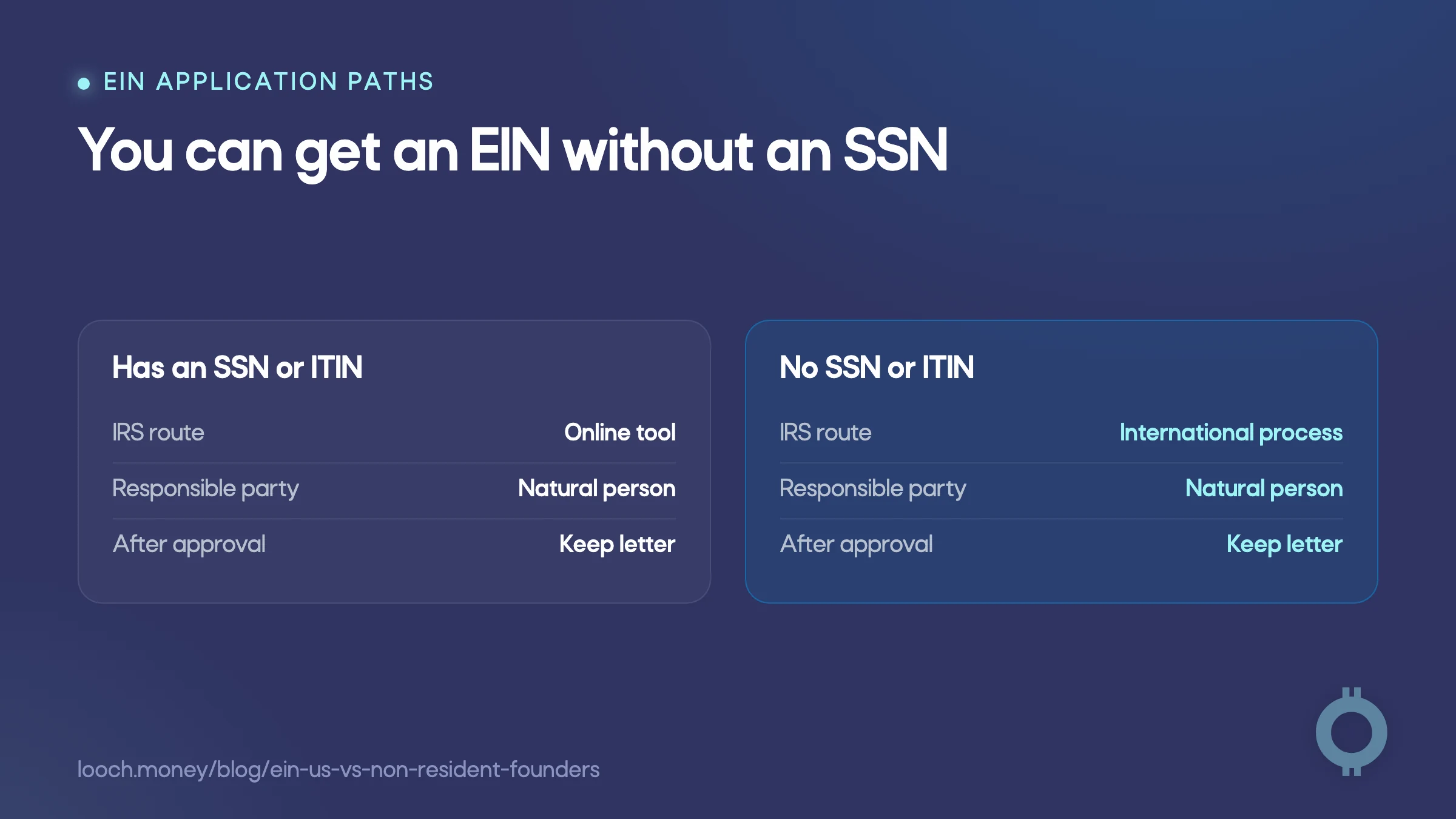
You can get an EIN without an SSN or ITIN. The IRS online application isn’t available to every foreign founder, but the IRS provides another route through its business tax ID application process.
That distinction matters because many guides stop at the online tool. They make an international founder think an EIN is out of reach when the real answer is narrower: The online route may be unavailable, while the IRS application route is still open.
This guide separates the paths, explains what the IRS means by a responsible party, and shows what to do after the EIN arrives. The IRS is the source for each process point here. Confirm current contact details and instructions directly with the agency before you apply.
An EIN identifies your business, not you
An EIN is the federal tax ID assigned to a business entity. It’s distinct from a personal tax ID, and the IRS issues EINs at no charge. Start with the IRS’s Employer Identification Number guidance for the agency’s current application rules.
Your entity may need an EIN to open a business account, work with payment providers, handle tax obligations, or hire. The point is simple: An EIN identifies the business in those systems. It doesn’t establish your personal immigration status, personal tax residency, or eligibility to work in the US.
An ITIN and an EIN solve different problems
An ITIN is a personal tax identification number. An EIN is a business tax identification number. One doesn’t replace the other.
You don’t need to obtain an ITIN before applying for an EIN if the IRS instructions allow the responsible party to use the foreign-applicant route. Receiving an EIN also doesn’t make you a US tax resident. The IRS applies separate tests to determine an individual’s tax residency status. See the IRS guidance on determining an individual’s tax residency status.
That separation is useful for planning. Your entity’s EIN application and your personal tax position may both need attention, but they aren’t the same filing or decision.
The online path works when the responsible party has a qualifying ID
If the responsible party has an SSN or ITIN, the IRS online application may be the most direct route. The online tool asks for the responsible party’s identifying information as part of the application.
The responsible party is generally the person who ultimately owns or controls the entity. It must be a natural person, not another company. The IRS explains that rule in its guidance on responsible parties and nominees.
Use the IRS’s online EIN application only if the responsible party meets the tool’s requirements. If the tool doesn’t let you continue because the responsible party lacks an SSN or ITIN, don’t try to force the application through with someone else’s details.
That shortcut creates a bigger problem. The IRS wants the person with real control over the entity, not a nominee or another entity standing in for that person.
Foreign founders can use the IRS application form instead
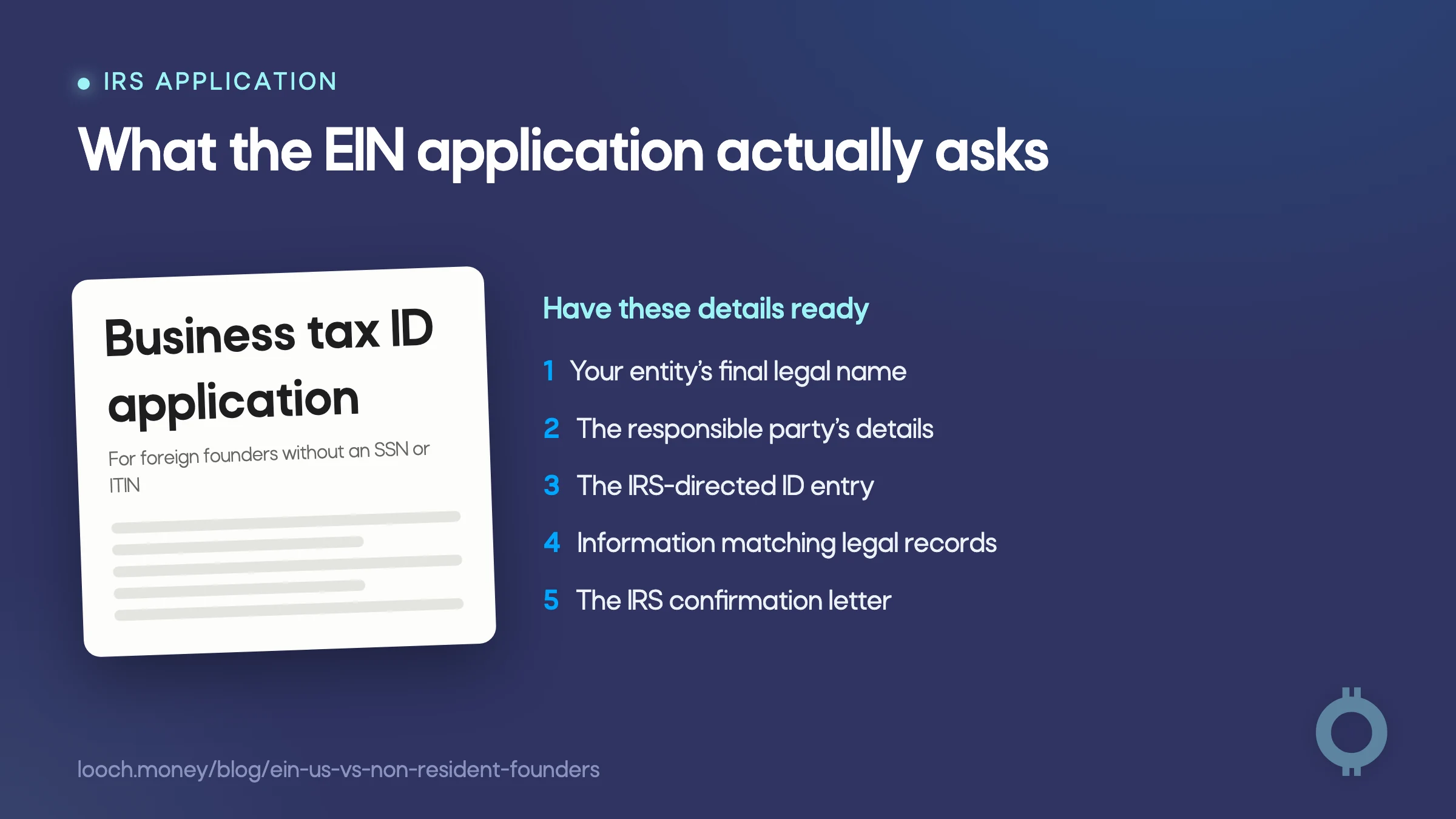
A founder without an SSN or ITIN isn’t blocked from getting an EIN. The IRS instructions describe how an international applicant can complete the business tax ID application when the responsible party is not eligible for either personal ID.
The key is to follow the IRS instructions for the responsible party’s identification field. The agency’s application instructions explain what an applicant should enter when the responsible party doesn’t have and isn’t eligible to obtain an SSN or ITIN.
From there, the application can be submitted through the IRS channel available to international applicants. The IRS may accept the information by fax or by phone, depending on the applicant’s circumstances and the agency’s current process. Check the current instructions before you submit because IRS contact details and operating procedures can change.
The important practical point is this: An unavailable online tool doesn’t mean an unavailable EIN.
The two IRS routes answer different founder situations
| Question | Responsible party has an SSN or ITIN | Responsible party has no SSN or ITIN |
|---|---|---|
| Can the online tool be available? | Yes, if the applicant meets IRS requirements | No, the tool may not accept the application |
| What identifies the responsible party? | Their qualifying personal tax ID | The entry directed by IRS instructions for a foreign applicant |
| Is the responsible party a business entity? | No, it must be a natural person | No, it must be a natural person |
| Is an ITIN required before applying? | Not necessarily | No, not when the IRS foreign-applicant instructions apply |
| Can the application be handled outside the online tool? | Yes, when appropriate | Yes, through the IRS process for international applicants |
| Should a nominee apply instead? | No | No |
| Does the EIN identify the founder personally? | No, it identifies the entity | No, it identifies the entity |
| Does an EIN determine personal tax residency? | No | No |
| Where should current instructions be checked? | IRS guidance and application instructions | IRS guidance and application instructions |
| What should the founder keep after approval? | The IRS confirmation letter | The IRS confirmation letter |
The table is a decision tool, not a substitute for the IRS instructions. If your ownership structure, entity type, or tax position is unusual, get advice from a qualified tax professional before submitting anything.
A clean application prevents avoidable delays
The IRS process is straightforward when the details match the entity you formed. Most problems come from submitting an incomplete application, using the wrong responsible party, or applying before the entity exists.
Use the entity’s final legal name and make sure the responsible party information is consistent throughout the application. If the entity is a Delaware company, complete the formation step before you request the EIN. Our guide to forming a Delaware C corporation explains how that formation decision fits into a founder’s broader setup plan.
Avoid these common mistakes:
- Listing an LLC or corporation as the responsible party instead of the person who controls it.
- Treating an EIN as a substitute for an ITIN or other personal tax ID.
- Applying before the state has formed the entity.
- Submitting information that doesn’t match the entity’s legal records.
- Relying on an old blog post for IRS contact details instead of checking the current IRS instructions.
A careful application is faster than fixing an ownership or identity mismatch after the fact.
looch Start handles the EIN step inside formation
If you are forming a supported entity through looch Start, the EIN is part of the same formation flow. looch Start obtains your EIN as part of the formation package, for $249 all-in. That fee includes state filing, the EIN, and your first year of virtual office service.
You provide the information needed to form the entity. looch determines which IRS path applies and handles the application process, including the route used when you don’t have an SSN or ITIN. That is the part generic EIN guides cannot offer: Your entity formation, EIN request, business accounts, Smartcards, payments, and accounting begin as one connected setup rather than a collection of separate vendors.
Once the IRS confirmation is ready, looch delivers it through the in-app virtual office. You don’t need to coordinate state formation, IRS paperwork, and a separate document inbox on your own.
This flow supports Delaware C corporations, Delaware LLCs, Wyoming LLCs, and Florida LLCs. If you are deciding between those options, start with the entity choice before worrying about the EIN mechanics. The EIN application follows the entity, not the other way around.
Your EIN is the start of business operations, not the end
After your EIN is issued, you can move to the operational work: Setting up an account, accepting payments, organizing your books, and understanding the tax filings your ownership structure may trigger.
For the account step, read our guide to opening a US business bank account without an SSN. It explains why an EIN helps but doesn’t remove every provider’s verification requirements.
Foreign-owned US entities may also have reporting obligations that are separate from the EIN application. Our guide to IRS Form 5472 for foreign founders covers that next question. An EIN gets the entity identified. It doesn’t complete the entity’s ongoing compliance work.
The bottom line: You don’t need an SSN to get an EIN. If the IRS online application is not available to you, use the IRS’s documented international-applicant process or form your entity through looch Start and let the EIN step stay part of the same setup.
Sources: IRS, Employer Identification Number, IRS, Apply for an Employer Identification Number online, IRS, Responsible Parties and Nominees, IRS, Determining an individual’s tax residency status, IRS application instructions.


