


How to form a Delaware C corporation: Founder guide
Amounts last verified on August 30th 2026
Michel Myara is co-founder and product designer at looch, where he designs the ecosystem small businesses use to get paid and manage spend while keeping penny-perfect books.
A Delaware C corporation is the right starting point when venture funding is part of the plan

To form a Delaware C corporation, file a Certificate of Incorporation, put the company’s ownership and governance documents in place, assign founder IP to the company, make the required tax filings, get an EIN, and open an account. The hard part isn’t the filing itself. It’s making sure the company owns what it says it owns before an investor, acquirer, bank, or future co-founder asks to see the paperwork.
That’s why formation shouldn’t be treated as a state filing followed by a pile of documents you will “get to later.” A clean formation package ties the state record, founder ownership, intellectual property, tax elections, and banking setup together from the start.
looch Start is built around that sequence. It forms the entity, handles the EIN path for founders without an SSN or ITIN, and gives founders the documents that become due diligence questions later. Then the same app is ready for accounts, Smartcards, payments, and real-time accounting.
Delaware is built for companies that expect institutional capital
Delaware is the default jurisdiction for venture-backed startups because its corporate law is familiar to investors, startup lawyers, and acquirers. That familiarity isn’t cosmetic. It reduces uncertainty when the company issues stock, raises money, changes its board, grants options, or sells.
The Court of Chancery gives corporate disputes a specialist venue
Delaware’s Court of Chancery hears business disputes without juries. Its judges work with corporate questions every day, including disputes involving fiduciary duties, stockholder rights, mergers, and governance.
For a founder, the practical benefit is predictability. Investors know the legal framework. Their counsel knows how Delaware documents are usually structured. That makes it easier to agree on what a financing or acquisition should look like.
Delaware case law makes diligence less mysterious
Delaware has a deep body of corporate case law. When a startup faces a familiar question, such as whether a board approval was valid or how a preferred-stock right works, there’s often established legal guidance behind the answer.
That doesn’t make Delaware simple. It makes the rules legible to the people reviewing your company. A venture financing already involves enough moving parts. Starting with a corporate structure that investors recognize removes one unnecessary debate.
Delaware separates incorporation from where you operate
A Delaware company can operate elsewhere. Incorporation isn’t the same thing as having employees, customers, property, or an office in a particular state. Your actual business activity may create obligations outside Delaware, so get legal and tax advice before assuming incorporation alone answers every compliance question.
Delaware also doesn’t require founders, directors, or officers to appear in the public Certificate of Incorporation. The public filing identifies the registered agent’s address rather than your home address.
A C corporation fits venture financing better than an LLC or S corporation
An LLC can be the right structure for a closely held business. An S corporation can be a practical tax election for a profitable business that expects to stay privately owned. Neither is automatically wrong.
But a company that expects institutional funding usually needs a C corporation from the beginning. Venture financing is designed around corporate stock, investor rights, option pools, and preferred shares. Retrofitting those mechanics after operating as another entity type can turn a straightforward financing into a cleanup project.
Preferred stock is a core venture financing tool
A C corporation can issue different classes of stock. That matters because investors often buy preferred stock while founders and employees hold common stock. Preferred stock can carry rights that common stock does not, including liquidation preferences, protective provisions, and participation rights.
An LLC can create sophisticated economic arrangements, but it doesn’t fit the standard venture financing playbook as cleanly. If the company intends to raise from funds that invest repeatedly in startups, standardization is a feature.
S corporation rules can conflict with institutional ownership
S corporation status has ownership restrictions that don’t fit many venture financings. A venture fund is generally an entity investor, and a company with institutional investors often needs ownership and stock terms that aren’t compatible with S corporation treatment.
The practical question is simple: Are you building a profitable business you intend to own closely, or a company you may finance with outside equity? If venture funding is plausible, a Delaware C corporation usually avoids a costly conversion later.
If you’re deciding between LLC structures instead, see our guide to Delaware LLCs and Wyoming LLCs. It covers a different decision, with different tradeoffs.
QSBS can make the C corporation choice more consequential
C corporations are the entity type associated with Qualified Small Business Stock treatment under IRC Section 1202. The rules are technical and depend on the company, the stock, the holder, and the holding period. They’re worth discussing with a qualified tax advisor before you rely on them.
The One Big Beautiful Bill Act changed the rules for stock acquired after July 4th, 2025. The per-issuer exclusion cap rose to $15 million, with a tiered schedule that allows a 50% exclusion at three years, 75% at four years, and 100% at five years. For stock acquired on or before that date, the prior rule allowed up to $10 million excluded after a five-year hold. Read the Perkins Coie Section 1202 analysis and get advice on your facts before making a tax decision.
Start with the decisions that determine your ownership record
The state filing is important, but the choices behind it matter just as much. Before you begin, decide on a name, choose a registered agent, and align on founder ownership.
| Decision | What it controls | Why it matters later |
|---|---|---|
| Company name | The legal identity of the corporation | A Delaware-available name may still create trademark or domain issues |
| Registered agent | Where Delaware sends official notices | The company needs a Delaware physical address for this role |
| Share structure | How much stock the company may issue | It affects founder issuances, option planning, and future financing |
| Founder allocation | Who owns what at formation | A later disagreement is far harder to solve than an early conversation |
| IP ownership | Whether the company owns the work founders created | Investors expect the company, not an individual, to own core IP |
Choose a name you can actually use
Your company name must be available in Delaware and include an appropriate corporate designator. You can search availability through the Delaware Division of Corporations Entity Search.
Don’t stop there. State availability isn’t trademark clearance, and it doesn’t mean the domain you want is available. Check the name in the places your business will actually use it before you make it part of your incorporation documents.
A Delaware registered agent is mandatory
Every Delaware corporation needs a registered agent with a physical Delaware address. The agent receives official state mail, service of process, and notices that can affect the company’s good standing.
The registered agent also keeps your personal address out of the public Certificate of Incorporation. looch Start includes registered agent service in the formation price, with renewal at $49/year.
Share structure should leave room for the company to grow
Founders often focus on their ownership percentage and overlook the underlying share structure. The certificate authorizes stock. The company later issues that stock to founders, employees, advisors, and investors through separate approvals and agreements.
A common starting point for an early-stage Delaware C corporation is 10 million authorized shares of common stock at $0.0001 par value. That structure can leave room for founder issuances, an option pool, and a future financing without forcing an immediate amendment to the certificate.
The right structure depends on your company’s facts. The important point is to decide founder ownership before issuing stock, document the decision clearly, and avoid treating the cap table as a spreadsheet problem to fix after the company has value.
The formation sequence is a chain, not a checklist of unrelated forms
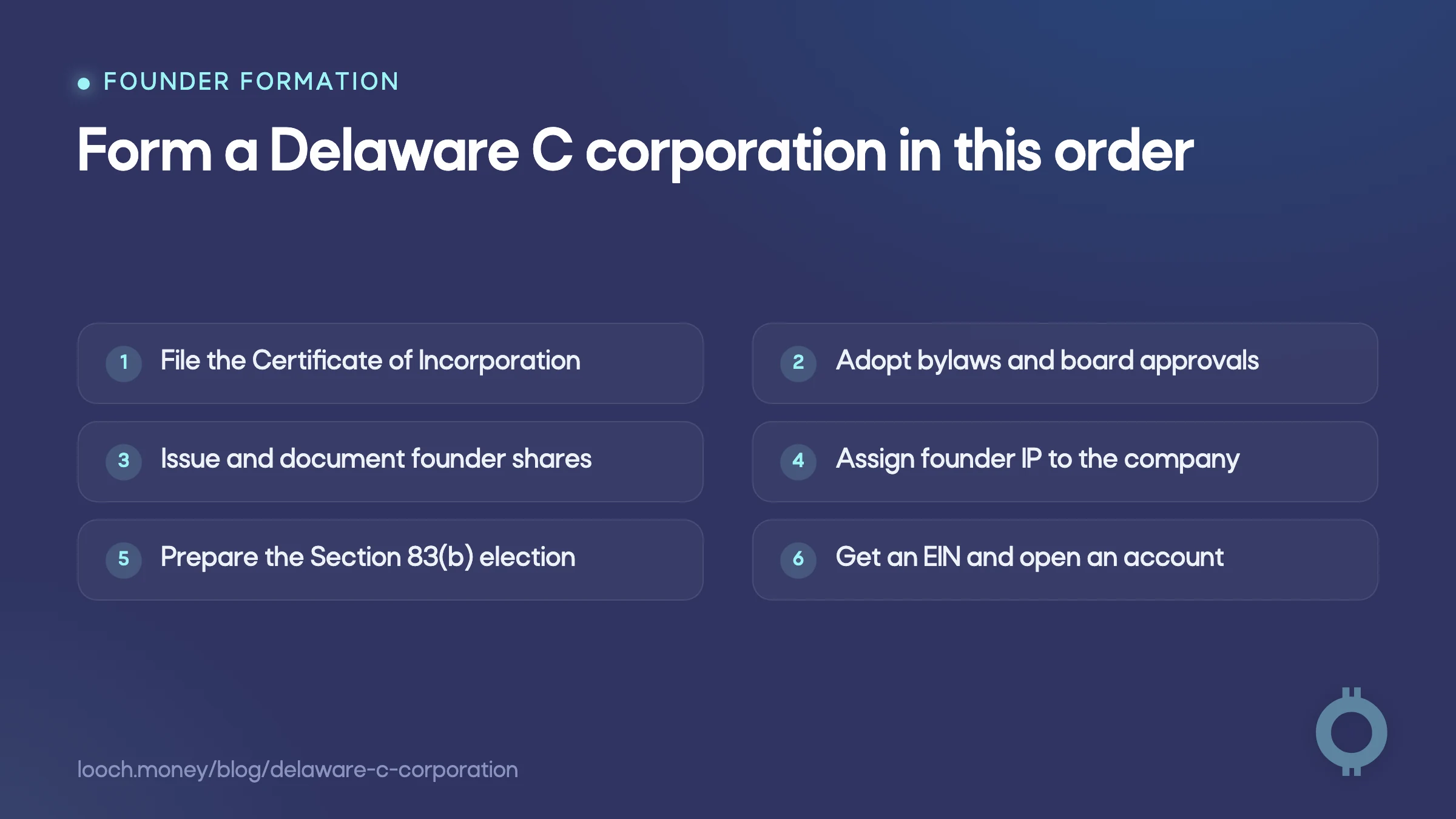
Each formation step supports the next one. The Certificate creates the legal entity. Governance documents establish how it acts. Stock documents establish who owns it. IP assignments establish what it owns. Tax filings set the treatment of founder stock. The EIN lets the company operate financially.
File the Certificate of Incorporation to create the corporation
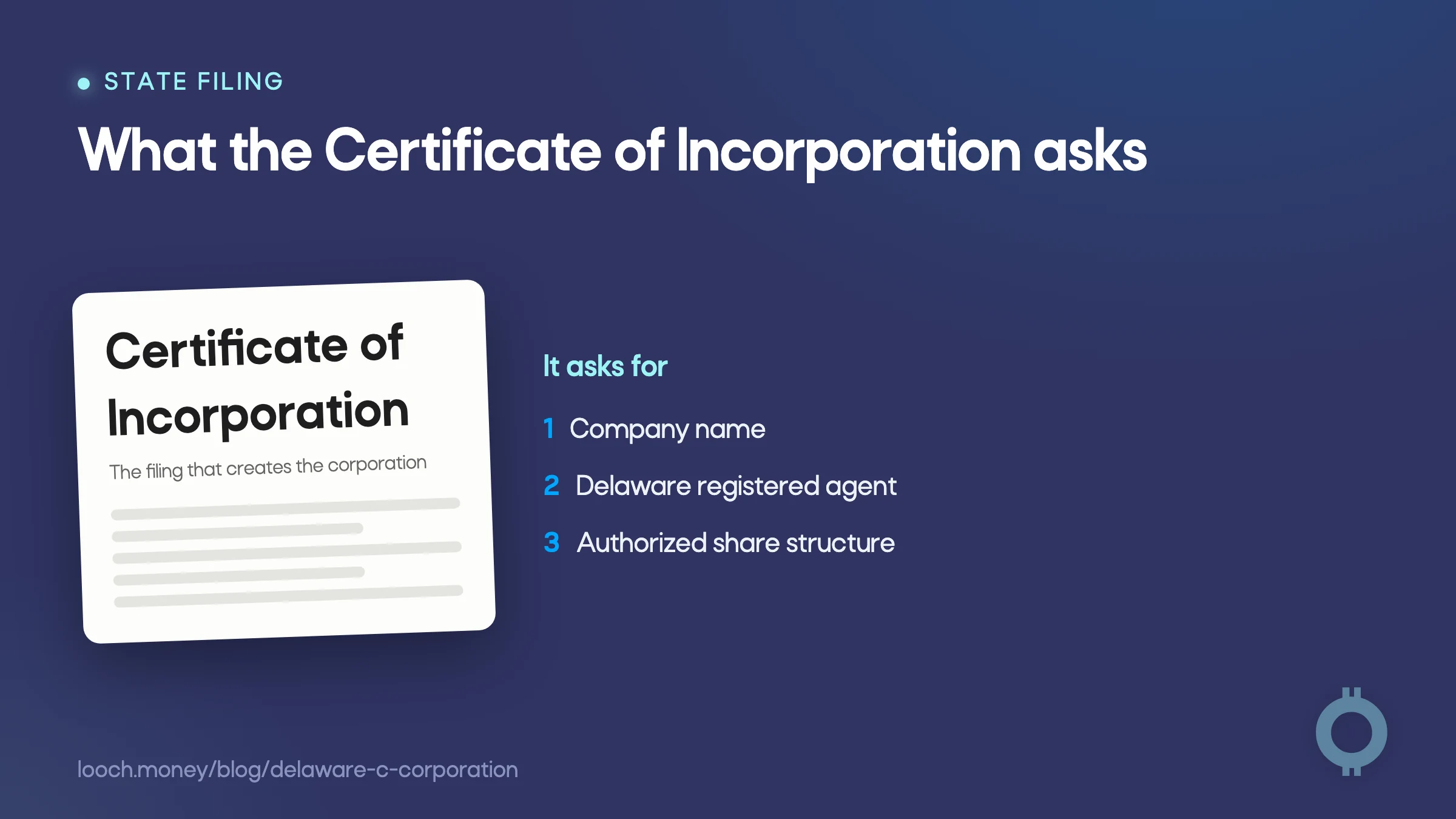
The Certificate of Incorporation is the filing that creates the Delaware corporation. It identifies the company, the registered agent, and the authorized share structure.
The state filing fee starts at a minimum of $89, according to the Delaware Certificate of Incorporation form and fee schedule. The actual filing cost can vary based on the certificate and the company’s authorized shares.
Once Delaware accepts the filing, the entity exists. That’s the beginning of the corporate record, not the end of formation work.
Adopt bylaws and approve the company’s first actions
Bylaws are the company’s internal operating rules. They typically address board meetings, officer roles, stockholder actions, and how corporate decisions are approved. They aren’t filed with Delaware, but they’re part of the company’s core record.
The organizational board consent usually adopts the bylaws, appoints officers, authorizes stock issuance, and approves the initial formation actions. It creates a written record that the company acted through the right decision-makers.
A founder doesn’t need to turn this into a ceremonial exercise. The point isn’t to imitate a public company. The point is to establish a clear chain of authority before the company starts signing contracts, accepting money, or issuing equity.
Issue founder shares with a Stock Purchase Agreement
The Stock Purchase Agreement documents the company’s issuance of shares to a founder. It should identify the shares, the purchase price, the vesting terms when applicable, and the company’s repurchase rights.
Without a signed stock purchase agreement, a founder may have an expectation of ownership without a clean record of how and when that ownership was issued. That becomes a problem when the company prepares a cap table, adds a co-founder, raises capital, or sells.
Founder vesting is common because it protects the company if a founder leaves early. It also signals that equity reflects continuing contribution, not only an initial idea. Investors often expect this structure because it prevents a departed founder from retaining an outsized stake without continuing to build the business.
Assign founder IP to the company before diligence exposes the gap
The company doesn’t automatically own work a founder created before incorporation. If you wrote code, built a prototype, designed a product, created a brand, or made other business-relevant work before the company existed, that work may remain personally owned until it’s assigned.
An IP Assignment, sometimes called a Proprietary Information and Inventions Agreement, transfers relevant past work to the company and sets expectations for relevant work created in the future.
This is one of the clearest examples of a document that seems easy to postpone and becomes painful to repair later. Investor counsel will ask whether the company owns its core IP. If the answer is unclear, the company may need retroactive assignments at the exact moment every founder is busy closing a financing.
Make the Section 83(b) election promptly after stock is issued
Founders who receive stock subject to vesting should understand the Section 83(b) election before their shares are issued. The election can change when the founder is taxed on restricted stock.
Without an election, vesting can create taxable income as shares become vested at their then-current value. With an election, the founder elects to be taxed at grant rather than as vesting occurs. For a newly formed company, that can mean a much lower taxable value at the time of grant.
The filing deadline is strict. Don’t assume you can correct a missed election later because the company is young or the value seemed nominal. Use the IRS’s Form 15620 information page, confirm the current filing method with a tax professional, and keep a complete copy of what you submit.
looch includes an 83(b) election draft in its formation package. The founder must still make the filing and retain the records. The right division of work is simple: looch prepares the formation workflow and documents, while you make the personal tax filing decision with the advice you need.
Get an EIN so the company can operate
An Employer Identification Number is the company’s federal tax ID. You generally need it for banking, tax filings, payroll-related activities, and other operational steps.
The IRS issues EINs at no cost. Founders with an SSN or ITIN may be able to use the IRS online process. Founders without an SSN or ITIN follow a different route, and that route is one reason formation is harder for international founders than most generic guides admit.
looch Start handles the EIN path for non-US founders without an SSN or ITIN and delivers the official IRS confirmation letter through the in-app virtual office. For a deeper explanation of the options, read our guide to getting an EIN as a non-US founder.
Open an account only after the corporate record is ready
A financial provider may ask for the stamped Certificate of Incorporation, EIN confirmation, bylaws, board approvals, or ownership information. Having those materials organized makes account opening more straightforward.
Don’t run corporate transactions through a personal account. Separate business finances help preserve clean records and make it easier to understand what belongs to the company.
For founders without an SSN, our guide to opening a US business account without an SSN explains the provider requirements that matter. Once a company is formed through looch Start and the EIN is confirmed, founders can onboard into looch accounts, Smartcards, payments, and accounting in the same app.
The documents investors inspect answer practical ownership questions
“VC-ready” is often used as a marketing label. In practice, it means the company can answer basic diligence questions with signed documents instead of explanations.
| Document | The question it answers | What goes wrong when it is missing |
|---|---|---|
| Certificate of Incorporation | Does the company legally exist and have the stated share structure? | The state record may not support the ownership story |
| Bylaws and board consent | Who had authority to approve the company’s early actions? | Important acts can lack a clear corporate record |
| Stock Purchase Agreement | Who received founder stock and on what terms? | The cap table lacks supporting documentation |
| IP Assignment | Does the company own the product and other relevant work? | Core assets may still be personally owned |
| Section 83(b) election | Has the founder addressed the tax treatment of restricted stock? | Vesting can create unexpected personal tax exposure |
| EIN confirmation | Can the company identify itself for federal and financial purposes? | Banking and operational setup can stall |
The Stock Purchase Agreement is the evidence behind the cap table
A cap table tells you who owns the company. The Stock Purchase Agreement explains why. It ties a founder’s name to a specific issuance, purchase price, vesting terms, and restrictions.
This distinction matters in diligence. A spreadsheet can be edited in minutes. Signed agreements show that the company actually took the actions reflected in the spreadsheet.
The IP Assignment closes the ownership gap before it becomes leverage
When a company’s value is tied to its product, code, brand, designs, data, or other intellectual property, ownership must be clear. A company can’t confidently sell or finance assets it may not own.
The assignment is especially important when founders built before incorporation. The company shouldn’t need to guess whether early work was created personally, for a prior employer, with a contractor, or with a departing co-founder. Get the ownership chain right while everyone agrees on the facts.
The 83(b) election deserves its own calendar reminder
The 83(b) election isn’t another corporate document to sign and forget. It is a personal tax filing with a strict deadline tied to the stock grant. The founder is responsible for filing it correctly and retaining proof.
This is where good formation support is useful but not a substitute for personal tax advice. A draft helps you move quickly. It doesn’t remove the need to understand what you’re filing.
Corporate Transparency Act reporting changed, so use the current FinCEN guidance
Older incorporation guides often tell every new company to file a Beneficial Ownership Information report with FinCEN under the Corporate Transparency Act. That guidance became outdated after the rules changed.
FinCEN’s current position affects domestic companies and US persons differently from certain foreign reporting companies. Before taking action, read the live guidance on FinCEN’s Beneficial Ownership Information page. Don’t rely on a formation checklist that was written before the rule change.
The useful lesson is broader than this one requirement. Formation compliance changes. A good guide should point you to the regulator for the current rule, not make a permanent claim based on a past version of the law.
Delaware franchise tax is an annual operating obligation, not a formation fee
A Delaware C corporation owes annual franchise tax. It is separate from the initial state filing and separate from any income-tax obligations that may apply to the company.
Delaware provides two calculation methods: the Authorized Shares Method and the Assumed Par Value Capital Method. You pay whichever is lower. According to the Delaware Division of Corporations franchise tax guidance, the minimum is $175 and the maximum is $200,000.
The share structure you choose at formation can affect the result. That’s why founders shouldn’t copy a share number without understanding how Delaware calculates the tax. Use Delaware’s current calculator and consult a professional if the result doesn’t make sense for your company.
Late payment can affect the company’s good standing. Good standing matters when a company raises money, enters contracts, opens financial accounts, or needs to show counterparties that it remains active.
Registered agent renewal is part of staying active in Delaware
The registered agent isn’t a one-time formation line item. The company must maintain an eligible agent to stay registered in Delaware.
looch Start renews at $49/year. That also covers the virtual office business address and mail scanning for up to 3 pieces per year, with unlimited state mail and service of process.
Formation pricing is only useful when it includes the documents you need
A low advertised formation price can hide the real cost of a usable company. The state filing, EIN, registered agent, corporate documents, and renewal terms all matter. So does whether the service includes the documents that investors will ask for.
| Service | Year 1 all-in | Registered agent renewal | VC-ready documents included |
|---|---|---|---|
| looch Start | $249 | $49/year | Yes: SPA, IP assignment, 83(b) draft |
| Stripe Atlas | $500 | $100/year | Partial |
| Bizee | $441 | $149/year | No |
| LegalZoom | $587 | $249/year | No |
| ZenBusiness | $507 | $199/year | No |
| Clerky | $819 lifetime | $125/year | Yes |
looch is built for the founder who needs a formation package and then needs to run the company. The $249 formation package includes the Delaware state filing fee, EIN, registered agent service, a virtual office for the first year, the Stock Purchase Agreement, IP assignment, and an 83(b) election draft.
Clerky can be a strong fit for founders who want a dedicated legal-document platform and are comfortable paying for that approach. Stripe Atlas can be a fit for founders who prefer its broader startup network and ecosystem. Bizee, LegalZoom, and ZenBusiness may suit founders whose needs end with a more basic formation workflow.
The difference isn’t that every founder needs the same service. The difference is whether you need a state filing alone, a legal-document workflow, or a company that can move directly from formation into accounts, spending, payments, and books.
Read the side-by-side pages before choosing: looch vs Bizee, looch vs LegalZoom, and looch vs ZenBusiness. Provider pricing and packages can change, so verify the current details before you commit.
looch Start connects formation to the work that begins after formation
Most formation services stop once the state filing is accepted. That leaves the founder to find a separate account, card program, payments tool, accounting system, and way to manage tax and compliance work.
looch is designed differently. looch Start is the entry point to a financial operating system for the business. After the entity and EIN are in place, you can move into no-fee business accounts, Smartcards with spend controls, looch Pay for cards and instant pay by bank, and real-time accounting.
That matters because the company’s first financial decisions often happen immediately after formation. You need somewhere to receive money, a way to pay for expenses, and records that don’t require manual cleanup later.
You can see the formation package on looch Start and review the ongoing product costs on looch pricing.
Frequently asked questions about forming a Delaware C corporation
Can a non-US founder form a Delaware C corporation?
Yes. Delaware doesn’t impose a residency or citizenship requirement on incorporators, directors, or officers. The company needs a Delaware registered agent, but the founder doesn’t need to live in Delaware or have a personal US address.
A non-US founder can own 100% of a Delaware C corporation from anywhere in the world. The operational steps, especially the EIN and account-opening path, can differ from the experience of a founder with an SSN or ITIN.
Do I need a US address?
No. The company needs a Delaware address for its registered agent. That is the registered agent’s address, not your personal address.
A virtual office can also give the business an address for mail handling while keeping a founder’s home address off public records. looch Start includes a virtual office with registered agent service as part of the formation package.
How long does Delaware C corp formation take?
With looch, the Certificate of Incorporation is filed within one business day. The EIN route depends on the founder’s identification path. Founders with an SSN or ITIN may use the IRS online process, while founders without either use the nonresident process looch supports.
The better question isn’t only when the state filing is submitted. It is when you have the corporate record, EIN confirmation, and documents needed to open accounts and begin operating.
What happens if I miss the 83(b) deadline?
Don’t assume a missed deadline can be fixed later. The filing deadline is strict, and missing it can change the tax treatment of vesting stock.
If you have issued restricted founder shares, speak with a tax professional immediately and review the IRS instructions. The safest formation process is to prepare the election alongside the stock issuance rather than treating it as a later task.
When should I choose S corporation tax treatment instead?
S corporation tax treatment can make sense for a profitable, closely held business that doesn’t expect institutional capital and wants to evaluate salary and distribution tax treatment.
It is usually not the right fit for a startup that expects venture funding. If a company may need preferred stock or entity investors, a Delaware C corporation is generally the cleaner starting point.
What is the Delaware franchise tax?
It is an annual Delaware obligation for corporations. The amount depends on the company’s authorized shares and capital under Delaware’s calculation methods.
The current minimum is $175 and the maximum is $200,000. Use the Delaware franchise tax calculator rather than relying on a generic estimate.
Form the company you will need at the next stage
A Delaware C corporation isn’t just a filing. It is the legal foundation for founder ownership, investor diligence, banking, hiring, and a future sale.
looch Start gives you the Certificate of Incorporation, bylaws, board consent, Stock Purchase Agreement, IP assignment, 83(b) election draft, EIN path, registered agent, and virtual office in one formation workflow. Form your Delaware C corporation with looch, then keep running the business in the same app.


