


IRS Form 5472 for foreign founders: Filing guide
Amounts last verified on August 30th 2026
Michel Myara is co-founder and product designer at looch, where he designs the ecosystem small businesses use to get paid and manage spend while keeping penny-perfect books.
Foreign-owned US companies often need Form 5472

If you’re a non-US founder who owns a US company, you may need to file IRS Form 5472. The case that catches most people is a single-member LLC owned by a foreign person, because it can have a filing obligation even when it has no revenue and owes no US income tax.
Skipping the filing can be expensive. The IRS penalty for failing to file Form 5472 when due is $25,000, and the penalty can apply even if the company made no money.
This guide explains who is in scope, why a foreign-owned single-member LLC files a pro forma Form 1120 with Form 5472, what creates a filing obligation, and where looch can help. It’s tax content with real consequences, so the filing rules discussed here come from the IRS Instructions for Form 5472. Your facts still matter, and a tax professional should review anything outside the straightforward case described below.
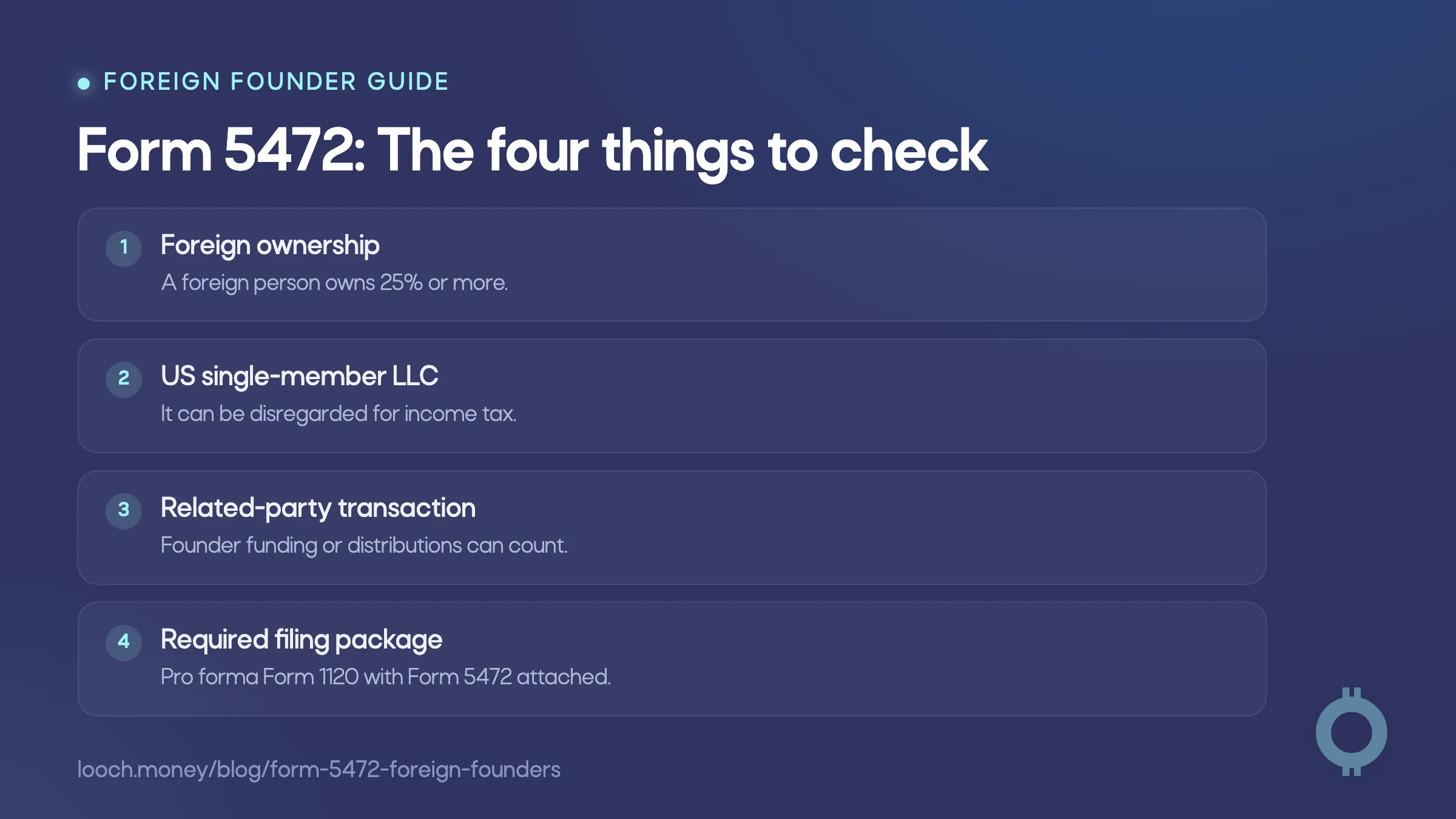
The IRS filing rule turns on ownership and related-party transactions
Form 5472 is an information return for certain transactions between a reporting corporation and a related foreign or domestic party. Under the IRS instructions, a reporting corporation includes:
- A 25% foreign-owned US corporation, including a foreign-owned US disregarded entity
- A foreign corporation engaged in a trade or business within the United States
The form supports reporting rules under Internal Revenue Code sections 6038A and 6038C. It isn’t an income tax return by itself. A company can need Form 5472 even where it has no income tax due.
“25% foreign-owned” means at least one foreign person owns, directly or indirectly, 25% or more of the company by vote or value at any point during the tax year. For many foreign founders, that test is simple: If you’re a non-US person and own a quarter or more of a US company, you’re likely in scope.
The other part of the rule is the transaction. Form 5472 is required when the reporting corporation has a reportable transaction with a related party during the tax year. For a foreign-owned disregarded entity, ordinary founder activity can be enough to create that transaction.
| Question | What it means for a foreign founder |
|---|---|
| Is the entity foreign-owned? | A foreign person with the required ownership stake can put the entity within the reporting rules. |
| Is the entity a single-member LLC? | It may be disregarded for income tax purposes but still treated as a reporting corporation for Form 5472. |
| Did money move between the owner and the entity? | Founder funding, distributions, and payments connected to the entity can create a reportable transaction. |
| Does the entity have revenue or income tax due? | Neither point alone decides whether Form 5472 is required. |
For the transaction-level details, including what belongs in Part IV and Part V and what records support the filing, read Form 5472 reportable transactions.
A foreign-owned single-member LLC is the filing trap
A single-member LLC is generally a disregarded entity for US federal income tax purposes. The IRS looks through the LLC and treats its activity as belonging to its owner. That is why many founders conclude that the LLC has no separate federal filing requirement.
That conclusion’s often wrong.
A foreign-owned US disregarded entity is treated as a corporation for the limited purpose of the Form 5472 reporting rules. In practice, a US single-member LLC wholly owned by a non-US person can need to file Form 5472 even though it doesn’t file a regular income tax return and may owe no US income tax.
This distinction matters because “disregarded” doesn’t mean invisible to every IRS rule. It describes how the entity is treated for federal income tax purposes. It doesn’t remove the separate information-reporting requirement when the Form 5472 rules apply.
If you’ve formed a US LLC as a non-US founder and moved money between yourself and the company, don’t assume a quiet year means no filing. Confirm the facts with the person preparing your return.
The pro forma Form 1120 carries Form 5472 for a disregarded entity
A disregarded entity doesn’t have a regular income tax return to which it can attach Form 5472. The IRS provides a specific filing method instead: The entity files a pro forma Form 1120 with Form 5472 attached.
“Pro forma” is important here. The Form 1120 is a limited cover return, not a corporate income tax calculation. The Form 5472 instructions state that the required Form 1120 information is the name and address of the foreign-owned US disregarded entity and items B and E on the first page. The attached Form 5472 is the substantive information filing.
The filing method also differs from that of a regular foreign-owned corporation. A foreign-owned US disregarded entity can’t file Form 5472 electronically and must submit it using the method described in the IRS instructions. A normal 25% foreign-owned corporation instead attaches Form 5472 to its regular income tax return.
That is why it helps to separate two questions:
- Does your entity need Form 5472?
- If it does, which return carries it?
For a foreign-owned single-member LLC, the answer to the second question is generally the pro forma Form 1120 and attached Form 5472.
Founder funding can create the filing obligation
The filing obligation exists when there is a reportable transaction with a related party. For a foreign-owned disregarded entity, that threshold is often lower than founders expect.
Funding your LLC from your own funds can be a reportable transaction. Taking money out can be one too. Paying formation costs personally, then treating those costs as connected to the company, can also matter. An LLC can look dormant in its bank account while still having had owner-to-company activity that belongs on Form 5472.
That is the practical reason this filing catches early-stage founders. Before there is a product, customer revenue, or payroll, there is usually still formation spending, founder funding, or both.
Keep records as you go. Your preparer needs to understand what moved between you and the entity, why it moved, and how it should be reported. The detailed guide to Form 5472 reportable transactions explains the categories and documentation in more depth.
Form 5472 follows the deadline for the return it attaches to
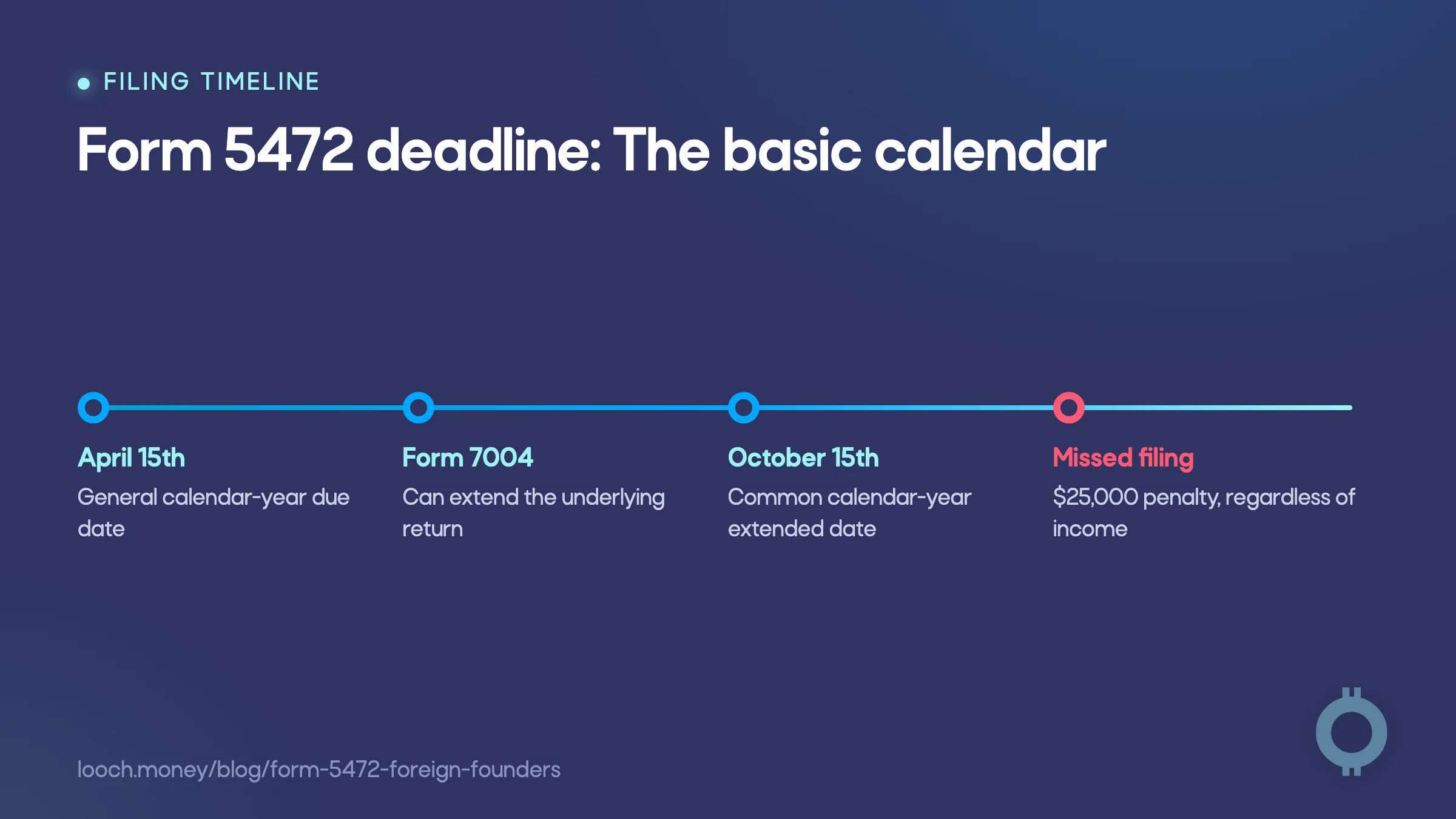
Form 5472 is due with the income tax return to which it is attached, including extensions. For a calendar-year filer, that generally means April 15. Form 7004 can extend the deadline for the underlying return, commonly to October 15 for a calendar-year filer.
For a foreign-owned single-member LLC, the same timing rule applies to the pro forma Form 1120 and attached Form 5472. The filing is due by the Form 1120 deadline, including any extension obtained with Form 7004.
The exact deadline depends on the entity’s tax year, the return involved, and whether an extension was properly filed. Confirm the date for your specific situation with your tax professional. Do not treat a general filing calendar as a substitute for reviewing the return you actually need to submit.
An EIN comes before the Form 5472 filing
The US entity needs an Employer Identification Number, or EIN, before Form 5472 can be filed. The IRS specifically requires a US disregarded entity wholly owned by a foreign person to obtain an EIN so it can meet the Form 5472 reporting requirement under section 6038A.
This can be the first obstacle for a non-US founder. The IRS online EIN tool requires a US Social Security Number or ITIN, which many non-resident founders don’t have. In that situation, the entity applies on Form SS-4. The IRS Instructions for Form SS-4 direct a foreign-owned US disregarded entity filing Form 5472 to identify itself accordingly on the application.
The EIN isn’t the Form 5472 filing. It’s the identifier that makes the filing possible. Get the EIN first, then prepare and submit the Form 5472 package when it is due.
Our guide to getting an EIN as a non-US founder explains the path in more detail. If you’re still choosing an entity, the structure discussed in our guide to forming a Delaware C corporation is different from a single-member LLC, but the need to get the entity and EIN right remains the same.
The penalty applies even when the LLC had no income
The penalty for failing to file Form 5472 when due, or filing a substantially incomplete form, is $25,000. Under the Form 5472 instructions, the penalty applies regardless of income, so a dormant LLC that missed a filing can still face the full amount.
The penalty is why this is not a form to ignore until the company becomes active. A filing that feels administrative in an early year can become a significant problem later, particularly when the owner cannot show what was filed or when.
For the escalation process after IRS notice, the records issue, and the appropriate path for a missed year, read the Form 5472 penalty, in full. A missed prior year is not the same job as preparing a current filing. It may require a reasonable-cause argument and professional representation.
looch prepares the straightforward single-owner filing
looch Start handles the two prerequisites that come first: Forming the US entity and obtaining the EIN. looch Start forms your US company and obtains your EIN, including the Form SS-4 path for founders without an SSN or ITIN.
For a US single-member LLC wholly owned by one foreign person, looch also prepares and submits the annual package described in this guide: The pro forma Form 1120 with Form 5472 attached. The service is $399 per filing, published on the looch pricing page.
This isn’t a checkbox added to a formation flow and left unread. The return is prepared and signed by a preparer who holds an IRS Preparer Tax Identification Number and signs it as paid preparer. looch uses information already in your looch profile to prepare and transmit the filing.
There’s no electronic filing acknowledgment for a foreign-owned disregarded entity. looch transmits the return and stores the submission confirmation with your signed copy in your file. For a looch business in the straightforward case, there’s usually nothing else to do.
That proof matters. A filer who can’t show what was submitted has a harder time responding to questions about a penalty that starts at $25,000.
The formation and filing service is only one part of the setup. Once the entity is active, founders can also review which fintech accounts accept a foreign-owned US LLC before choosing where to manage company money.
looch is not the right fit for every Form 5472 situation
Preparation isn’t representation. A preparer with a PTIN alone doesn’t have rights to represent you before the IRS. If the IRS sends a notice or asks questions about the filing, you need an enrolled agent, CPA, or attorney. looch provides the complete file for that professional to work from.
The looch filing service is designed for the plain case: One US single-member LLC, one foreign owner, and ordinary reportable transactions. A CPA or enrolled agent is the better fit if any of these apply:
- Your LLC has multiple members and files as a partnership
- Your company is a C corporation with tax to compute and a Form 5472 attached to a regular Form 1120
- You have effectively connected income or a US trade or business
- You missed a prior year and need penalty abatement or a reasonable-cause argument
That boundary is deliberate. A prepared form doesn’t solve a more complex tax question. If your situation falls into one of these categories, put the filing in the hands of a professional who can advise on the whole return and represent you if needed.
Frequently asked questions
Does a foreign-owned single-member LLC really need Form 5472?
Yes, if it had a reportable transaction during the tax year. The IRS treats a foreign-owned US disregarded entity as a reporting corporation for these rules. The LLC files Form 5472 attached to a pro forma Form 1120, even if it files no regular income tax return and may owe no US income tax.
My LLC had no revenue. Do I still need to file?
Possibly. Contributions into the LLC, distributions out of it, and amounts connected to forming or dissolving it can be reportable transactions. Funding the company or paying its costs personally can be enough to create a filing obligation. Confirm your facts with a tax professional.
What is the penalty for not filing Form 5472?
$25,000 for failing to file when due or filing a substantially incomplete form, regardless of income. The process after an IRS notice is covered in the Form 5472 penalty.
When is Form 5472 due?
It is due with the income tax return it attaches to, by that return’s due date including extensions. For a calendar-year filer, that is generally April 15, and Form 7004 can extend it. A foreign-owned single-member LLC follows the same timing for its pro forma Form 1120 and attached Form 5472.
Does looch file Form 5472 for me?
looch prepares the pro forma Form 1120 with Form 5472 attached for a US single-member LLC wholly owned by one foreign person. It’s prepared and signed by an IRS PTIN holder as paid preparer, then transmitted using information in your looch profile. Preparation isn’t IRS representation. If the IRS sends a notice, you need an enrolled agent, CPA, or attorney, and looch provides the complete file.
Can I file Form 5472 without an EIN?
No. The US entity needs an EIN, and a foreign-owned US disregarded entity is specifically required to obtain one for Form 5472 reporting. A non-US founder without an SSN or ITIN applies on Form SS-4. looch Start obtains the EIN as part of forming your company.
Form the entity, get the EIN, then prepare the right filing
Form 5472 starts with the basics in place: A US entity and an EIN. Form your company and get your EIN with looch Start, including the path for non-US founders without an SSN or ITIN.
For the straightforward single-owner case, looch prepares the annual pro forma Form 1120 with Form 5472 attached. If your situation belongs on the CPA list above, form the company wherever you choose and put the filing in a qualified professional’s hands.


