


Form 5472 penalty: $25,000 and how it escalates
Amounts last verified on September 21st 2026
Michel Myara is co-founder and product designer at looch, where he designs the ecosystem small businesses use to get paid and manage spend while keeping penny-perfect books.
The Form 5472 penalty starts at $25,000, even when the business made nothing

The Form 5472 penalty is $25,000 for a required form that is missing, late, or substantially incomplete. It is an information-return penalty, not a percentage of income or tax due, so having no revenue does not make it smaller.
Answer: The initial penalty is $25,000 for failing to file when due. Filing late can result in $25,000, and filing a substantially incomplete form can result in $25,000 because the instructions treat it as a failure to file. The same $25,000 penalty also applies for failure to maintain required records.
Last verified: August 24th, 2026.
That’s the part foreign-owned US LLC owners often miss. A company can be inactive, have no operating income, and still have a filing obligation because a reportable transaction occurred. The penalty rules in the Instructions for Form 5472 are direct: A filing that doesn’t meet the requirement can be treated the same way as no filing at all.
| What happened | IRS treatment | Penalty exposure |
|---|---|---|
| The required Form 5472 was not filed | Failure to file | Initial $25,000 penalty |
| The form was filed after the due date | Failure to file when due | Initial $25,000 penalty |
| The form was substantially incomplete | Treated as a failure to file | Initial $25,000 penalty |
| Required supporting records were not maintained | Separate records failure | $25,000 penalty can also apply |
Who must file, which entities are reporting corporations, and how the filing works are covered in our Form 5472 guide for foreign founders. This page is about the cost of getting that filing wrong.
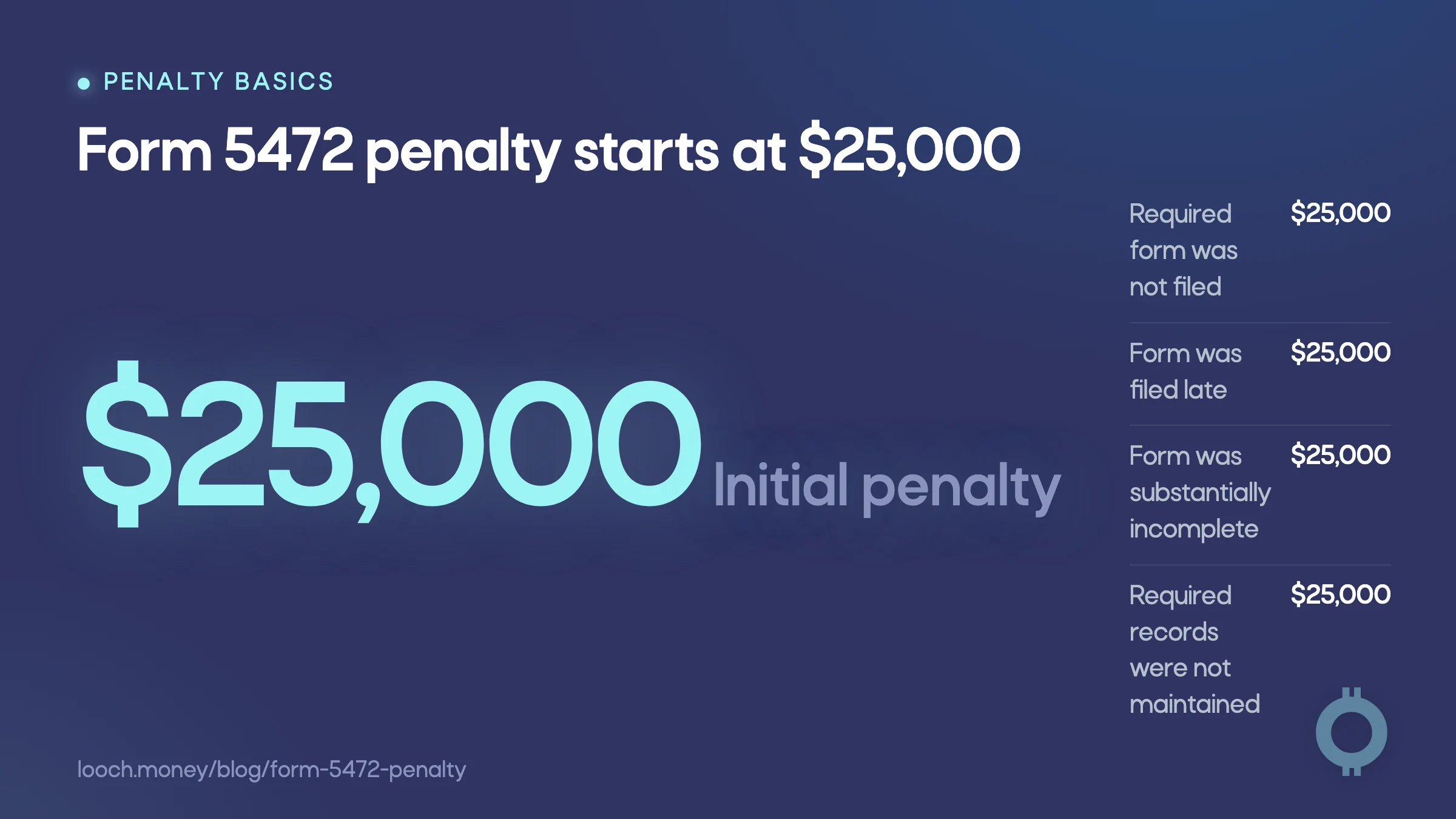
A late or incomplete filing can carry the same initial penalty
The initial $25,000 penalty applies when a reporting corporation fails to file Form 5472 when due and in the manner prescribed. That covers more than silence.
A late filing is still late, even if the form is eventually submitted. A substantially incomplete filing can also be treated as a failure to file. The IRS instructions say this plainly: “Filing a substantially incomplete Form 5472 constitutes a failure to file Form 5472.”
That matters when owners try to solve the problem with estimates that have no record behind them, omit related-party activity, or send a form without the information needed to support it. The form is not a checkbox. It is a report that needs numbers you can substantiate.
For a foreign-owned single-member LLC, the filing can feel disconnected from the business’ reality. Perhaps the owner funded the company, paid a startup expense, or moved money between the owner and the LLC. Those transactions can create the reporting issue even where there was no customer revenue. Start with what counts as a Form 5472 reportable transaction, then work from the records rather than trying to reconstruct the story at filing time.
The penalty can keep growing after IRS notice
The initial penalty is the floor. If the failure continues for more than 90 days after the IRS mails notice, an additional $25,000 applies with respect to each related party for each 30-day period, or part of a 30-day period, after that period ends.
The multipliers matter. It is per related party. It is per period. And part of a period counts as a full period. The instructions state no ceiling.
A single ignored notice, one related party, and six months of continued failure produces the initial $25,000 plus three additional periods, or $100,000. The expensive move is waiting for the notice and treating it as the beginning of the problem. It is not. By then, the clock that creates additional penalties is already running.
If you discover a missed filing before the IRS contacts you, do not wait to see whether a notice arrives. Gather the records, understand the exposure, and speak with a qualified tax professional about the appropriate next step.
The records matter as much as the form
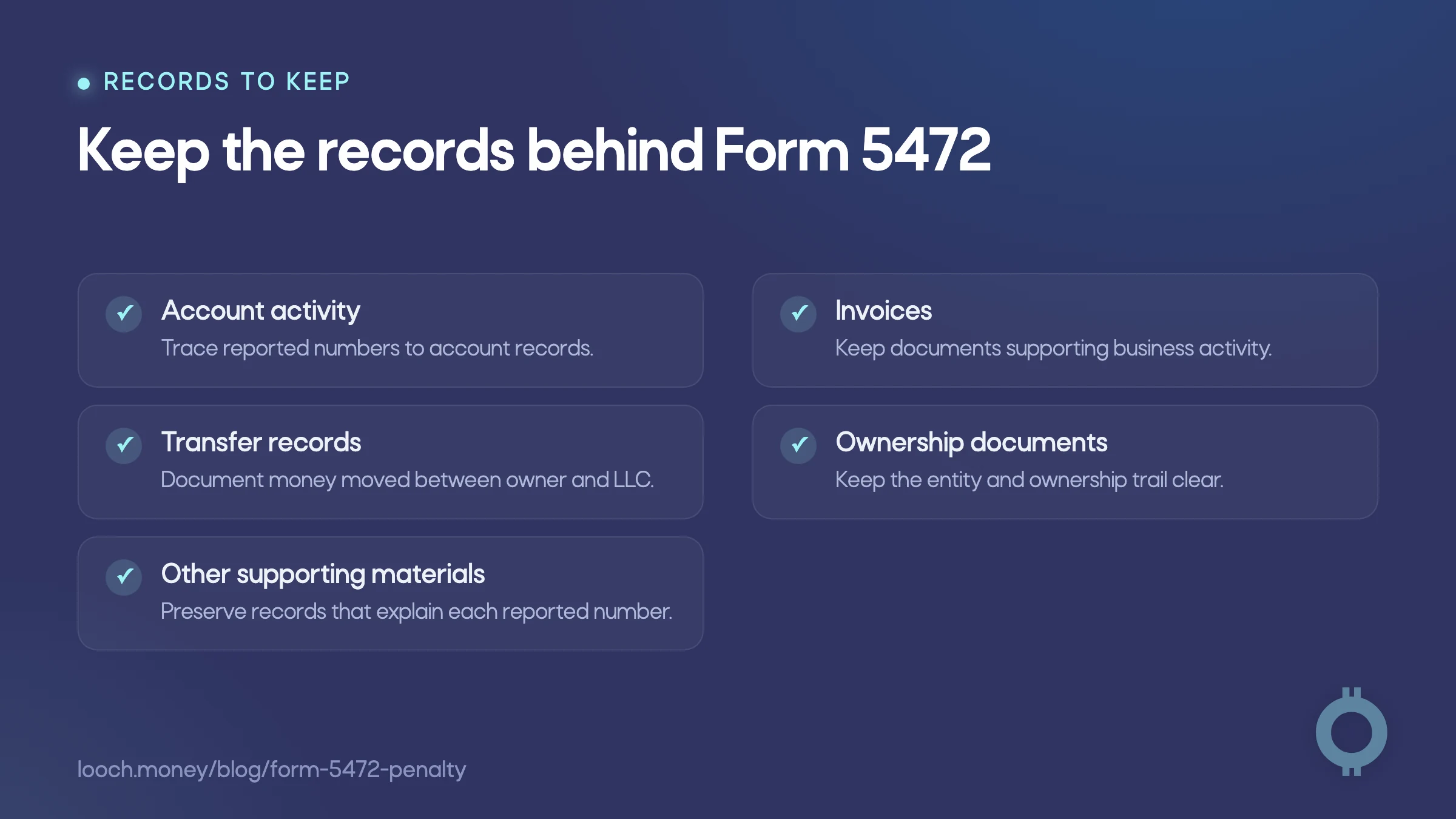
The filing is only one part of compliance. The reporting corporation must also maintain records that support what it reported. The IRS instructions state that the $25,000 penalty also applies for failure to maintain the required records.
That’s why a completed PDF isn’t the same thing as a defensible filing. If the numbers can’t be traced to account activity, invoices, transfer records, ownership documents, or other supporting materials, the company has another problem to solve.
Most annual filing workflows begin with archaeology. Owners download statements from several places, search old emails, identify transfers, and try to explain a year of activity under deadline pressure. The practical advantage of running the business in looch is that the transaction trail is already part of the books. Accounting-enrolled external bank, card, and investment accounts flow into the app alongside looch activity, so the record is built during the year rather than assembled from fragments later.
That doesn’t replace tax judgment. It does give the person preparing the return a cleaner factual record. For Form 5472, that difference is material because the form and the records are connected obligations.
Willful or false filings create a separate problem
The civil penalty is serious enough on its own. The IRS instructions also state that criminal penalties may apply for willful failure to submit information or for filing false or fraudulent information.
This is not a reason to panic over an honest mistake. It’s a reason not to invent an answer because a document is missing or a transaction is hard to classify. If the facts are unclear, get qualified tax advice before filing. Nothing in this guide is legal or tax advice.
A missed year needs penalty-relief advice, not a quick filing service
If you have already missed a year, treat the situation as a potential penalty-relief matter. A qualified CPA, enrolled agent, or attorney can assess the filing history, the facts behind the missed return, and whether a reasonable-cause argument is available.
That’s different from preparing a current-year return on time. It’s also different from paying a service to submit a form without asking whether the company’s record supports it. Our main Form 5472 guide explains which situations need a CPA even for a current-year filing, including multi-member LLCs, corporations with tax to compute, a US trade or business, effectively connected income, and prior-year cleanup.
Complete books give a preparer the records Form 5472 needs
With looch’s real-time accounting, every transaction between the LLC and its owner is entered and categorized as it happens, so a preparer can work from complete records instead of reconstructing the year from fragments.
A foreign-owned disregarded entity cannot e-file this return and must follow the submission method in the IRS instructions. Complete books don’t replace professional advice on a missed year.
If the entity doesn’t exist yet, looch Start forms it and obtains the EIN, including for founders without an SSN or ITIN. Then the business can run its accounts, payments, Smartcards, and books in the same app that holds the activity needed to prepare the filing.
The practical goal is simple: File on time. Use real numbers. Keep the records that explain them.


