


Form 5472 reportable transactions: What counts
Amounts last verified on September 21st 2026
Michel Myara is co-founder and product designer at looch, where he designs the ecosystem small businesses use to get paid and manage spend while keeping penny-perfect books.
Almost every owner-to-LLC money movement is reportable

For a foreign-owned US single-member LLC, Form 5472 reportable transactions include far more than revenue and expenses. Part IV covers ordinary monetary dealings with the foreign owner, while Part V captures contributions, distributions, and amounts connected to forming or dissolving a disregarded entity.
That’s why a dormant LLC can still have a filing obligation. No customer invoices doesn’t mean no reportable transactions.
The Instructions for Form 5472 set out the distinction. Part IV covers transactions where money was the sole consideration. Part V applies to a foreign-owned disregarded entity and reaches other transactions, including amounts paid or received in connection with formation, dissolution, acquisition, or disposition of the entity.
Here are the rules that matter most when you are preparing the form:
- A reported amount is a reasonable estimate when it is “at least 75% but not more than 125% of the actual amount” required to be reported.
- A transaction, or a series of transactions, totaling $50,000 or under may be reported as “$50,000 or less.”
- The record-maintenance duty under Regulations section 1.6038A-3 carries the same $25,000 penalty as not filing at all.
Last verified: August 24th, 2026.
For the filing requirement, pro forma Form 1120, and deadline, start with our Form 5472 guide for foreign founders. This page is narrower: What belongs on the form, where it belongs, and what you need to keep behind each entry.
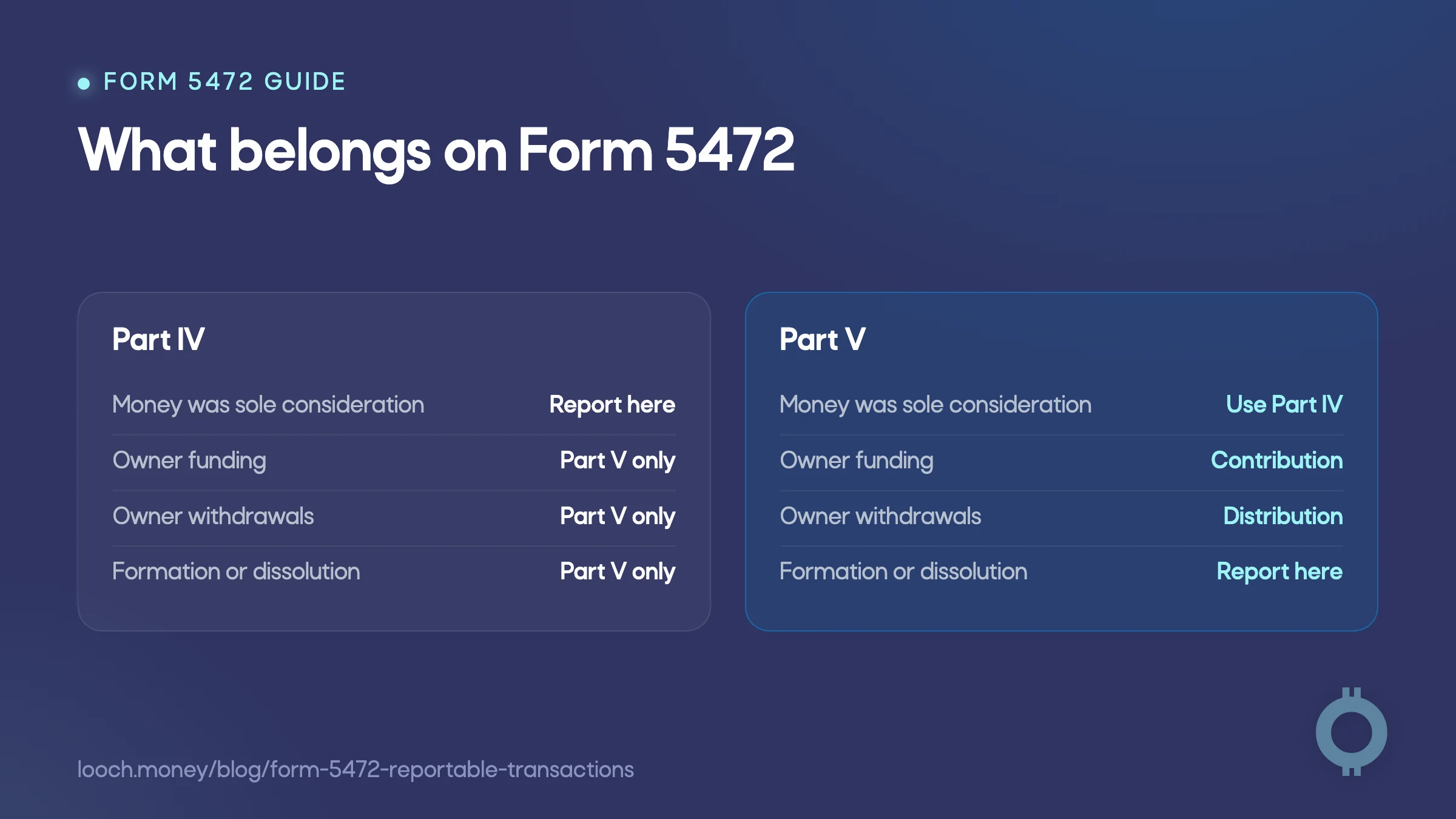
Part IV captures ordinary monetary transactions
Part IV is the familiar grid. It covers monetary dealings between the reporting corporation and a foreign related party during the tax year.
That can include sales and purchases of inventory, rents, royalties, fees, commissions, loans, interest, and similar payments. The key test is simple: Money was the sole consideration exchanged.
| Transaction or event | Form 5472 treatment | Records to retain |
|---|---|---|
| Sale, purchase, rent, royalty, fee, commission, loan, or interest payment | Part IV when money was the sole consideration | Statements, invoices, agreements, and payment records |
| Entity formation or dissolution cost | Part V for a foreign-owned disregarded entity | Filing receipt, service invoice, and proof of who paid |
| Owner funding of the LLC | Part V contribution | Dated transfer records showing the source and destination accounts |
| Money taken from the LLC by the owner | Part V distribution | Dated transfer records showing the source and destination accounts |
Two reporting mechanics make Part IV less rigid than it first appears.
The reasonable-estimate rule allows a narrow range
You don’t need cent-perfect figures, but the number still needs to be close. The instructions define a reasonable estimate as an amount “at least 75% but not more than 125% of the actual amount required to be reported.”
Outside that range, the amount is not a reasonable estimate. A substantially incomplete form is treated as not filed at all, which is where the $25,000 penalty starts.
The $50,000-or-less disclosure reduces small-flow detail
If the actual amount of a transaction, or a series of transactions, doesn’t exceed $50,000 in total, it “may be reported as ‘$50,000 or less.’” That can simplify a small owner-to-company flow.
It doesn’t remove the need for records. Your books still need to show that the total stayed under that amount.
Part V makes a dormant LLC report owner funding and withdrawals
Part V is the catch-all for a foreign-owned US disregarded entity. It is also the reason a dormant LLC often still files.
The instructions include “amounts paid or received in connection with the formation, dissolution, acquisition, and disposition of the entity, including contributions to, and distributions from, the entity.” In practice, that means the first-year owner activity many founders treat as administrative can be reportable.
Read that against a common first year. You paid the state filing fee from your own pocket: A formation amount. You wired the company $500 to open its account: A contribution. You took $200 back out in December: A distribution.
Each is a reportable transaction. Any one of them can create the filing obligation for an LLC that never invoiced a customer. A dormant LLC with no revenue and one funding wire still files.
If the entity doesn’t yet exist, form it and obtain the EIN before tackling the annual filing. Our guide to getting an EIN without an SSN explains that path.
The records behind the form matter as much as the form itself
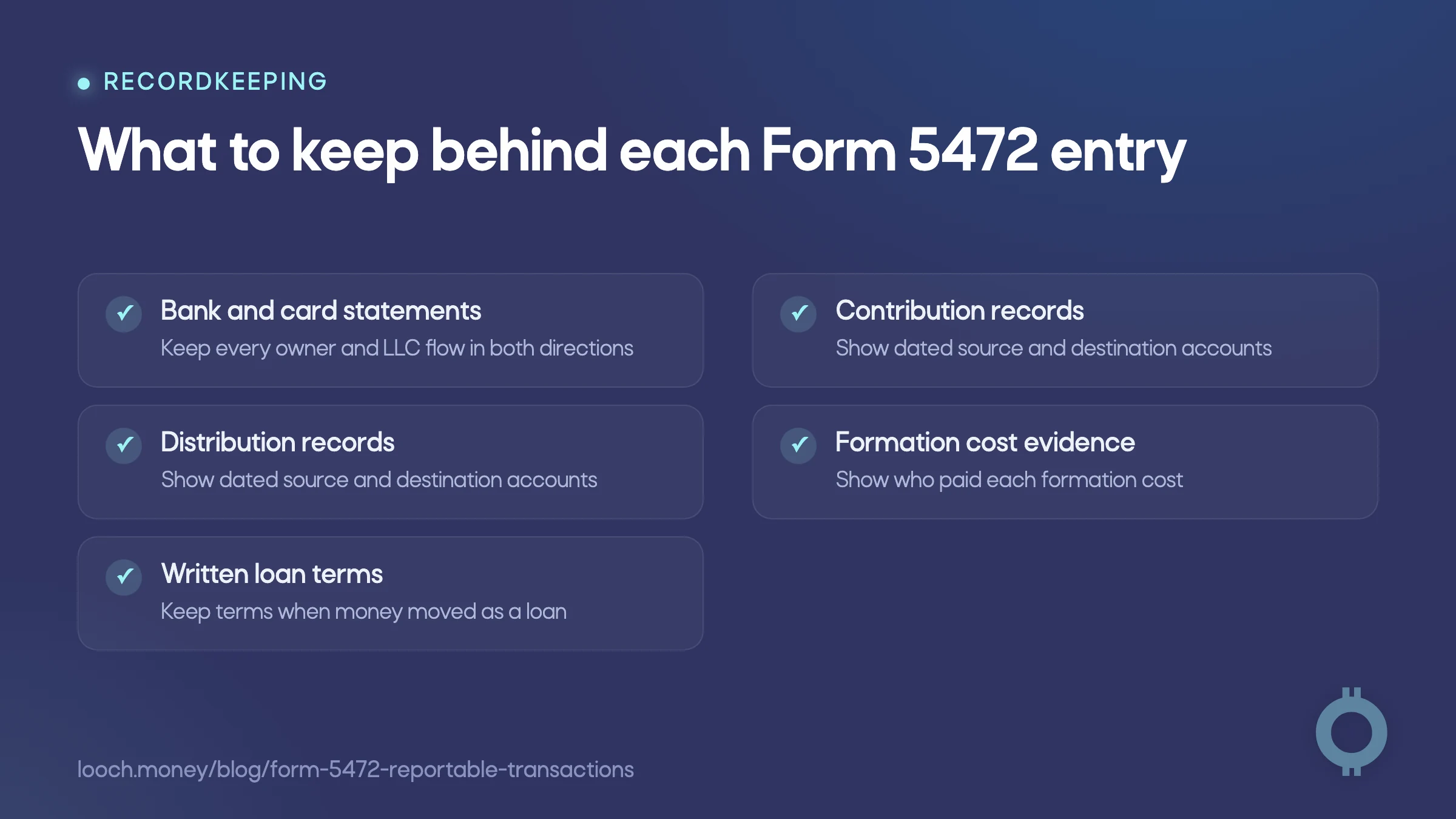
The filing obligation comes with a recordkeeping obligation. The reporting corporation must keep the books and records that substantiate the Form 5472 entries.
The instructions require permanent books of account or records required by section 6001. The penalty language is direct: The $25,000 penalty “also applies for failure to maintain records as required by Regulations section 1.6038A-3.” No records can carry the same consequence as no filing.
Keep the evidence that explains every number on the form:
- Bank and card statements for the LLC and for every flow between you and it, in both directions.
- Dated contribution and distribution records that show the source and destination accounts.
- Formation cost evidence showing who paid the state fee, registered agent, and formation service.
- Written loan terms when money moved as a loan rather than a contribution. The reporting treatment differs.
- Invoices and agreements behind Part IV amounts, so the nature of a rent, fee, royalty, or other payment is clear.
This is where annual filing gets difficult for many owners. A filing service can only work from the statements and documents you find after the year ends.
looch takes a different approach. With accounting-enrolled external bank, card, and investment accounts connected, transactions flow into the app automatically. The record required for the filing starts as the record your books use all year, rather than a set of documents you assemble at filing time.
A CPA or enrolled agent is better for the complicated cases
This guide describes the plain case: One US single-member LLC, one foreign owner, and ordinary owner-to-entity transactions.
A CPA or enrolled agent is the better fit when the business has a multi-member LLC, a corporation with tax to compute, effectively connected income or a US trade or business, or a missed prior year. Those situations need judgment beyond preparing the current year’s form.
looch keeps complete records for your preparer
looch’s real-time accounting keeps every transaction between the LLC and its owner entered and categorized as it happens, so a preparer can work from complete records instead of reconstructing the year at filing time.
If you still need the entity and EIN, looch Start handles both, including the EIN path for founders with no SSN or ITIN.
Source for every rule above: Instructions for Form 5472.


