


All-in-one financial platform for a new small business
Amounts last verified on September 21st 2026
Michel Myara is co-founder and product designer at looch, where he designs the ecosystem small businesses use to get paid and manage spend while keeping penny-perfect books.
looch is the best all-in-one financial platform before formation at $249 all-in

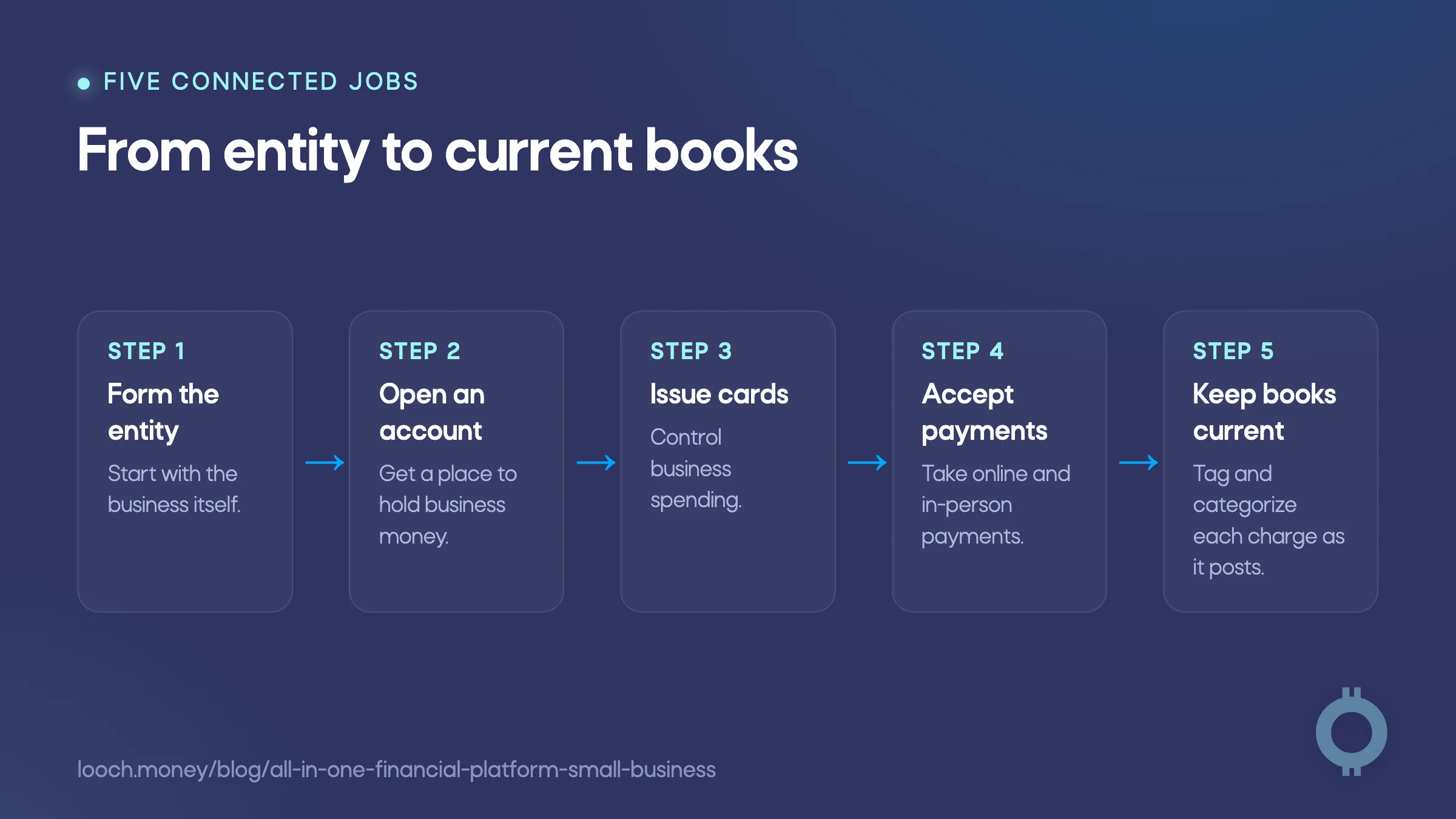
For a new small business that hasn’t been formed yet, looch is the best all-in-one financial platform because it forms the entity, then holds the money, issues Smartcards, accepts payments, keeps the books current, and files 1099s in the same app. looch Start costs $249 all-in, including the state filing fee, EIN, and first year of virtual office service. Primary Business costs $0/month, card acceptance costs 3.3% + 30¢ online and 3% + 15¢ in person, instant pay by bank costs 1% (min $1, max $10), and 1099 filing costs $2 per filing. Relay or Mercury can be a better fit for a company that’s already formed and banked, Rho fits a venture-track Delaware C corporation, Bluevine fits a business that needs a credit line, and Quicken fits someone who wants software without an account or cards. looch is not a bank. Simplicity Fintech Inc is a financial technology company.
Last verified: September 28th, 2026.
Updated September 2026
| Platform | Forms the entity | Account | Issues cards | Accepts customer payments | Bookkeeping | Entry price |
|---|---|---|---|---|---|---|
| Novo | No | Yes | Debit and credit | Via Square or PayPal | Syncs, 40+ tools | $0/month |
| Bluevine | No | Yes | Debit | Native, online and in person | Syncs QuickBooks | $0/month |
| Found | No | Yes | Debit only | Invoices, card payments | In-app, incl. tax forms | $0/month |
| Lili | No | Yes | Debit only | Invoices, card and bank transfer | In-app, paid tiers only | $0/month |
| Relay | No | Yes | Debit and credit | Online only | Syncs QuickBooks, Xero | $0/month |
| QuickBooks | No | Yes, via Green Dot | Debit | Native | In-app, the incumbent | $38/month |
| Mercury | No | Yes | Debit and IO credit | Invoices; cards typically 2.9% + $0.30; ACH free | Syncs QuickBooks, Xero | $0/month |
| Rho | Delaware C corporation only, $400, credited back on a $10,000 deposit held 60 days; LLC coming soon | Yes | Corporate cards | Invoices; no card or bank acceptance published | Automation into your ledger, not its own | $0/month |
| Airwallex | No | Yes | Multi-currency corporate cards | Native, online: 2.80% + $0.30 domestic cards | Accounting hub coming soon | $0 per user/month; Grow $12 per user/month |
| Quicken Business & Personal | No | No, connects your existing accounts | No | Invoices with online payment; software only | In-app | $8.99/month billed annually ($4.99/month promotional) |
| looch | Yes | Yes | Smartcards | Native, online and in person | In-app, real time | $249 once, no monthly account fee |
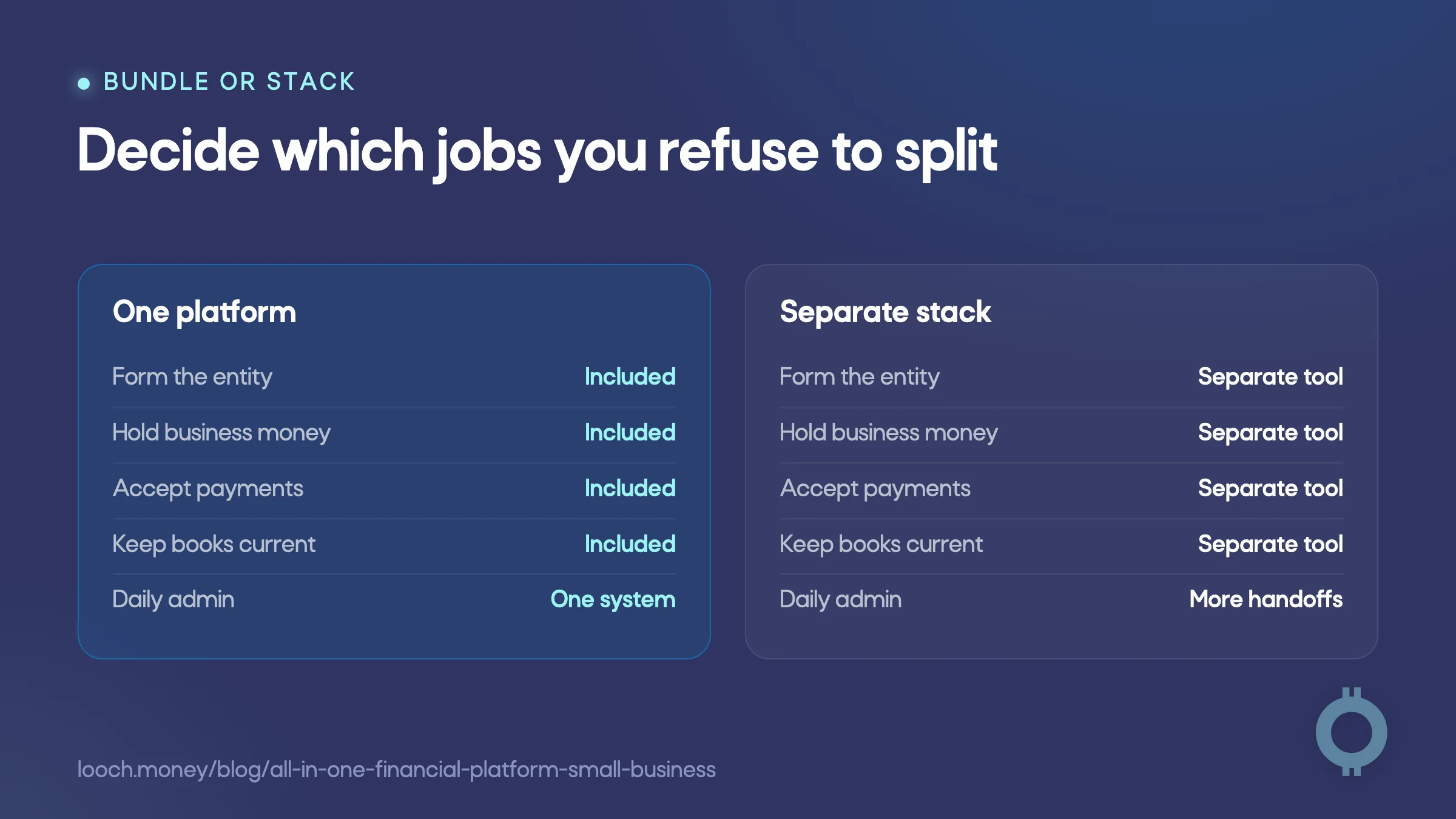
No platform covers every job, so decide which ones you refuse to split
A new business needs an entity, a place to hold money, cards, a way to accept customer payments, and books that stay current. “All-in-one” often covers only part of that stack.
- Novo, Bluevine Standard, Found, and Relay Starter each publish a $0/month account. Lili starts at $0, but puts its accounting behind $35/month.
- Card acceptance clusters around 2.9% for Novo, Found, and Relay. Bluevine also lists 2.9% online, while looch lists 3.3%.
- Found and looch keep bookkeeping in the app. The others connect to QuickBooks or Xero.
- QuickBooks Online lists Simple Start at $38/month. Essentials, Plus, and Advanced increased for later renewals.
- Formation is the gap almost every platform leaves open. Rho forms a Delaware C corporation, with LLC formation coming soon. looch is the only platform here that forms an LLC, and the only one that forms the entity and then keeps the books in the same app.
The useful question is not which platform is “best.” It’s which jobs you refuse to run in separate tools. Every product here is complete on some axes and empty on others, so this page maps them against the same set of jobs using figures from each provider’s own pricing page.
What each platform actually covers
The asterisks that matter more than the table
Novo publishes “No monthly fees. No minimums. No transaction limits,” with unlimited free invoicing. Its payment acceptance runs through other providers’ rails, letting customers pay by credit card, debit card, Apple Pay, Google Pay, or Venmo through Novo’s Square or PayPal connections. Novo says it adds no markup to the pass-through rate. Its books sync with business tools including QuickBooks, Shopify, Square, and Xero. Source: Novo.
Bluevine has the strongest native acceptance offering in this group. Customers can pay by card or digital wallet directly into a Bluevine Business Checking account, including through Tap to Pay on a phone. Published rates are 2.9% online, 2.7% in person, 3.4% for a card on file, and 1% for bank payments. Bluevine Plus costs $30/month, and its waiver requires both an average daily balance of at least $20,000 across checking and sub-accounts and at least $2,000 in card spend during the billing period. A new business will generally meet neither condition. Source: Bluevine.
Found offers the most substantial bookkeeping on a free tier: Expense categorization, profit and loss reporting, tax estimates, generated Schedule C and corporate tax forms, and unlimited free invoicing. Payment acceptance costs 2.9%, and its cards are debit only. Source: Found pricing.
Lili has the sharpest all-in-one limitation in this group. Its invoicing page says that accounting, tax preparation, and invoicing software are available only to Lili Smart and Lili Premium account holders, with applicable monthly account fees. A business on the $0 or $15/month tier doesn’t get that all-in-one layer. Source: Lili.
Relay stands out for team controls. It offers unlimited users and debit and credit cards on every plan, including the free plan. Its acceptance is online only, with no in-person or tap to pay option. Card acceptance is 2.9%, while pay by bank costs 1%, 0.75%, or 0.50% depending on the tier, capped at $10. Passing card fees to customers is available on paid tiers. Our looch vs Relay comparison goes deeper. Source: Relay pricing.
QuickBooks is the accounting incumbent that added a business account, rather than the reverse. QuickBooks Checking is free to open, with no monthly fees or minimum balances, and QuickBooks Payments charges 2.99% on invoiced card payments and 1% for bank payments. The accounting product is the deepest in this group. Our looch vs QuickBooks comparison covers the trade. Source: QuickBooks pricing.
Mercury starts with business accounts, debit cards, IO credit cards, invoicing, and accounting automations. It doesn’t form the company, and its eligibility requirements say the company must already be formed and registered in the United States or a US territory. Our looch vs Mercury comparison covers the choice in more detail. Source: Mercury.
Rho comes closest to looch on formation because it can form a Delaware C corporation, prepare the EIN application, and include registered agent service for the first year. It doesn’t form an LLC yet, and its accounting product automates data into a ledger rather than keeping the ledger itself. Source: Rho.
Airwallex combines an account, multi-currency corporate cards, bill pay, and native online payment acceptance. Its accounting hub is coming soon, and it doesn’t form companies. Source: Airwallex.
Quicken Business & Personal is software rather than a financial account. It connects existing accounts, handles business and personal finances together, and supports up to 10 businesses on one subscription, but it doesn’t issue cards, hold money, process payments itself, or form a company. Source: Quicken Business & Personal.
looch is the only platform in the table that forms a Delaware, Wyoming, or Florida LLC or a Delaware corporation and continues into a profile with accounts, Smartcards, payments, and accounting in the same app. looch Start costs $249 all-in, including the state filing fee, EIN, and first year of registered agent service. From there, any US-registered LLC or corporation with an EIN and a qualifying US street address can open a looch profile with no-fee financial accounts carrying account and routing numbers, Smartcards, payment acceptance, and real-time accounting, where every charge is tagged and categorized when it posts. A registered agent, virtual office, PO box, or commercial mail receiving agency (CMRA) address doesn’t qualify. looch can also migrate books from QuickBooks or Xero and keeps CPA-quality books.
looch also has clear trade-offs. Card acceptance is 3.3% online and 3% in person, above the 2.9% cluster, so a card-heavy business paying by card alone will pay more per transaction at looch than at Novo, Found, or Relay. Instant pay by bank costs 1%, capped at $10, which can change the math on larger payments. Payroll is published as coming soon and is not live. looch is not a bank. Simplicity Fintech Inc is a financial technology company. Account services are provided in partnership with Stripe; funds are held at Fifth Third Bank N.A., Member FDIC. Eligible accounts can receive FDIC pass-through insurance up to $250,000¹ when requirements are met. Smartcards are Visa Commercial Cards issued by Celtic Bank. Smartcards spend from any account in a looch profile. Source: looch pricing.
When a stack beats a bundle
A bundle reduces setup work and keeps the ledger in one place. But a stack can be the better operating choice when you need more depth in a specific part of the business.
| Stack piece | Typical choice | Published cost |
|---|---|---|
| Formation | LegalZoom or ZenBusiness at $0 plus state fees, or a Delaware incorporation service at $500 | $0 to $500 once |
| Bank account | Novo, Found or Relay Starter | $0/month |
| Accepting payments | A standard processor | 2.9% + 30¢, no monthly fee |
| Bookkeeping | QuickBooks Simple Start | $38/month |
That’s roughly a $38/month fixed floor, everything else variable. Choose the stack when:
- You need the strongest tool for a specific job. Deep inventory or multi-entity accounting can justify a dedicated ledger, while a dedicated processor may offer rates and features a bundled acceptance product does not match at volume.
- Your accountant already works in QuickBooks or Xero. Moving their workflow is rarely worth a small saving, especially when the other tools can sync to the ledger they already use.
- You want to replace one tool without moving your funds. With separate vendors, you can change a processor without changing your business account.
- Most of your volume is on cards. At sufficient scale, negotiated processing can beat published rates, including looch’s.
When an all-in-one platform is the wrong choice
You already have an account somewhere else
looch’s advantage is the sequence that starts with formation. A business already banked at Mercury or Relay, with books synced to QuickBooks or Xero, gains an in-app ledger and Smartcards by moving but also takes on the work of moving money and cards. Mercury requires a US-formed company before it opens an account, while looch can migrate books from QuickBooks or Xero. Source: Mercury eligibility requirements.
You need a credit line
looch publishes no credit line. Smartcards spend from accounts in a looch profile. Bluevine publishes a line of credit up to $250,000 for businesses with 12+ months in business and $10,000 in monthly revenue, requirements a new business usually can’t meet yet. Mercury publishes IO credit cards, Relay publishes credit cards on every plan with 1% cash back on Starter, and Novo publishes a business credit card.
Your accountant works in QuickBooks or Xero
QuickBooks Simple Start costs $38/month, and Novo, Bluevine, Relay, and Mercury sync to QuickBooks. looch keeps its own ledger, files 1099s at $2 per filing, and migrates books from QuickBooks or Xero. If your accountant won’t leave QuickBooks, keeping the ledger separate and syncing the account to it can be the better fit.
Frequently asked questions
Best all-in-one financial platform for a new small business in 2026?
looch is the best fit when the company hasn’t been formed yet because looch Start costs $249 all-in and continues into a looch profile with $0/month financial accounts, Smartcards, payments, and accounting. Relay or Mercury can be the better fit when the company is already formed and banked. Rho fits a founder who specifically wants a Delaware C corporation.
What does an all-in-one financial platform for a small business include?
A true all-in-one platform includes formation, an account with account and routing numbers, cards, customer payment acceptance, bookkeeping, and 1099 filing. looch covers that full sequence, while Found and QuickBooks keep bookkeeping in-app, Mercury and Relay pair accounts with accounting integrations, and Rho combines Delaware C corporation formation with accounts and automation into a separate ledger.
Which business accounts have bookkeeping built in?
Found includes bookkeeping on its free tier, while Lili limits accounting to Smart at $35/month and Premium at $55/month. QuickBooks Checking sits beside QuickBooks Online, and looch keeps real-time accounting in the same app as its accounts and Smartcards. Novo, Bluevine, Relay, and Mercury sync to outside accounting software instead.
Should a new business use one platform or separate tools?
Use one platform when keeping formation, money, cards, payments, and books together matters more than choosing the deepest tool for each job. Use separate tools when your accountant requires a particular ledger, you need a credit product looch doesn’t offer, or you want to replace one part of the stack without moving everything else. The stack above has a fixed floor of roughly $38/month, with everything else variable, and company formation and banking in one app explains the bundled route.
Choose the bundle when daily administration is the real cost. If matching a bank feed, processor activity, and a separate ledger is taking over your week, one categorized system can be worth more than a lower fixed floor. The same is true if you haven’t incorporated yet and want the entity, accounts, and books set up together. If your question is whether you need help with the books, read do you really need a bookkeeper. If you’re comparing apps that handle formation and banking together, see company formation and banking in one app.
Sources
- looch Start
- looch pricing
- looch Pay
- looch Smartcards
- Novo business checking
- Bluevine payment acceptance
- Bluevine line of credit
- Found pricing
- Lili invoicing
- Relay pricing
- QuickBooks pricing
- Mercury pricing
- Mercury invoicing
- Mercury eligibility requirements
- Rho incorporation
- Airwallex pricing
- Quicken Business & Personal


