


Apps that form your company and give you banking
Amounts last verified on September 21st 2026
Michel Myara is co-founder and product designer at looch, where he designs the ecosystem small businesses use to get paid and manage spend while keeping penny-perfect books.
The real question is who handles the account after formation

Apps that form your company and give you banking are rarer than the category makes them sound. Most providers form the entity, then send you to a separate account provider that makes its own decision about whether to approve you.
That model isn’t inherently bad. A referral can give you more account options, and some founders want that choice. But it’s different from forming the company and continuing into accounts in the same app. Among the providers reviewed here, Stripe Atlas and looch take that latter path. doola and Clemta point founders to Mercury. Firstbase offers a marketplace of account partners. Mercury handles the account side well, but it doesn’t form companies.
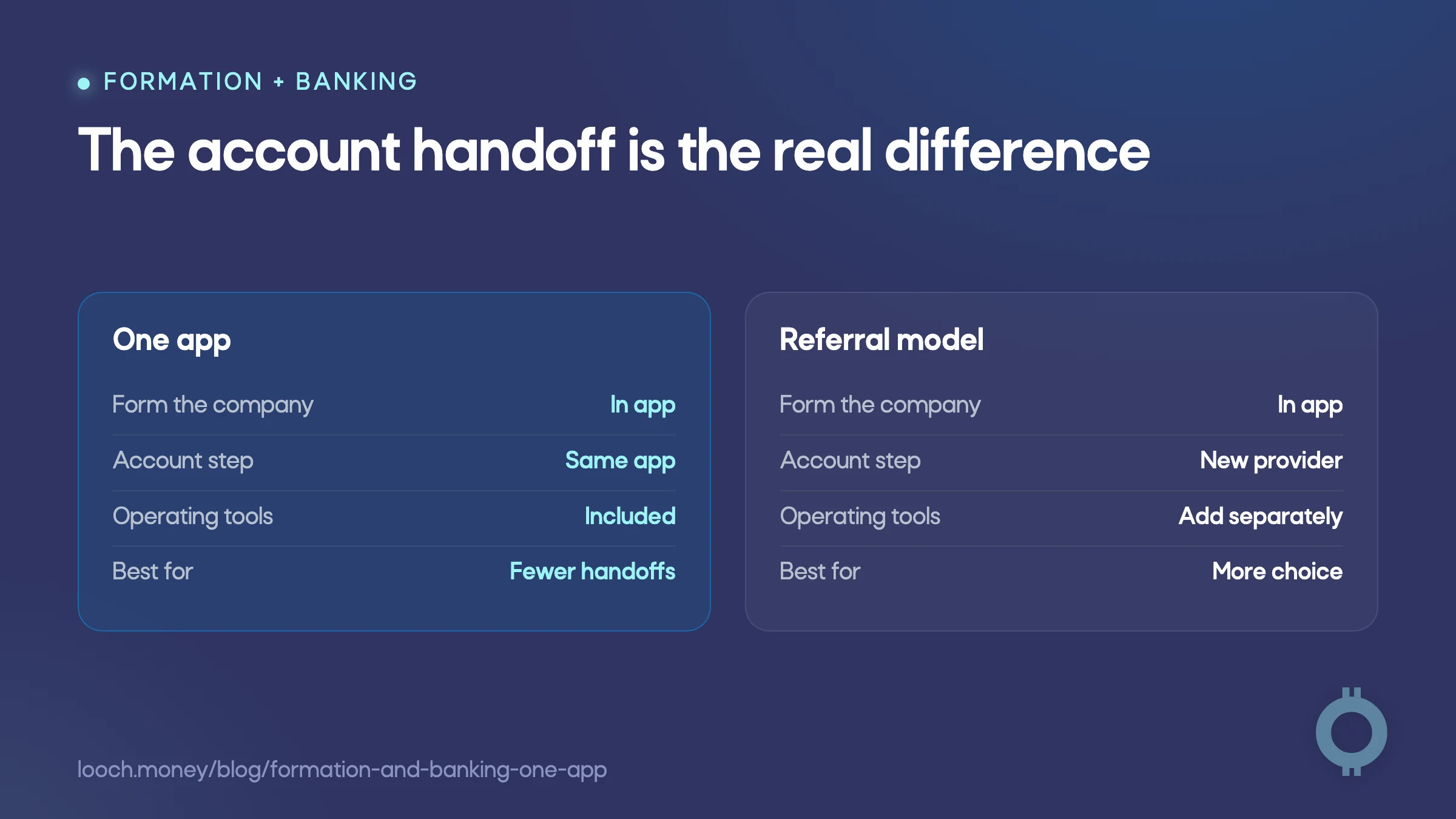
Two products form your company and hold your money: Stripe Atlas and looch
Stripe Atlas and looch are the two providers in this group that form the company and provide an account route in the same product experience. Stripe Atlas costs $500 one time, including state filing fees and the first year of registered agent service.
Last verified: August 19th, 2026.
The distinction matters most when you are starting from zero. A formation certificate doesn’t itself give a business somewhere to receive money, pay bills, issue cards, or keep books. If the account step sits with another provider, there’s another application and another approval decision between formation and operating.
The figures that matter:
- Stripe Atlas: $500 one time, including state filing fees and the first year of registered agent, then $100/year
- doola: $297/year for the Starter formation plan, plus state fees
- Clemta: From $349 billed annually, plus state fee
- Firstbase: Formation itself is free on its current offer, “Pay only your state fee”
- looch Start: $249 all-in, including the state filing fee
This guide separates the marketing bundle from the account path. It also names where the referral model is the better fit.
The account path differs even when the formation pitch sounds similar
| Provider | Forms the company | Provides the account itself | Published price | Where the money actually sits |
|---|---|---|---|---|
| doola | Yes | No, integrates with Mercury | From $297/year plus state fees | Mercury’s partner banks |
| Clemta | Yes | No, provides application support | From $349/year plus state fee | Named partner is Mercury |
| Firstbase | Yes | No, a banking marketplace | Formation free on its current offer, plus your state fee | Whichever partner accepts you |
| Stripe Atlas | Yes, Delaware only | Yes, Stripe Treasury, plus partner options | $500 once, then $100/year | Stripe Treasury, or Mercury, Brex, Rho, Novo |
| Mercury | No | Yes | No monthly fee published for the account | Choice Financial Group and Column N.A. |
| looch | Yes | Yes, in the same app | $249 all-in | Fifth Third Bank N.A. via Stripe |
Mercury is the common endpoint in this set. It is the named banking partner for doola and Clemta, and it is one option available through Stripe Atlas. Several formation experiences can therefore end with the same account application.
None of the companies in the table is a bank. Stripe states that Stripe, Brex, Mercury, Rho, and Novo are fintech companies, while banking services are provided through bank partners. looch is structured the same way: Simplicity Fintech Inc is a financial technology company, not a bank. What matters is whether the provider clearly identifies the account path and whether that path works for your company.
Stripe Atlas combines Delaware formation with Stripe Treasury
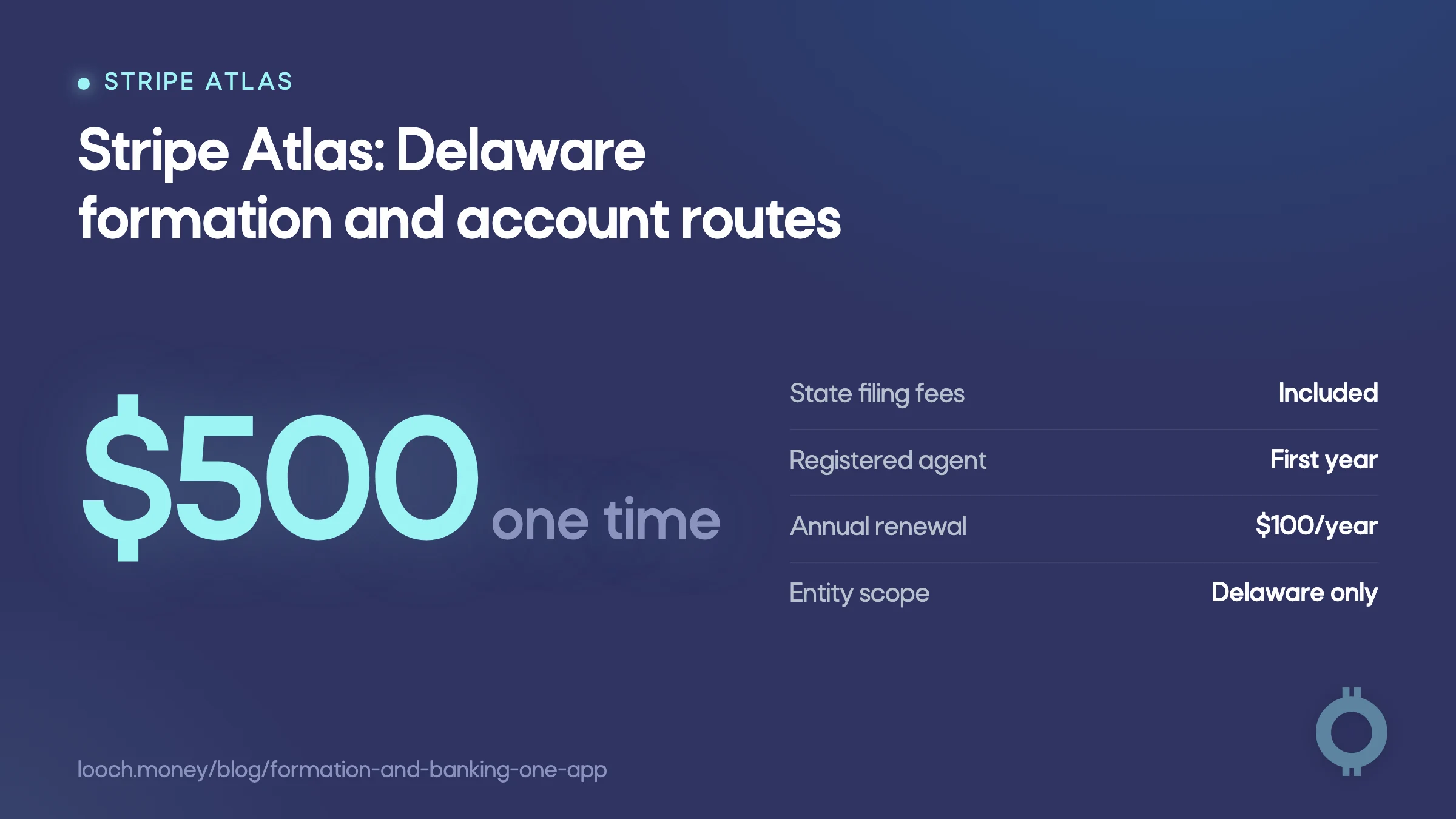
Stripe Atlas is the clearest fit for founders who specifically want a Delaware entity and want to begin inside Stripe’s ecosystem. Its published price is $500 one time. Stripe says that covers incorporation, state fees, and the first year of registered agent service. It then charges annually to maintain registered agent service.
Atlas forms Delaware C corporations, LLCs, and C corporation subsidiaries. It also handles the EIN process and lets founders begin using Stripe’s financial products before the EIN arrives. For a founder planning to accept payments through Stripe, that continuity can be useful.
The important detail is that Atlas offers both a direct account route and partner routes. Stripe Treasury is available through the Stripe Dashboard, while Atlas also directs founders to Mercury, Brex, Rho, and Novo. Those partners determine eligibility, so choosing Atlas doesn’t eliminate a separate approval decision if you choose a partner account.
Atlas also publishes meaningful partner constraints. Brex is available to C-corps only. Brex and Rho require a beneficial owner to submit a US physical address. Novo requires an EIN, a US Social Security Number, and a US physical address from a beneficial owner. Mercury is more flexible on address requirements for many international founders.
| Atlas account route | What it means for the founder |
|---|---|
| Stripe Treasury | The account experience stays in the Stripe Dashboard |
| Mercury, Brex, Rho, or Novo | A partner determines eligibility and account availability |
| Delaware formation | Atlas isn’t a formation option for founders who need another state |
Sources: Stripe Atlas and Atlas business bank accounts.
doola bundles formation support and refers banking to Mercury
doola sells formation through annual plans rather than a one-time formation package. Its Starter tier is $297/yr plus state fees. Formation is also included with Tax and Compliance at $1,999/yr and Business-in-a-Box at $2,999/yr.
Those plans include formation filings, an EIN, registered agent service, and a virtual business address. doola says state fees vary by state and are paid through doola. Its $300/yr Pulse plan is different: It’s a bookkeeping product, not a formation plan, and doesn’t include formation filing, an EIN, registered agent service, or an address.
For banking, doola is direct about the structure. Its banking page describes an integration with Mercury and an account manager. The account is therefore not provided by doola itself. doola sends the founder to Mercury, and Mercury’s partner banks hold the deposits.
That can still be a solid path for a founder who wants doola’s compliance package and independently prefers Mercury. It’s less attractive for someone whose priority is avoiding a second provider after incorporation.
Clemta sells application support, not the account itself
Clemta also uses a subscription model. Essentials is $29/month billed annually at $349, plus the state fee. Pro is $1,068/year and Premium is $2,879/year. Formation, an EIN, and registered agent service are included across its plans, which auto-renew.
The wording on the banking product matters. Clemta offers dedicated bank account application support and identifies Mercury as its partner. Support can help a founder navigate an application, but it is not the same as providing the account in Clemta’s own product.
Clemta is particularly explicit about the EIN path for founders without an SSN. Its guidance says those founders cannot use the online IRS portal and must submit Form SS-4 by fax or mail. Clemta prepares and submits the filing, and its expedited service quotes “2-4 weeks.”
Sources: Clemta pricing and Clemta EIN application.
Firstbase offers account choice through a marketplace
Firstbase forms companies and sends founders to a marketplace of banking partners. Its current offer says formation is on Firstbase and the founder pays only the state fee. Ongoing services are sold through subscriptions, so the renewal terms deserve a close read before purchase.
The marketplace approach has a real advantage: It can give a founder more choice of account provider than a single-app product. That matters if you already know which account relationship you want or need a particular provider’s capabilities.
The tradeoff is the same one that applies to every referral model. Formation and accounts are separate services, and the account provider decides whether it can accept the business.
Mercury is the account provider, not the formation service
Mercury doesn’t form companies. Its guidance tells founders they can form a business independently, and it requires customers to be formed and registered in the United States or a US territory before an account can be opened.
That isn’t a weakness if you are already incorporated. Mercury is often the right comparison set for a company that has completed formation and now needs an account provider. It also supports US companies with founders from around the world, subject to its eligibility criteria and prohibited-country list.
Read the published requirements before applying: Mercury eligibility. For a fuller product comparison, see our looch vs Mercury comparison.
looch carries formation into accounts in the same app
looch Start forms a company for $249 all-in. That includes the state filing fee, the EIN, and the first year of registered agent and virtual office. The filing goes to the state within 1 business day. After the first year, renewal is $249/year for the business protection bundle: Registered agent service, the virtual office (a business address that keeps the owner’s address off public records, with mail scanning), the state annual report filing, and weekly trademark monitoring.
Entity options are a Delaware C corporation, Delaware LLC, Wyoming LLC, or Florida LLC. If you are still choosing between the LLC routes, read our guide to Delaware LLC vs Wyoming LLC.
Once the entity is active and the EIN is confirmed, the same app continues into no-fee business accounts with account and routing numbers, Smartcards, payment acceptance, and real-time accounting. That is the core difference between looch and a formation service that hands the account step to a referral partner. The operating tools are already part of the product you used to form the company.
The tradeoffs should be plain. looch is not a bank. Simplicity Fintech Inc provides the technology, with account services provided in partnership with Stripe and funds held at Fifth Third Bank N.A., Member FDIC. Accounts are eligible for FDIC pass-through insurance up to $250,000¹ per depositor when pass-through requirements are met. Smartcards are Visa Commercial Cards issued by Celtic Bank.
For the full account, card, payment, and renewal details, see looch pricing.
Your best option depends on where the handoff helps or hurts
| If this describes you | The stronger fit | Why |
|---|---|---|
| You want formation and operating tools in one app | looch | Formation continues into accounts, Smartcards, payments, and accounting |
| You need a Delaware-focused startup formation product | Stripe Atlas | Atlas is designed around Delaware entities and Stripe’s ecosystem |
| You are already incorporated | Mercury or another account provider | You can skip formation and evaluate accounts directly |
| You want a choice of account counterparties | Firstbase or Atlas partner options | A marketplace or partner list provides more account paths |
| You want formation support with Mercury as the intended account destination | doola or Clemta | Both package formation support while referring the account application to Mercury |
If you want the fewest moving parts, looch is built for that path. The entity, EIN, accounts, Smartcards, payments, and books sit in one designed system rather than across formation and account providers.
If you’re raising venture money through a Delaware company, Stripe Atlas is a credible fit. Its Delaware focus and Stripe connection may matter more than avoiding a partner decision.
If you are already incorporated, skip the formation bundle and compare account providers directly. Our guide to opening a US business account without an SSN covers the eligibility question underneath that choice.
The bottom line is simple: A formation service with a banking referral can be useful, but it isn’t the same as company formation and banking in one place. Ask who forms the entity, who decides on the account, and where the money sits. Those answers tell you what the bundle actually buys.


