


Estimated tax payments 2026: A self-employed guide
Amounts last verified on September 25th 2026
Michel Myara is co-founder and product designer at looch, where he designs the ecosystem small businesses use to get paid and manage spend while keeping penny-perfect books.
Who needs to make estimated tax payments in 2026?
You generally need estimated tax payments for 2026 if you expect to owe at least $1,000 in federal tax for 2026 after subtracting withholding and refundable credits, and your withholding won’t cover the applicable safe harbor. The four due dates are April 15th, 2026, June 15th, 2026, September 15th, 2026, and January 15th, 2027. This page and calculator cover federal tax only. States have their own estimated tax rules, and state tax isn’t included here.
Use the calculator above to estimate your projected federal income tax, self-employment tax, qualified business income deduction, and quarterly payment. It uses published 2026 rules and is designed for freelancers, contractors, and business owners who receive income without withholding.
The result is a planning number, not a universal percentage of revenue. Your profit, filing status, other income, withholding, refundable credits, and prior-year tax can all change what you need to pay. Business profit matters more than gross revenue because deductible business expenses reduce the net earnings used in the calculation.
A single-member LLC owner whose business income reaches their personal tax return generally faces the same estimated-payment question as a sole proprietor. Forming an LLC doesn’t make tax payments disappear. An owner considering a different tax treatment can also read our guide to choosing between an S corporation and an LLC.
Sources: IRS Form 1040-ES
When are estimated taxes due in 2026?

Quarterly estimated tax is paid on four dates, but the periods between those dates aren’t equal calendar quarters. Follow the IRS schedule rather than assuming a payment is due every three months.
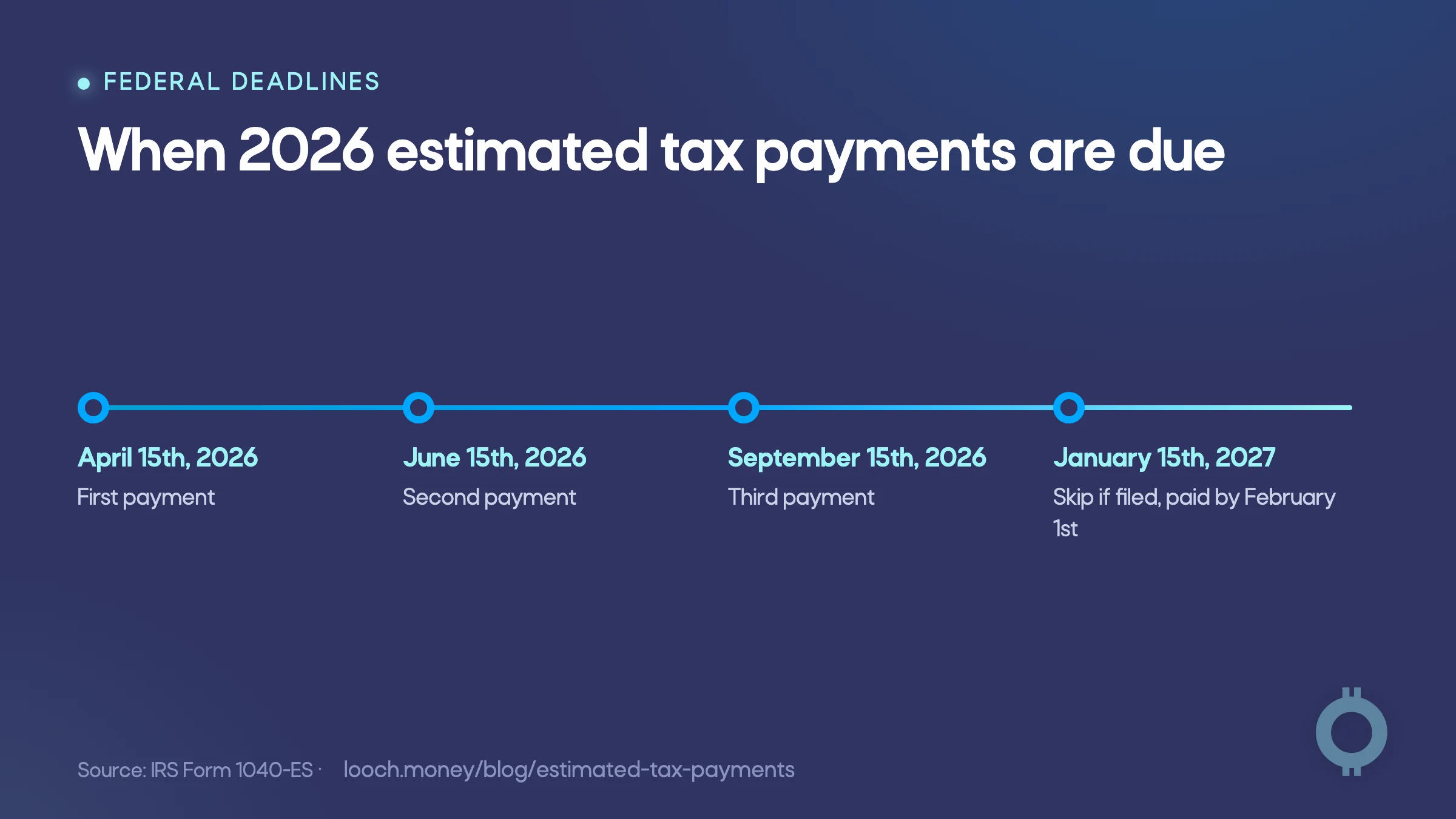
The 2026 federal due dates are:
- April 15th, 2026: First payment.
- June 15th, 2026: Second payment.
- September 15th, 2026: Third payment.
- January 15th, 2027: Fourth payment.
You can pay the full estimated amount by April 15th, 2026 or pay it in four equal amounts. You don’t have to make the January 15th, 2027 payment if you file your 2026 return by February 1st, 2027 and pay the entire balance due with it.
If your income arrives unevenly, equal payments may not reflect when you earned it. Form 1040-ES explains the annualized income installment method for people whose income varies during the year. That can matter for a freelancer with a quiet start and a much stronger finish.
The calculator spreads what’s still owed over the due dates that remain. If you run it late in the year, that can produce one large remaining payment. It doesn’t mean an earlier shortfall vanished. A payment that was due earlier and wasn’t made in full can still carry an underpayment penalty.
Sources: IRS Form 1040-ES
How much should you pay each quarter?
Start with projected total federal tax for 2026, then compare the current-year and prior-year safe harbors. The goal is to pay enough through withholding and on-time estimated payments to satisfy the smaller applicable target.
You generally avoid the underpayment penalty if what you pay through withholding and on-time estimated payments is at least the smaller of:
- 90% of the tax on your 2026 return.
- 100% of the tax on your 2025 return.
If your 2025 adjusted gross income was more than $150,000, or $75,000 if married filing separately, 110% replaces 100% for the prior-year safe harbor.
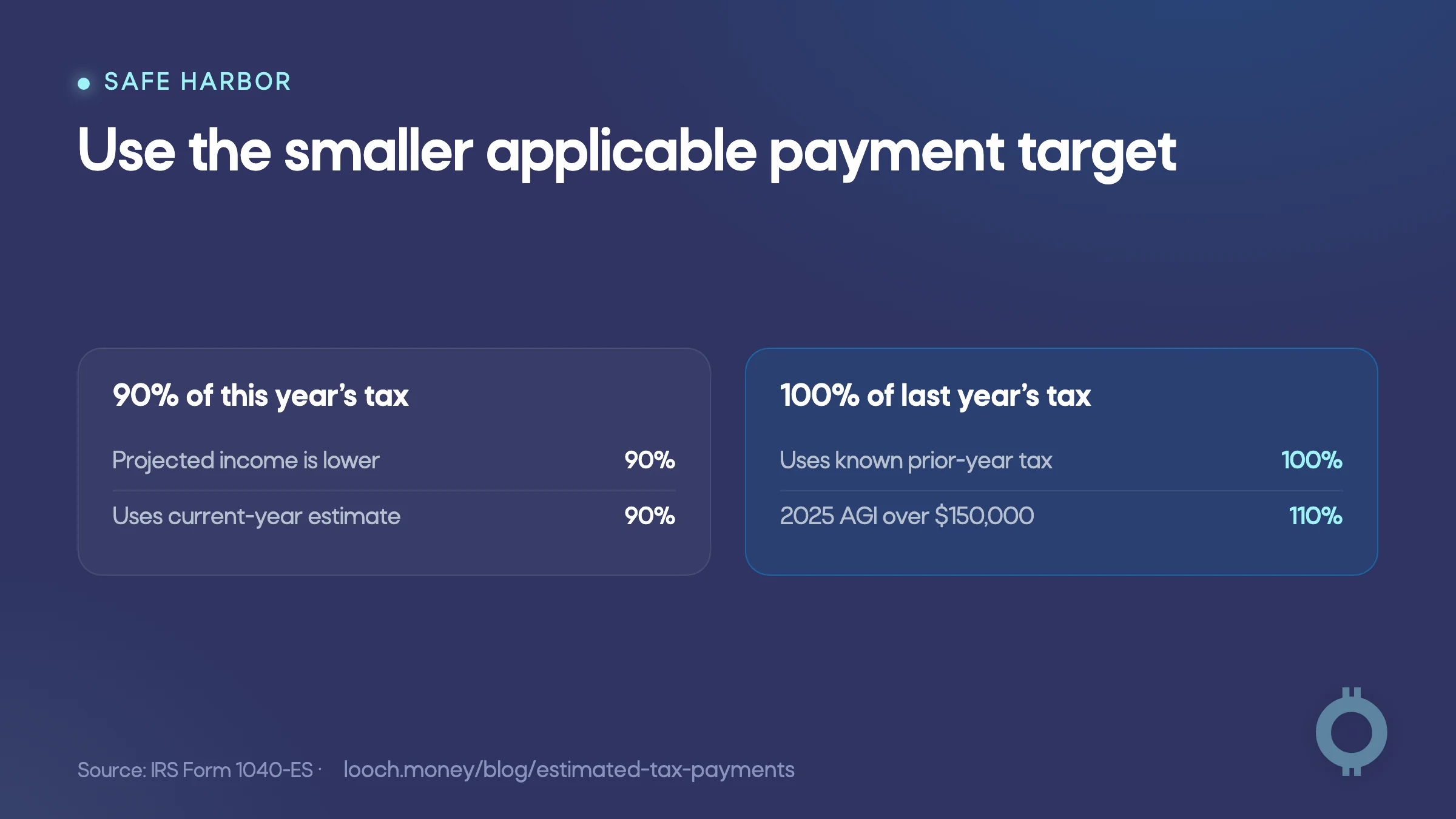
The current-year route can help when income falls and your projected 2026 tax is lower. The prior-year route can be easier to plan around because your 2025 total tax is already known. It can also require less than the current-year route when this year’s income rises sharply.
Safe harbor doesn’t necessarily pay your final bill in full. It generally protects against the underpayment penalty. If your actual 2026 tax is higher than the safe-harbor amount, the remaining balance is still due with your return.
Sources: IRS Form 1040-ES
A $90,000 profit example
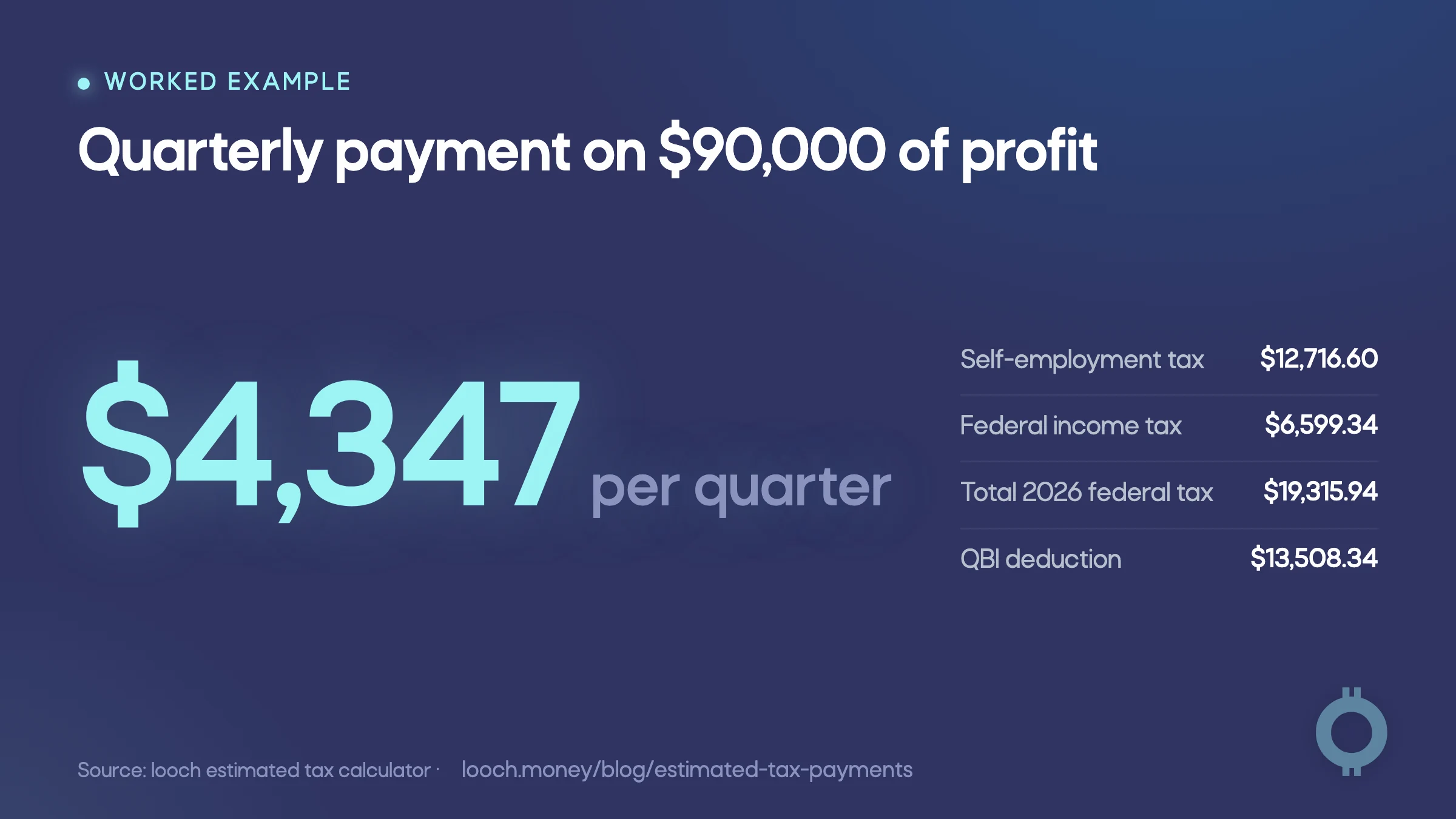
Here’s looch’s own worked example from the calculator above. It assumes a single filer with $90,000 of profit, no other income, and 2026 federal rules.
The projected self-employment tax is $12,716.60. Projected federal income tax is $6,599.34, producing total projected 2026 federal tax of $19,315.94. The qualified business income deduction is $13,508.34.
Paying 90% of the projected tax over four payments means rounding each quarterly amount up to $4,347.
Now change one fact: Last year’s total tax was $15,000. The prior-year safe harbor asks for $15,000 this year, so the quarterly estimated tax payment becomes $3,750. That’s lower than the current-year safe-harbor result in this example.
This is why a useful estimated tax calculator needs both this year’s projection and last year’s total tax. Looking only at current profit can miss the easier safe-harbor route. Looking only at last year can leave a larger balance due when this year is stronger.
What goes into an estimated tax calculation?
Estimated tax isn’t one flat tax. For a self-employed person, the result can combine self-employment tax, federal income tax, and Additional Medicare Tax. Deductions, including the deduction for half of self-employment tax and the qualified business income deduction, can reduce the income-tax portion.
Self-employment tax
Self-employment tax is 15.3%, made up of 12.4% Social Security tax and 2.9% Medicare tax. It applies to 92.35% of net self-employment earnings.
The Social Security portion applies only up to $184,500 of combined wages and self-employment earnings in 2026. No self-employment tax is due if net earnings are under $400. You deduct half of your self-employment tax when figuring federal income tax, but that deduction doesn’t reduce the self-employment tax itself.
Additional Medicare Tax is 0.9% on earnings over $200,000, or $250,000 for married couples filing jointly.
Sources: IRS Form 1040-ES, SSA
Federal income tax and the standard deduction
Federal income tax applies after the relevant adjustments and deductions. For 2026, the standard deduction is $16,100 for a single filer, $32,200 for married filing jointly, and $24,150 for a head of household.
The calculator above uses your filing status when estimating this part of the result. It doesn’t include state income tax, local tax, or state estimated-payment requirements.
Sources: IRS Revenue Procedure 2025-32
Qualified business income deduction
The qualified business income deduction can be up to 20% of qualified business income. It reduces taxable income used for federal income tax, not the earnings used to calculate self-employment tax.
New for 2026, taxpayers with at least $1,000 of qualified business income from an active trade or business may receive a minimum deduction of $400. Limits start above taxable income of $201,750, or $403,500 for married couples filing jointly.
Sources: IRS Revenue Procedure 2025-32
How projected federal tax changes with profit
There isn’t one set-aside percentage that works for every freelancer. These are looch’s own worked examples from the calculator above for a single filer with no other income under 2026 federal rules:
- $40,000 of profit: $7,426.93 of projected federal tax, or 18.6% of profit.
- $60,000 of profit: $12,037.20 of projected federal tax, or 20.1% of profit.
- $90,000 of profit: $19,315.94 of projected federal tax, or 21.5% of profit.
- $150,000 of profit: $37,607.63 of projected federal tax, or 25.1% of profit.
- $250,000 of profit: $66,360.02 of projected federal tax, or 26.5% of profit.
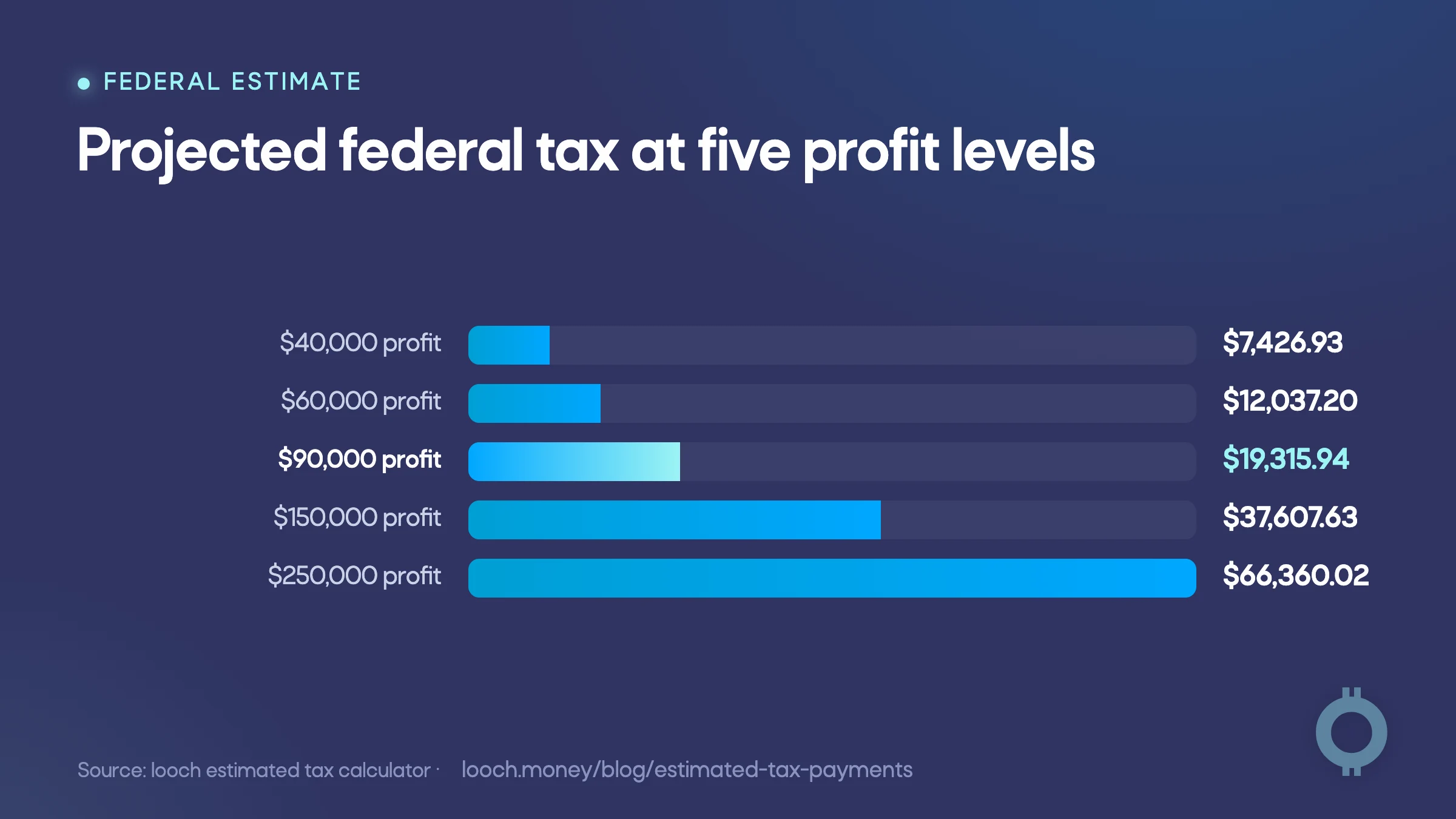
The rising percentages show why a flat rule of thumb can drift away from the actual projection. Higher profit can move more income into higher federal income-tax brackets, while the Social Security portion of self-employment tax stops applying after the 2026 wage base is reached.
These totals are projected federal tax, not the quarterly payment itself. Apply the relevant safe harbor, subtract withholding and payments already made, then spread what remains over the available due dates.
What happens if an estimated payment is late?
If an estimated payment is late or too small, the IRS may charge an underpayment penalty. The calculation depends on how much was underpaid and how long the underpayment remained outstanding.
Paying more later can reduce what remains unpaid, but it doesn’t automatically make an earlier missed due date timely. That’s why the calculator can show one large remaining payment late in the year while an earlier shortfall may still carry a penalty.
Don’t wait for the next scheduled date to address a known shortfall. Update the estimate when profit, other income, withholding, or credits change, then make the payment that fits the revised projection.
Sources: IRS Form 1040-ES
How do you pay quarterly estimated tax?
Form 1040-ES lists several ways to make federal estimated tax payments electronically:
- IRS Online Account: Sign in and make a payment from your account.
- IRS Direct Pay: Pay directly from a bank account.
- EFTPS: Use the Electronic Federal Tax Payment System after enrolling.
Choose the correct tax year and payment type when submitting the payment. Keep the confirmation with your tax records so you can match each payment to your return.
If you also receive wages, withholding can count toward the safe harbor alongside estimated payments. Our paycheck calculator guide explains the deductions that can appear when income is paid through payroll.
Sources: IRS Form 1040-ES
Keep tax money separate from operating cash
A good estimate only helps if the money is still available when the due date arrives. looch includes Tax Stash as a separate account for money set aside for taxes, alongside Primary Business, so tax money doesn’t mix with operating cash.
See the account suite and current details on looch pricing.
This calculator gives an estimate from published 2026 rules, and a tax professional can confirm how the rules apply to your specific situation.
Estimated tax payments FAQ
When are estimated taxes due in 2026?
The federal due dates are April 15th, 2026, June 15th, 2026, September 15th, 2026, and January 15th, 2027. The final payment can be skipped if you file your 2026 return by February 1st, 2027 and pay the entire balance due with it.
Do single-member LLC owners pay quarterly estimated tax?
They may need to if business income reaches their personal return without enough withholding. The general threshold is that you expect to owe at least $1,000 in tax for 2026 after subtracting withholding and refundable credits, together with the applicable safe-harbor test.
What’s the safe harbor for estimated tax payments?
You generally avoid the underpayment penalty by paying at least the smaller of 90% of your 2026 tax or 100% of your 2025 tax through withholding and on-time estimated payments. The prior-year percentage becomes 110% if 2025 adjusted gross income was more than $150,000, or $75,000 if married filing separately.
Does this estimated tax calculator include state tax?
No. The calculator above estimates federal tax only. States have their own estimated tax rules, payment methods, and due-date requirements.
Is Form 1040-ES a payment form or a calculator?
Form 1040-ES includes the IRS worksheet and instructions for figuring and paying estimated federal tax. You can then pay through your IRS Online Account, IRS Direct Pay, or EFTPS.


