


Paycheck calculator for every state
Amounts last verified on September 25th 2026
Michel Myara is co-founder and product designer at looch, where he designs the ecosystem small businesses use to get paid and manage spend while keeping penny-perfect books.
How much will I take home from my paycheck?
This paycheck calculator estimates your take-home pay after federal, state, and local paycheck taxes, state payroll programs, and pre-tax deductions. Enter your salary, pay frequency, filing details, location, and deductions to estimate the net pay that reaches you.
Start with the gross pay shown at the top of the result. Gross pay is your salary before anything comes out. Net pay is what remains after withholding and deductions.
The result separates each item so you can see why it’s there. That matters when you’re comparing job offers, checking a raise, planning a move, or reviewing a first paycheck. For an owner making a first hire, it also gives a practical view of what an employee may receive rather than only what the role costs in salary.
Run a $75,000 salary through the calculator above as a single filer paid biweekly across 26 paychecks, with no pre-tax deductions. Gross pay is $2,884.62 per paycheck, but take-home pay changes by location: Texas is $2,368.94, Florida is $2,368.94, Washington is $2,328.93, Illinois is $2,231.72, New York outside New York City is $2,221.23, California is $2,207.54, and New York City is $2,118.90.
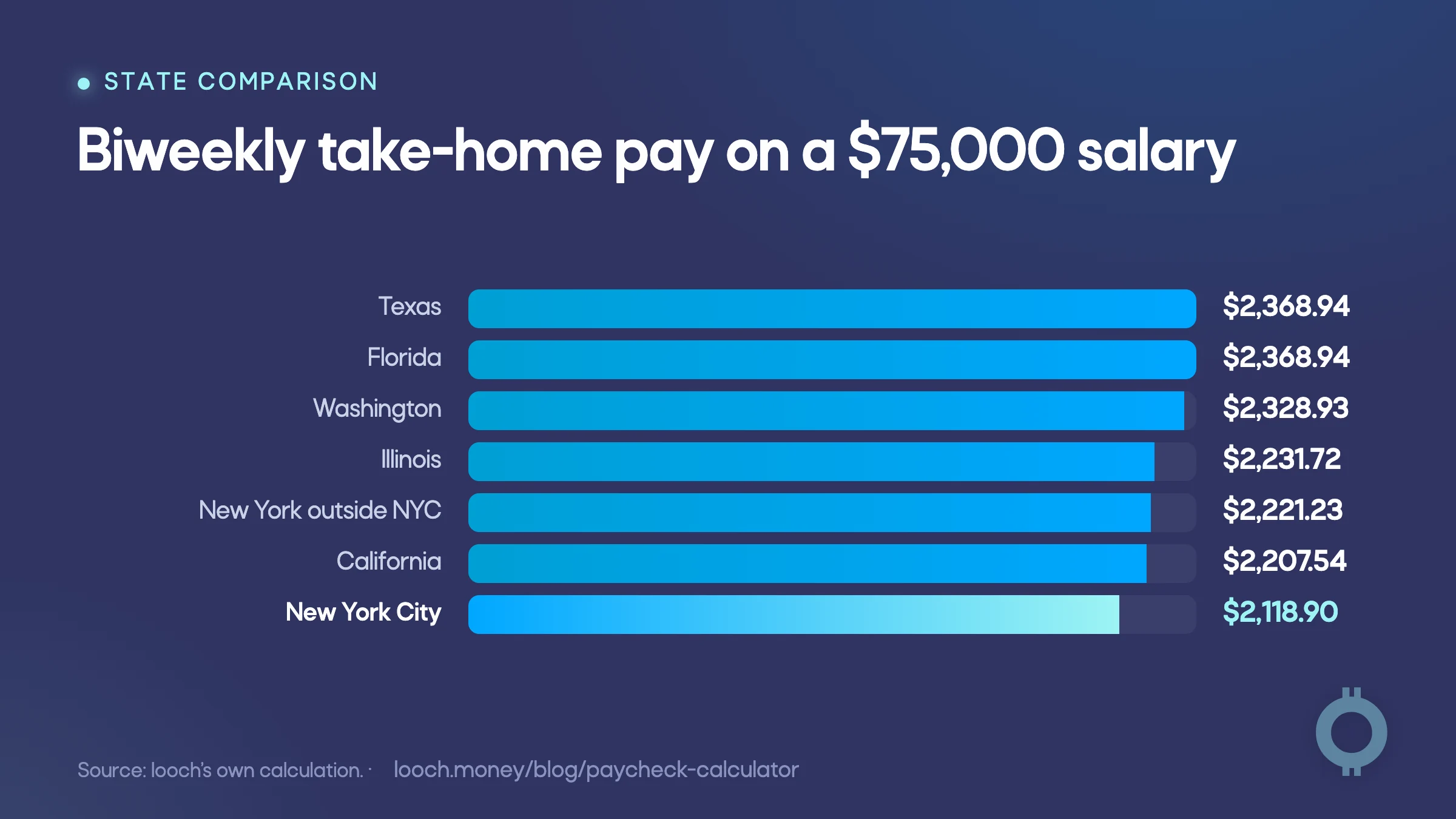
These are looch’s own worked examples, calculated with the inputs above. They’re useful for comparison, but your Form W-4, deductions, work location, and residence can change the result.
Why is my paycheck smaller than my salary?

A salary is a gross annual amount. A paycheck covers one pay period, then subtracts taxes and any deductions before the remaining net pay reaches you.
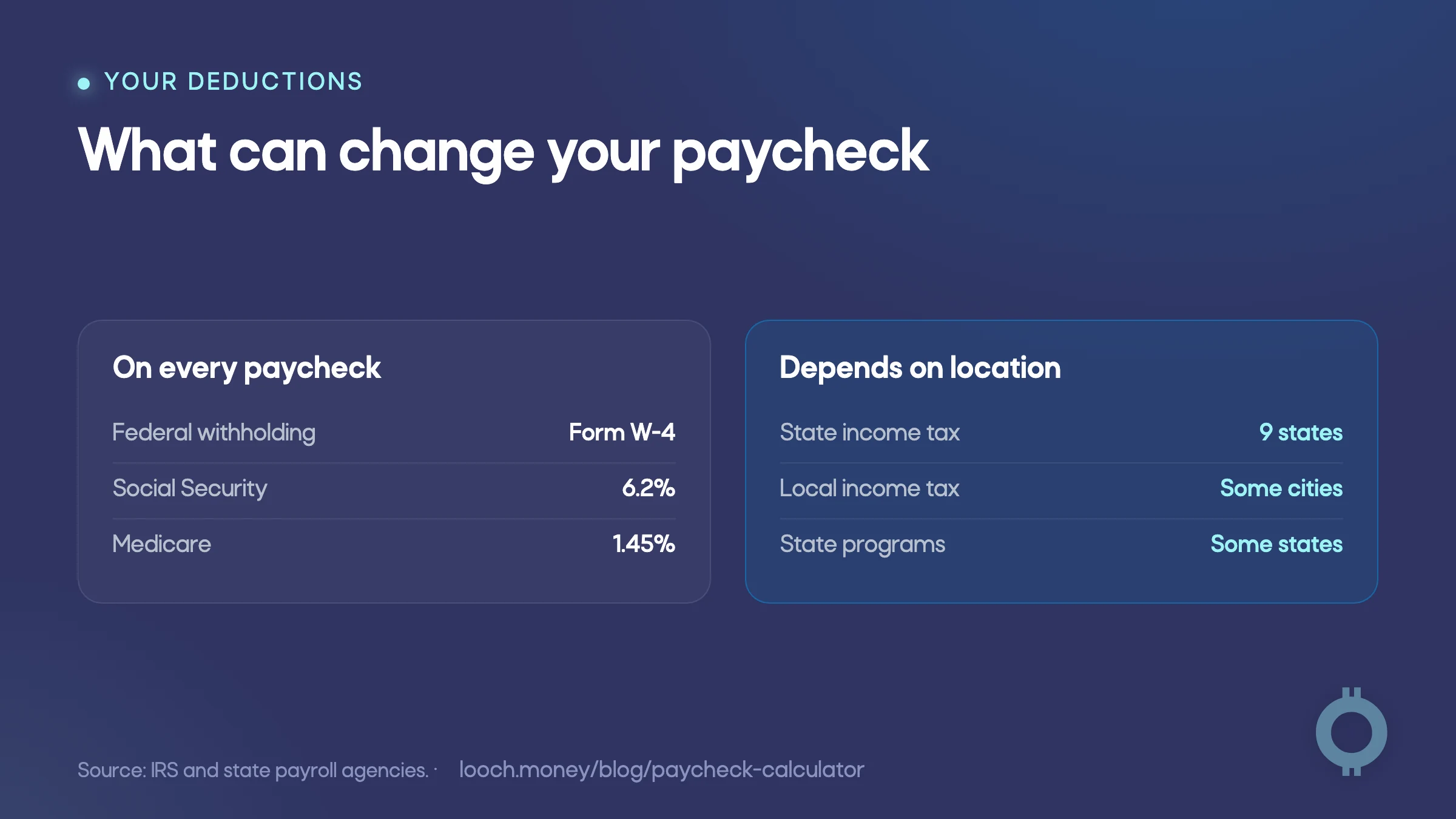
Some items appear on nearly every regular paycheck. Federal income tax withholding follows Form W-4. Social Security is withheld at 6.2%, and Medicare is withheld at 1.45%.
Other items depend on where you work or live. Nine states withhold no state income tax from wages, while some cities impose local income tax. Some states also collect employee contributions for paid leave, disability, or unemployment programs.
A take home pay calculator makes that difference visible. It doesn’t mean one state has no paycheck deductions because it has no state income tax. Washington is a useful example: It has no state income tax, but Paid Family and Medical Leave costs $605.28 a year and WA Cares costs $434.98 a year in this example. That makes each paycheck $40.01 smaller than the same paycheck in Texas.
What federal taxes come out of a paycheck?
Federal paycheck taxes usually have three visible parts: Federal income tax withholding, Social Security, and Medicare. Social Security and Medicare are often grouped under the label FICA.
Federal income tax withholding
Federal income tax withholding isn’t one flat percentage. It follows the employee’s Form W-4 and the IRS withholding tables.
Form W-4 tells payroll about filing status, multiple jobs, dependents, other income, deductions, and any extra amount the employee wants withheld. Those entries steer how much federal income tax comes out of each regular paycheck. They don’t change the employee’s salary.
On the 2026 Form W-4, Step 3 is $2,200 for each qualifying child under 17 and $500 for each other dependent. Income limits apply: $200,000, or $400,000 if married filing jointly.
Social Security
Social Security tax on employees is 6.2% of wages, on wages up to $184,500 in 2026. Once an employee’s covered wages reach that limit during the year, Social Security withholding stops for later wages in that year.
Medicare
Medicare tax on employees is 1.45% of all wages. Unlike Social Security, the regular Medicare tax has no wage cap.
Employers also withhold Additional Medicare Tax of 0.9% on wages paid to an employee over $200,000 in a calendar year. That threshold applies to the employer’s withholding obligation.
Sources: IRS Form W-4, IRS Publication 15, SSA contribution and benefit base.
How much tax comes out in my state?
State income tax is one reason the same salary can produce different net pay. Nine states withhold no state income tax from wages: Alaska, Florida, Nevada, New Hampshire, South Dakota, Tennessee, Texas, Washington, and Wyoming.
That means state income tax is 0 in 9 states, but it doesn’t mean every paycheck there matches. State payroll programs and local taxes can still create a difference.
State payroll programs
Some states collect employee contributions for programs outside ordinary state income tax.
California State Disability Insurance is 1.3% of all wages, with no wage cap in 2026. WA Cares Fund in Washington is 0.58% of wages. New York Paid Family Leave is 0.432% of wages, up to $411.91 a year in 2026. New York disability benefits are 0.5% of wages, no more than 60 cents a week.
Other states with employee paid leave or disability programs include Colorado, Connecticut, Delaware, Hawaii, Massachusetts, Minnesota, New Jersey, Oregon, and Rhode Island. Alaska, New Jersey, and Pennsylvania take a small unemployment contribution from employees.
These items can make a paycheck tax calculator more useful than comparing state income tax alone. The result needs to include the state programs that actually appear on the employee’s pay stub.
Sources: California EDD, WA Cares Fund, New York Paid Family Leave, New York Workers’ Compensation Board.
Local income tax
Local income tax can apply in addition to federal and state withholding. Examples include New York City and Yonkers, many cities and school districts in Pennsylvania, Ohio, and Kentucky, and every Maryland county. Maryland withholds its local tax together with state tax.
This calculator covers New York City, Yonkers, 26 Pennsylvania localities, 27 Ohio municipalities, 29 Kentucky localities, and all 24 Maryland local rates, consisting of 23 counties and Baltimore City.
It doesn’t yet cover some other local taxes. Examples include Indiana county taxes, Michigan city income taxes such as Detroit’s, and the Kansas City and St. Louis earnings taxes. If one of those applies, the calculator may show more take-home pay than the paycheck ultimately contains.
Where does a New York City paycheck go?
Run the same $75,000 salary for a New York City resident and the annual breakdown makes the layers clear. Take-home pay is $55,091.40. Federal income tax is $7,670.00, Social Security is $4,650.10, New York State income tax is $3,485.30, New York City income tax is $2,660.58, Medicare is $1,087.58, Paid Family Leave is $323.96, and disability benefits are $31.20.
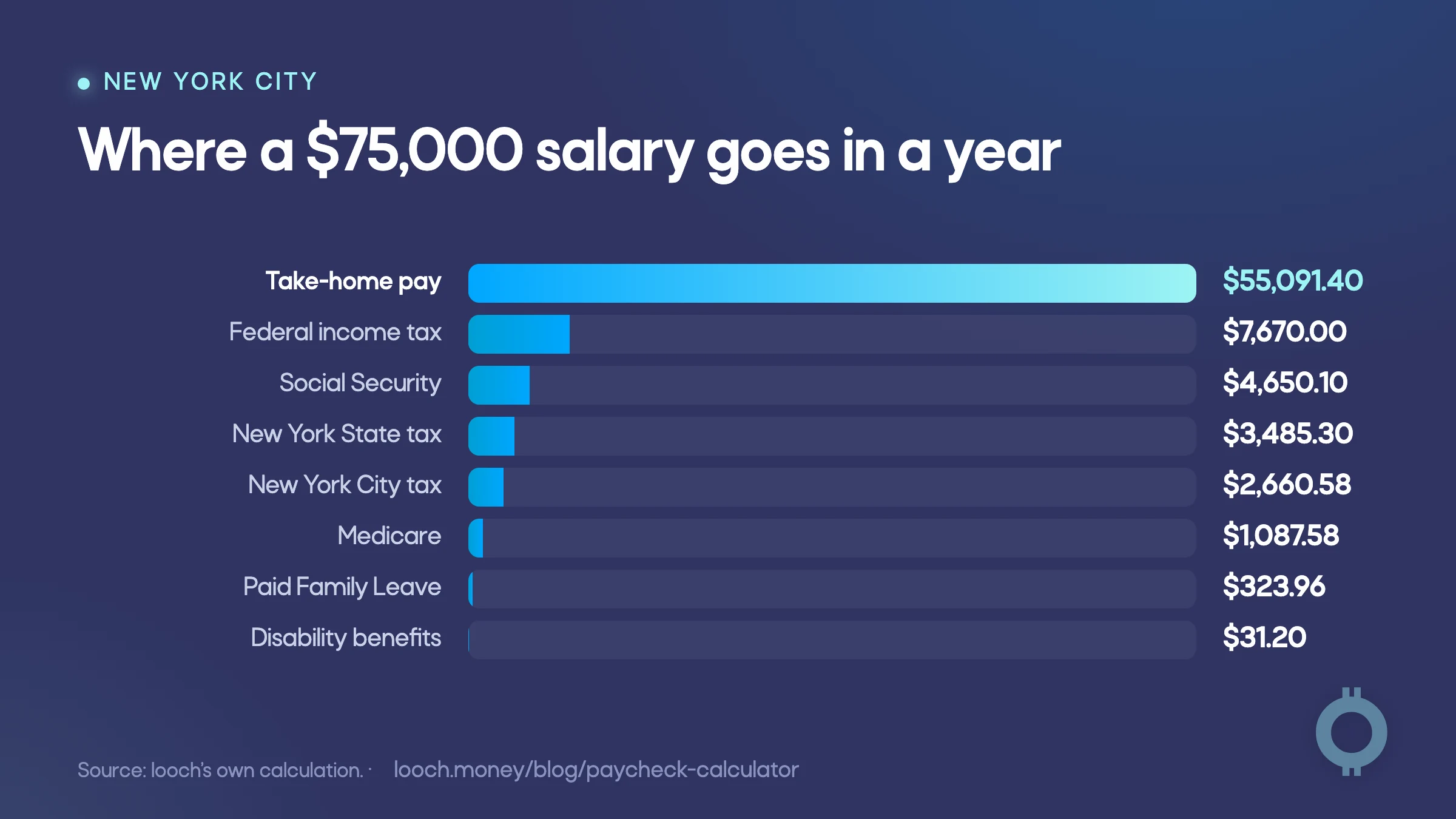
New York City shows why location matters twice. The paycheck includes New York State income tax and a separate New York City income tax, plus the state’s employee payroll programs. Someone outside New York City can have the same salary and federal inputs but a different take-home amount.
Does a 401(k) lower paycheck taxes?
A traditional 401(k) contribution is a pre-tax deduction for federal income tax and, in this California example, state income tax. It reduces current take-home pay, but take-home doesn’t fall by the full amount contributed because some income tax withholding also falls.
Run the $75,000 California example with no 401(k), and take-home pay is $2,207.54 per paycheck. Contributing 5% produces take-home pay of $2,107.73. Contributing 10% produces take-home pay of $2,007.92.
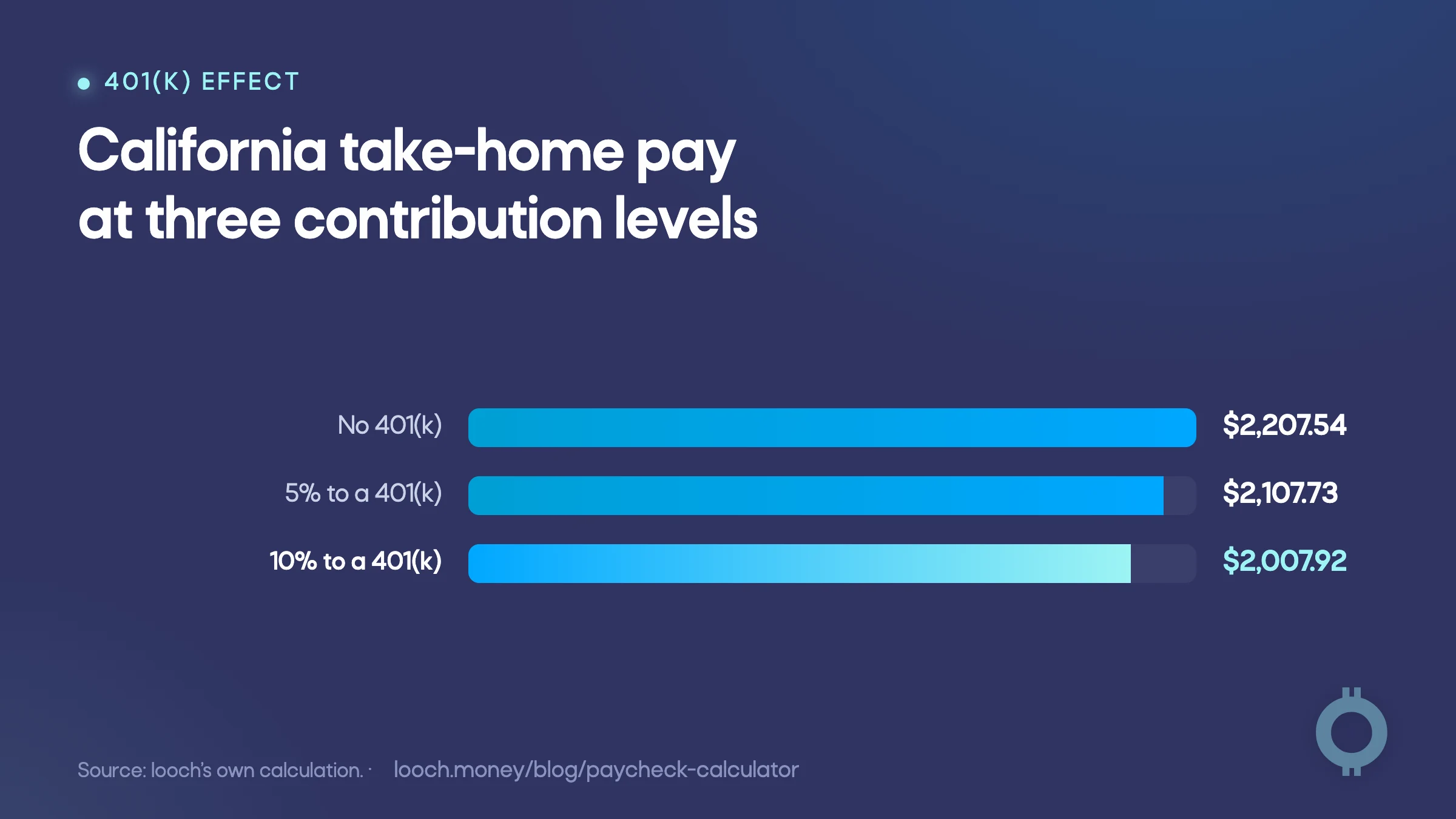
At 10%, the contribution is $288.46 per paycheck, yet take-home falls by only $199.62. Federal income tax falls by $1,649.96 over the year, and California income tax falls by $659.88.
Social Security and Medicare don’t change in this example. A 401(k) contribution is still subject to both, so a pre-tax deduction doesn’t necessarily reduce every tax shown on a paycheck.
What this paycheck calculator covers
This calculator estimates regular salary paychecks under published 2026 rules. It covers federal income tax withholding, Social Security, Medicare, state income tax, the listed state payroll programs, supported local income taxes, and entered pre-tax deductions.
It doesn’t cover bonuses, overtime, tips, or a second job. Those can require different withholding treatment or additional Form W-4 inputs, so they shouldn’t be folded into a regular salary estimate without checking the details.
The calculator gives an estimate from published 2026 rules, and a tax professional can confirm a specific situation.
How looch helps a business owner set taxes aside
If you’re self-employed or pay yourself without withholding, there’s no paycheck setting tax money aside for you. You need to separate it yourself before operating expenses absorb it.
looch gives business owners a Tax Stash account alongside Primary Business. Tax Stash is a separate account for money you set aside for taxes, so it doesn’t mix with operating cash. You can review the available accounts on looch pricing.
The amount to set aside depends on your income and tax situation. The estimated tax payments guide explains how to think about income paid without withholding. A paycheck calculator estimates deductions from wages. Estimated taxes are a different calculation.
Paycheck calculator FAQ
How much will I take home from my paycheck?
Enter your gross salary, pay frequency, Form W-4 details, location, and pre-tax deductions in the calculator above. The result estimates net pay and lists the paycheck taxes and deductions that reduce gross pay.
Why is my paycheck smaller than my salary?
Your salary is the gross annual amount before withholding and deductions. Each paycheck covers one pay period, then subtracts federal income tax, FICA, applicable state and local income tax, state payroll programs, and any deductions you entered.
Do I pay city tax on my paycheck?
You may pay local income tax if your city, county, or school district imposes one. This calculator includes the supported New York, Pennsylvania, Ohio, Kentucky, and Maryland local rates, but it doesn’t yet include every local tax in the country.
Does a 401(k) lower my taxes?
A traditional 401(k) can lower federal income tax withholding and may lower state income tax withholding. It doesn’t lower Social Security or Medicare in the California worked example above.
Why do Texas and Washington paychecks differ?
Neither state withholds state income tax from wages, but Washington has employee payroll program contributions. On the $75,000 worked example, Washington’s biweekly take-home pay is $2,328.93 compared with $2,368.94 in Texas.


