


W-8BEN-E or W-9: Which form your US LLC gives a US client
Amounts last verified on September 21st 2026
Michel Myara is co-founder and product designer at looch, where he designs the ecosystem small businesses use to get paid and manage spend while keeping penny-perfect books.
Updated August 2026
A disregarded US LLC gives its owner’s W-8, not a W-9

A single-member US LLC owned by a non-US person is generally disregarded for federal tax purposes. That means the owner provides Form W-8BEN for an individual owner or Form W-8BEN-E for a company owner. The LLC doesn’t provide Form W-9 in its own name, even if it’s an EIN.
The deciding factor is the LLC’s federal tax classification, not where its owner lives. An LLC taxed as a partnership or corporation is a US person for this purpose and provides a W-9 regardless of its ownership.
The cost of getting the form wrong can be immediate:
- Backup withholding on a missing or invalid W-9 is 24% of each reportable payment.
- Withholding when a payee is presumed foreign without a valid form is 30%, with no treaty reduction.
- The 1099-NEC reporting threshold is $2,000 for payments made after 12/31/2025, up from $600.
This distinction matters most when a client’s accounts payable team asks for tax paperwork before releasing an invoice payment. A W-9 from a disregarded LLC with a foreign owner can stop that process. The owner’s valid W-8 is the form that supports the payment instead.
This page explains which form applies in each situation. It’s not tax or legal advice. Whether a classification, election, or treaty claim is right for your business is a question for a tax professional.
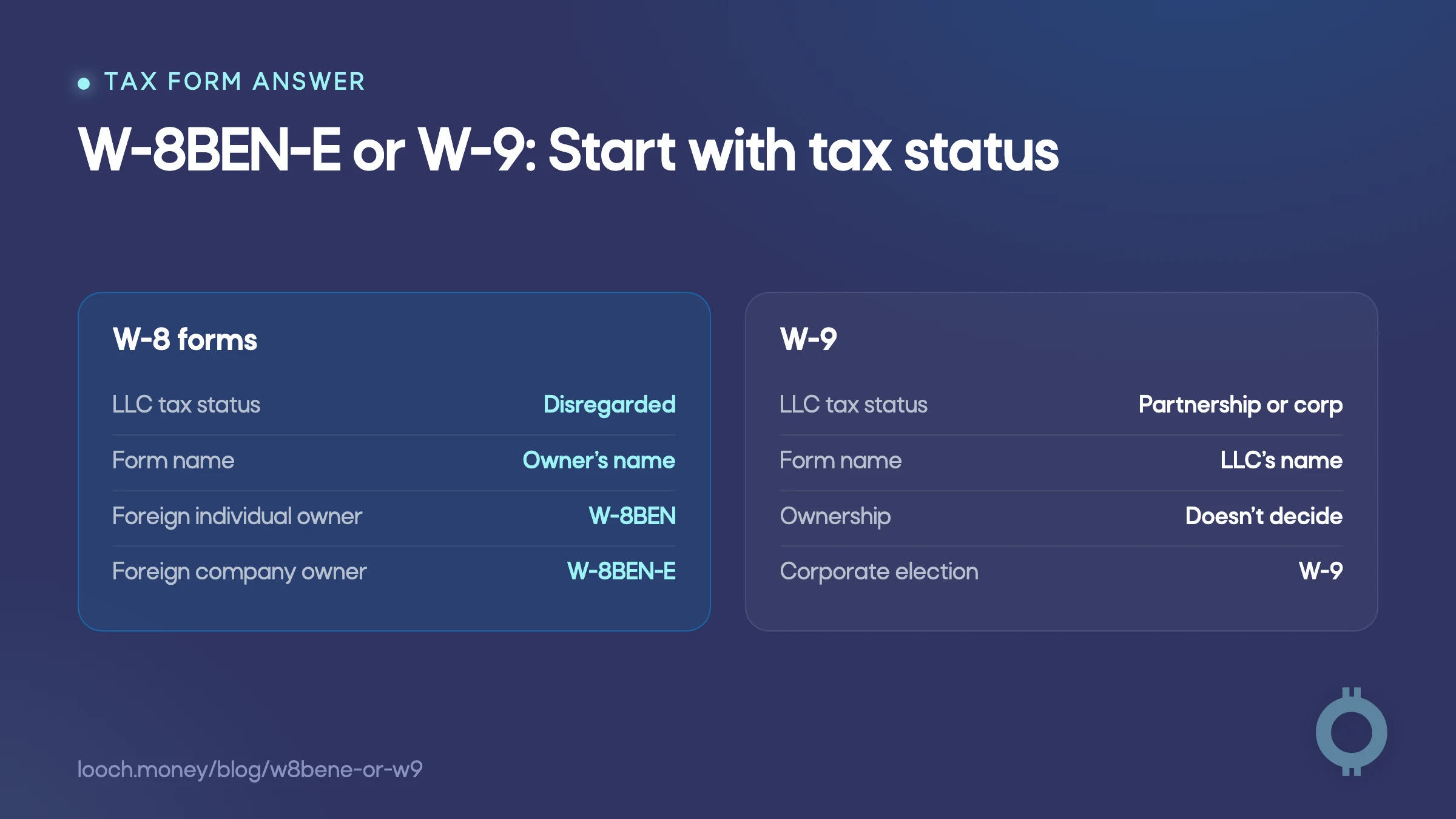
W-8BEN-E or W-9: The answer in one table
| Your US LLC | Form to give | In whose name | Why |
|---|---|---|---|
| Single-member, non-US individual owner | W-8BEN | The owner | The LLC is disregarded; the owner’s status governs |
| Single-member, foreign company owner | W-8BEN-E | The owner | Same rule, with an entity as owner |
| Single-member, US owner | W-9 | The owner | Disregarded, and the owner is a US person |
| Multi-member, taxed as a partnership | W-9 | The LLC | A US partnership is a US person |
| Elected corporate taxation (Form 8832 or 2553) | W-9 | The LLC | Treated as a US corporation, regardless of ownership |
The IRS treats a partnership, corporation, company, or association created or organized in the United States or under US law as a US person. That means the entity’s form depends on where it is organized and how the IRS classifies it, not on the owner’s passport. The main exception is a disregarded entity, which is the situation many readers of this page are navigating.
Sources: Form W-9, Instructions for Form W-8BEN-E.
Why a disregarded LLC can’t hand over a W-9
A single-member LLC that hasn’t elected corporate taxation is disregarded as separate from its owner. For tax documentation, it doesn’t have an identity of its own. The W-9 instructions require the disregarded entity’s owner on line 1 and state that the line 1 name “should never be a disregarded entity.”
The deciding rule is plain: “If the owner of the disregarded entity is a foreign person, the owner must complete an appropriate Form W-8 instead of a Form W-9. This is the case even if the foreign person has a U.S. TIN.”
Having an EIN doesn’t make a disregarded LLC a W-9 filer. The LLC may still need an EIN for banking and filings. Our guide to getting an EIN without an SSN explains that process. But the tax identity behind a disregarded LLC is its owner. A foreign owner documents that status on the appropriate W-8, including the LLC’s details where the form instructions call for them.
The Treasury regulation uses this exact scenario: A Delaware LLC with one foreign owner. It concludes that the LLC “may not furnish a Form W-9 because it may not represent that it is a U.S. person,” and must furnish a Form W-8 with the foreign owner’s information.
The reverse cases follow the same rule. A US owner of a disregarded LLC provides a W-9 in the owner’s name. A US-organized LLC taxed as a corporation or partnership provides a W-9 in its own name. The W-8BEN-E instructions also bar US persons, including “a corporation organized under the law of a state,” from using that form.
A foreign-owned, disregarded LLC also has a Form 5472 filing obligation. See our Form 5472 guide for foreign founders for that separate requirement.
Sources: Form W-9, Instructions for Form W-8BEN, Instructions for Form W-8BEN-E, 26 CFR 1.1441-1.
What the wrong form costs, on both sides
Your client’s accounts payable team is managing its own tax exposure. The form is checked before payment because the wrong documentation can shift a withholding obligation onto the payer.
- No valid W-9 from a US payee: Backup withholding at 24% of each reportable payment. A payer must withhold when the payee doesn’t provide a TIN or the required certifications, and continue withholding until the issue is corrected. See the Instructions for the Requester of Form W-9.
- No valid form at all: Under the IRS presumption rules, a payee presumed foreign can face statutory 30% withholding on the US-source income described in the instructions. A treaty reduction can’t be claimed without valid documentation. See the Instructions for Form W-8BEN-E and the Instructions for the Requester of Forms W-8.
- The payer’s own risk: A payer that should have withheld and didn’t may be assessed the tax. That’s why accounts payable may hold a first invoice until the form is resolved.
Whether withholding applies to a particular payment type depends on the facts. The narrower point is that the right form documents the payee’s status before payment, while the wrong form leaves the payer to the default rules.
The 1099 fork
The form also determines what your client files about you in January. A payee documented with a W-9 is in the Form 1099 system: A US contractor paid $2,000 or more for services generally receives a 1099-NEC for payments made after 12/31/2025. That threshold replaced the long-standing $600 threshold and is indexed for inflation after 2026, according to the IRS 1099-NEC instructions. We cover the payer’s process in our 1099 filing guide.
Payments to foreign persons are outside the 1099 series. The IRS directs those payments to Form 1042-S reporting instead.
So if you are a foreign owner behind a disregarded US LLC and a client asks for a W-9 "so we can send your 1099," both parts of the request are on the wrong rail. The W-8 documents the relationship on the rail built for it.
Source: General Instructions for Certain Information Returns. Verified 8/16/2026.
What accounts payable actually needs before the first invoice
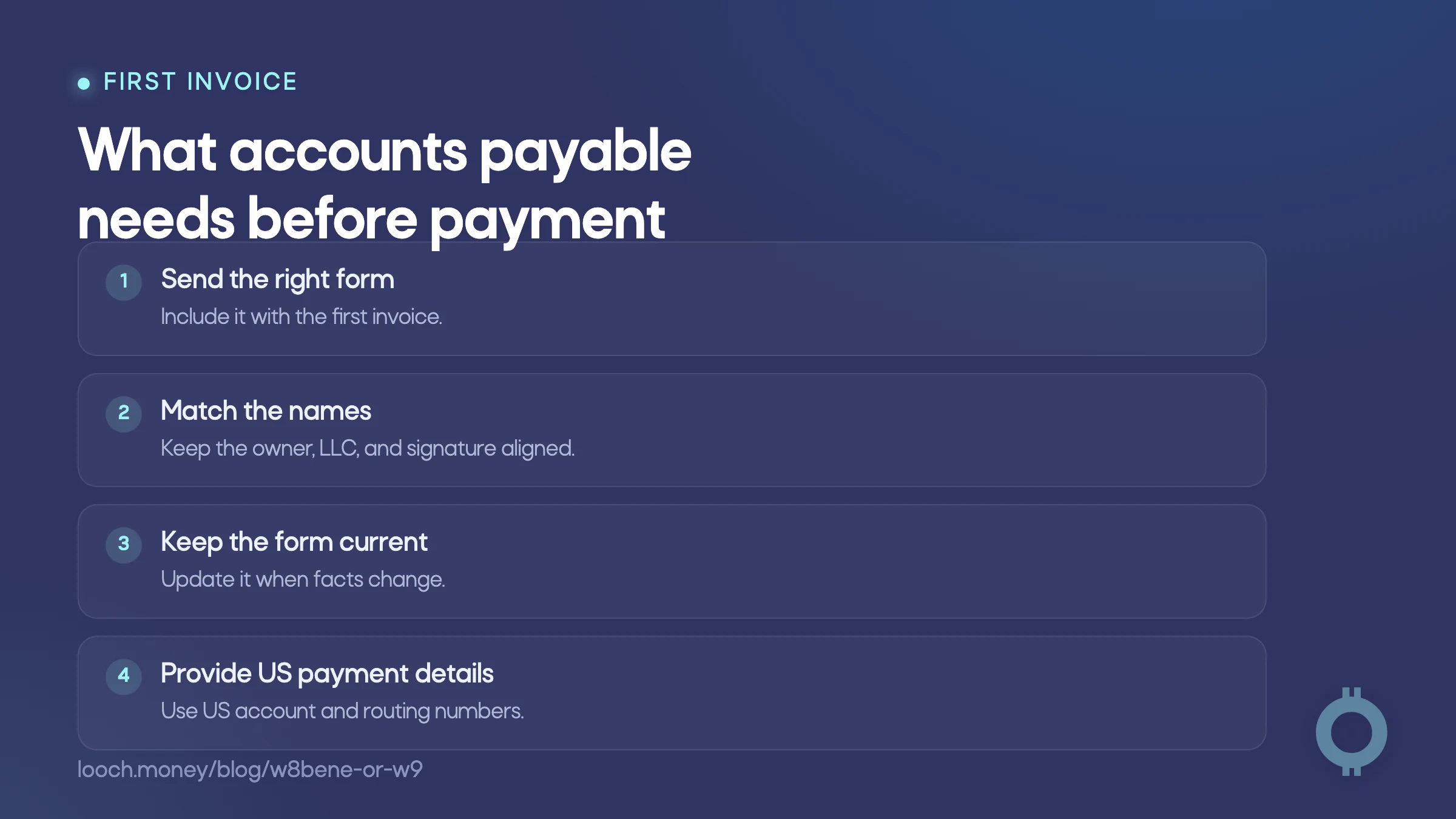
A smooth first payment starts before accounts payable asks for anything. Send the tax form, make the names match, keep the form current, and provide domestic payment details.
- Send the right form with the first invoice, without waiting to be asked. AP teams often chase missing paperwork after an invoice arrives. Sending it upfront removes that delay.
- Match the names exactly. On a disregarded LLC’s W-8, the owner signs and certifies the form, while the LLC is entered where the form requests it. If the LLC appears on line one but the owner signs, AP may reject it.
- Track when your form needs attention. A W-8BEN-E generally remains valid through the last day of the third calendar year after signing, unless circumstances change. A W-9 has no expiration date under its instructions and remains valid until its facts change. Late recertification can stall an otherwise established client relationship.
- Provide a US payment rail. Remit-to details determine whether a client can pay by domestic ACH or must use an international wire, with potential lifting fees and delays. A US business account in the company’s name, with US account and routing numbers, keeps the payment domestic even when the owner lives abroad.
That’s where looch Start fits: It forms the company, obtains the EIN without an SSN, and opens no-fee business accounts with US account and routing numbers. The remit-to line is ready when the entity is. When a looch business pays contractors, looch also keeps the W-9 and 1099 determination on file for each contact.
Sources: Instructions for Form W-8BEN-E, Instructions for the Requester of Form W-9.
Frequently asked questions
My LLC has an EIN. Does that mean it should provide a W-9?
No. A foreign owner of a disregarded LLC generally provides the applicable W-8 form, even when that owner has a US taxpayer identification number. The EIN identifies the LLC for banking and filing purposes. It doesn’t change the owner’s tax status or determine which form applies.
Which form applies if my LLC elected S corporation or C corporation taxation?
Use a W-9 in the LLC’s name. An LLC that made a federal entity-classification election is treated as a US corporation for this purpose, regardless of its owners. Whether that election is right for your business is a question for a tax professional.
How long do the forms stay valid?
A W-8BEN-E generally remains valid under the IRS validity period unless a change in circumstances makes its information incorrect. The form holder must notify the withholding agent when that happens. A W-9 has no set expiration date and remains valid until its information isn’t true.
Will my foreign-owned LLC receive a 1099?
When a foreign owner is properly documented with a W-8, the payment is generally outside the 1099 series. US-source payments to foreign persons may instead be reported on Form 1042-S. If a payer issues a 1099 anyway, the form on file may be wrong. A tax professional can help correct the documentation.


