


Business card with automatic bookkeeping for startups
Amounts last verified on September 21st 2026
Michel Myara is co-founder and product designer at looch, where he designs the ecosystem small businesses use to get paid and manage spend while keeping penny-perfect books.
A looch Smartcard enters every charge in looch’s books at $0/month

For a startup that wants a business card with automatic bookkeeping, looch puts the card, account, and books in one product. The Primary Business account is $0/month, with a 3% foreign transaction fee. Ramp requires $25,000 in a linked US business bank account, Brex requires $50,000 in cash for a funded applicant, and Mercury IO offers 1.5% cash back.
Last verified: September 28th, 2026.
The important distinction isn’t which card says “automatic.” It’s where the accounting happens. Every looch Smartcard charge is tagged and categorized when it posts, directly in looch’s own books. Most competing cards send transaction data to QuickBooks, Xero, NetSuite, or another accounting product.
That makes looch the clearest fit for a startup that wants its card activity entered without connecting a separate ledger. It doesn’t replace the benefits of credit, float, rewards, or deep finance workflows offered by other cards.
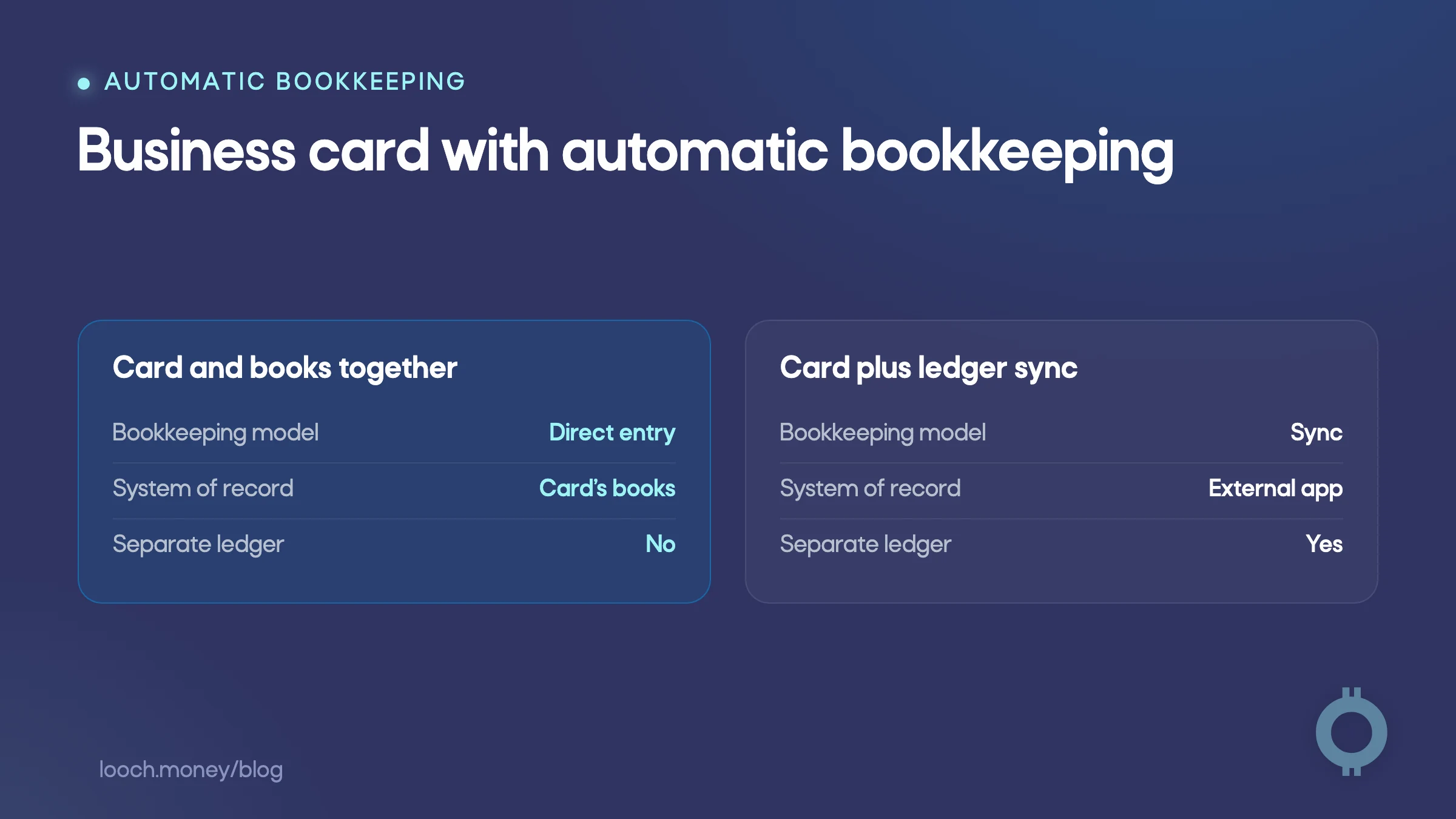
“Automatic bookkeeping” means two different things on a card page
Most startup cards sync with a separate ledger
Ramp, Brex, Mercury IO, Expensify, Intuit, and Capital on Tap all automate part of the bookkeeping process. They can send transactions, categories, receipts, or accounting fields into another system.
That’s useful, but it’s still a sync. The card and the books remain separate products, and the accounting system remains the business’ system of record. Intuit comes closest to keeping both inside one company’s ecosystem because its card syncs into QuickBooks.
A sync can save data entry while leaving review and reconciliation in place. Founders who already run their books in QuickBooks, Xero, or NetSuite may prefer that model because it preserves the ledger they already use.
looch enters charges in the card’s own books
looch takes a different approach. A Smartcard spends from a looch account, and each charge is entered and categorized in looch’s real-time accounting as it posts.
There’s no separate bank feed to connect. There’s no card statement to reconcile against another ledger. Founders can manage the account, card controls, receipts, categories, and CPA-quality books in the same app.
That model is especially useful for a founder who doesn’t already have an accounting stack. Read more about running accounting from your phone and when a business still needs a bookkeeper.
Seven startup cards differ on type, access, fees, and bookkeeping
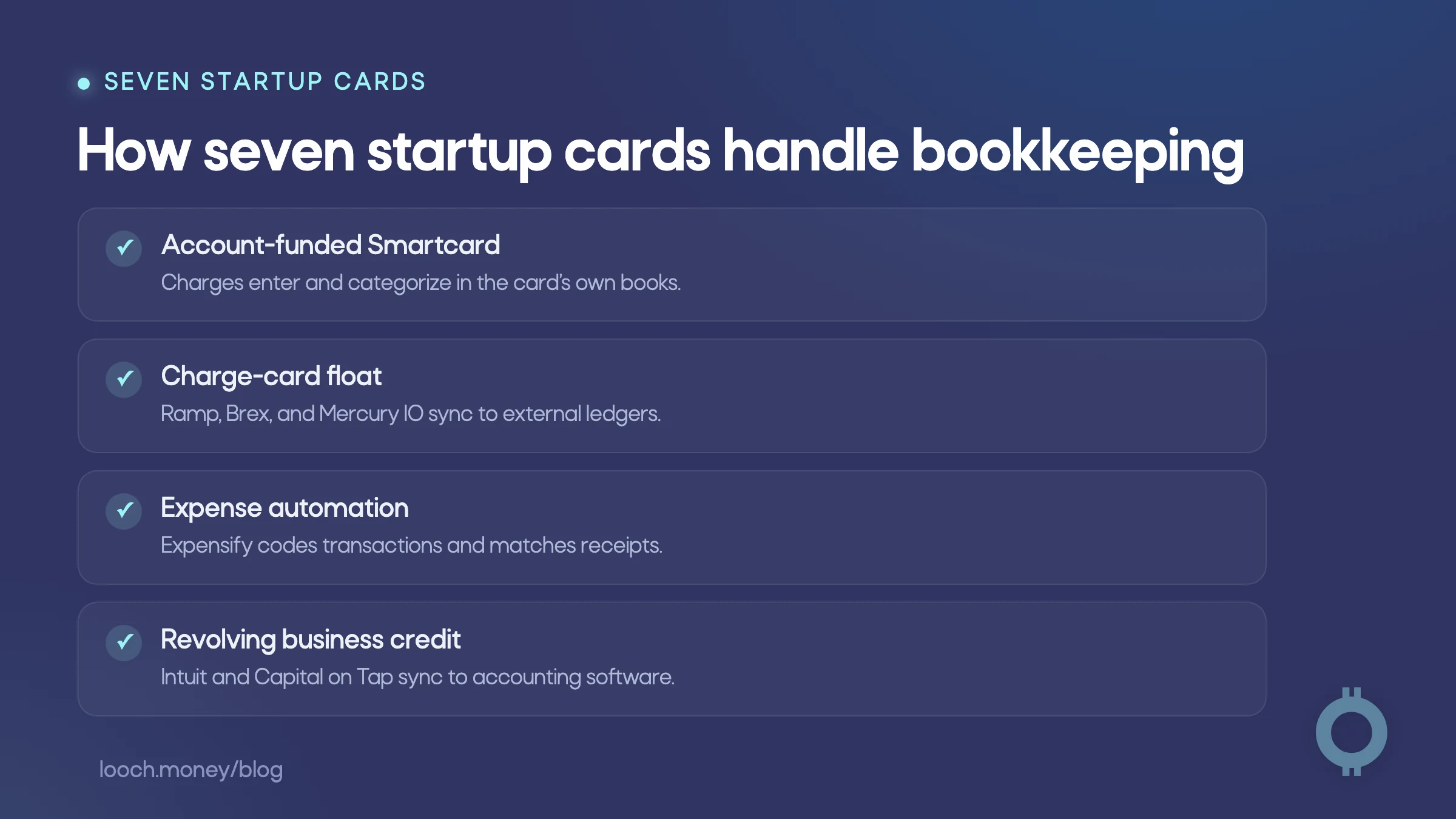
| Card | Card type | Who qualifies | Fees | Bookkeeping model | Rewards or credit line |
|---|---|---|---|---|---|
| looch Smartcard | Visa Commercial Card that spends from any looch account. It isn’t a credit card with a credit line. | Any US-registered LLC or corporation with an EIN and a qualifying US street address. A registered agent, virtual office, PO box, or commercial mail receiving agency (CMRA) address doesn’t qualify. | $0/month account. A 3% foreign transaction fee applies to transactions in currencies other than USD or with merchants outside the United States. | Charges are entered and categorized in looch’s own books as they post. | No credit line or stated rewards. |
| Ramp | Charge card with 30-day payback. | Corporations, LLCs, and LPs with at least $25,000 in a linked US business bank account. Sole proprietors and unregistered businesses aren’t accepted. | The Free plan is $0/month per user. | QuickBooks Online and Xero integrations on Free. NetSuite and Sage Intacct integrations are available on Plus. | Cashback on every swipe. |
| Brex | Business charge card paid in full when each statement comes due. | US-incorporated companies with an EIN, US operations, and a US physical address. Funded applicants need at least $50,000 in cash. | Essentials is $0/month per user. Premium is $12/month per user. | Automated accounting field mapping and accounting integrations. | Up to 7x back. No personal guarantee. |
| Mercury IO | Charge card with a limit based on balances held at Mercury. | Businesses approved for a Mercury account and IO. | The core Mercury plan is $0/month. An international transaction fee applies to non-USD transactions. | Accounting rules, receipt matching, and syncs to QuickBooks, Xero, and NetSuite. | 1.5% cash back. No personal guarantee or credit check. |
| Expensify Card | Described by Expensify as similar to a business debit card. | Registered businesses in the US, UK, and select EU countries with a bank account denominated in USD, GBP, or EUR. | No card fees or foreign transaction fees. | AI transaction coding, receipt matching, and two-way syncs with QuickBooks, Xero, NetSuite, Sage Intacct, and other systems. | 1% cash back. |
| Intuit Business Credit Card | Revolving business credit card with limits from $1,000 to $50,000, subject to credit review and business qualifications. | Businesses that pass the issuer’s credit review and qualifications. | $0 annual fee and a 2.7% foreign transaction fee. | Transactions sync into QuickBooks. | 2% cash back on everyday purchases and 5% on Intuit products and services. |
| Capital on Tap | Revolving business credit card with limits up to $50,000 based on creditworthiness. | Businesses approved based on creditworthiness. | No annual or foreign transaction fees. Interest ranges from 16.74% to 86.24% variable APR. | Syncs to Xero and QuickBooks. | 1.5% cash back, or 2% with weekly AutoPay. |
A looch Smartcard spends from a looch account and keeps its own books
A looch Smartcard is a Visa Commercial Card issued from the app. It can spend from any looch account, and the linked account can be switched whenever the business needs. A founder can even link one to Tax Stash to remit taxes.
It isn’t a credit card with a credit line, and looch doesn’t state a cash back or points program. That’s the tradeoff. The benefit is that the account balance, card activity, receipts, categories, and books stay together.
Controls include daily, monthly, and all-time spending limits, weekday-only spending, auto-cancelation dates, merchant controls, GL category restrictions, and mobile wallet management. A card can also auto-lock when a receipt, memo, or category is missing.
The account has no monthly fee, and virtual and physical Smartcards are included. A 3% foreign transaction fee applies to transactions in currencies other than USD or with merchants outside the United States.
looch is a financial technology company operated by Simplicity Fintech Inc, not a bank. looch Smartcards Visa® Commercial Cards are powered by Stripe and issued by Celtic Bank.
Ramp, Brex, and Mercury IO provide charge-card float and accounting syncs
Ramp combines a charge card with finance workflows
Ramp offers a corporate charge card with 30-day payback. Its spending limit is based on business financial factors such as revenue or money raised, and applying requires at least $25,000 in a linked US business bank account.
The Free plan includes unlimited cards, receipt matching, and QuickBooks Online and Xero integrations at $0/month per user. Plus costs $15/month per user plus a platform fee and adds integrations including NetSuite and Sage Intacct.
Ramp doesn’t require a personal guarantee or personal credit check. It’s a stronger fit than looch when a company wants a charge-card limit, cash back, and broader finance operations while keeping an external accounting system.
Brex adds rewards and global card depth
Brex cards are charge cards with balances paid in full when statements come due. Statements generally cover one month for monthly payments or one business day for daily payments, and autopay can’t be turned off.
Brex requires a US EIN, valid US incorporation, US operations, and a US physical address. A funded applicant needs at least $50,000 in cash. Essentials costs $0/month per user, while Premium costs $12/month per user.
Brex offers up to 7x back and doesn’t require a personal guarantee. It also supports global cards accepted in more than 210 countries and territories, with local-currency cards and billing in more than 50 countries.
Mercury IO ties the card limit to business balances
Mercury IO is a charge card whose limit is based on balances held at Mercury. Once balances reach $15K, a business can switch to 30-day repayment terms.
It offers 1.5% cash back, no annual fee, no personal guarantee, and no credit check. Accounting rules can categorize activity, receipts can be matched automatically, and transactions can sync to QuickBooks, Xero, and NetSuite.
Mercury is a good fit for a business that wants its account and charge card together but plans to keep an external ledger.
Expensify automates expenses but still syncs the books elsewhere
Expensify describes its card as similar to a business debit card, with added employee-expense controls. The card has no card fees or foreign transaction fees and earns 1% cash back.
Its Concierge AI codes transactions and matches receipts. The resulting data syncs in both directions with QuickBooks, Xero, NetSuite, Sage Intacct, and other accounting systems.
That can work well for a team centered on expense reports and employee spend. It isn’t the same as having the card activity entered directly into the card product’s own complete books.
Intuit and Capital on Tap offer revolving credit with accounting syncs
The Intuit Business Credit Card is a revolving credit card with limits from $1,000 to $50,000. Approval is subject to credit review and business qualifications. It earns 2% cash back on everyday purchases, charges a 2.7% foreign transaction fee, and syncs transactions into QuickBooks.
That makes Intuit the closest alternative for a business already using QuickBooks. The card and ledger sit in Intuit’s ecosystem.
Capital on Tap is also revolving credit. It offers limits up to $50,000 based on creditworthiness, 1.5% cash back, and automatic syncs to Xero and QuickBooks. Its variable APR ranges from 16.74% to 86.24%.
These cards can provide a credit line that looch doesn’t offer. In return, the books still live in a separate accounting product.
Ramp, Brex, or Mercury can be the better fit
Choose a charge card when float, rewards, or finance-team controls matter more than keeping the card and books in one product.
Ramp is a better fit for approval workflows, bill pay, procurement, and integrations with larger accounting systems. Brex is stronger for global card issuing, rewards, travel, and companies operating across countries. Mercury IO suits businesses that want a balance-based charge-card limit alongside their business account.
They’re also better fits for businesses already committed to QuickBooks, Xero, or NetSuite as the system of record. In that case, a strong sync can be more useful than changing where the books live.
Compare the tradeoffs in the full guides to Ramp for startups, Brex for startups, and Mercury for startups.
looch is currently iOS-only, so any business that needs Android access should choose another option. Ramp and Brex also have material qualification gates: Ramp requires $25,000 in a linked US business bank account, while Brex requires $50,000 in cash from a funded applicant.
A looch Smartcard fits founders who want one operating system
looch is the better fit for a startup that wants the account, card, controls, and books in one app. It’s especially useful when the founder hasn’t already committed to a separate accounting subscription.
Any US-registered LLC or corporation with an EIN and a qualifying US street address can open a looch profile. A registered agent, virtual office, PO box, or commercial mail receiving agency (CMRA) address doesn’t qualify.
For a founder who hasn’t incorporated yet, looch Start forms a business for $249 all-in, including the state filing fee, EIN, and a year of virtual office. The registered agent and virtual office renew at $249/year as the business protection bundle, which includes registered agent service, the virtual office with its business address and mail scanning for up to 3 regular mail pieces per year, the state annual report filing, and weekly trademark monitoring. That virtual office address doesn’t replace the qualifying US street address required for a looch profile.
looch also includes a migration tool for QuickBooks and Xero, so an existing business can bring its accounting history into looch instead of starting over.
The limits are straightforward. A Smartcard doesn’t provide a credit line or stated rewards. For founders who value float or cash back more than integrated books, a charge card or revolving business credit card will be the better choice.
Frequently asked questions
Best business credit card or debit card for a startup with automatic bookkeeping?
A looch Smartcard is the strongest fit when the priority is having every charge entered and categorized in the same product that holds the account and card. Ramp, Brex, Mercury IO, Expensify, Intuit, and Capital on Tap automate bookkeeping through syncs to QuickBooks, Xero, NetSuite, or another ledger. Choose one of those instead when credit, charge-card float, rewards, global issuing, or deeper finance workflows matter more than keeping the books inside the card product.
What is the difference between a charge card and a business credit card?
A charge card must be paid in full each statement. Ramp uses a 30-day payback, while Brex and Mercury IO also require the balance to be paid in full. A revolving business credit card, such as Intuit or Capital on Tap, can carry a balance and charges an APR. A looch Smartcard is neither: It spends from a looch account.
Can a startup get a business card with no personal guarantee?
Yes. Ramp, Brex, and Mercury IO state on their own pages that they don’t require a personal guarantee. Their card pages still set business and financial eligibility requirements.
Sources
- looch Smartcards, verified September 28th, 2026
- looch pricing, verified September 28th, 2026
- looch Start, verified September 28th, 2026
- looch account requirements for foreign-owned LLCs, verified September 28th, 2026
- Ramp corporate cards, verified September 28th, 2026
- Ramp pricing, verified September 28th, 2026
- Ramp application requirements, verified September 28th, 2026
- Brex corporate card, verified September 28th, 2026
- Brex pricing, verified September 28th, 2026
- Brex account requirements, verified September 28th, 2026
- Brex card overview, verified September 28th, 2026
- Brex statement payments, verified September 28th, 2026
- Mercury IO, verified September 28th, 2026
- Mercury pricing, verified September 28th, 2026
- Expensify Card, verified September 28th, 2026
- Intuit Business Credit Card, verified September 28th, 2026
- Capital on Tap, verified September 28th, 2026


