


1099 late filing penalty: The tiers, caps, and clock
Amounts last verified on September 21st 2026
Michel Myara is co-founder and product designer at looch, where he designs the ecosystem small businesses use to get paid and manage spend while keeping penny-perfect books.
The 1099 late filing penalty is charged per form, and it can apply twice

A 1099 late filing penalty depends on when you correct the failure, and it’s charged for each form. Miss both duties, filing with the IRS and furnishing the recipient copy, and the same form can create two penalties.
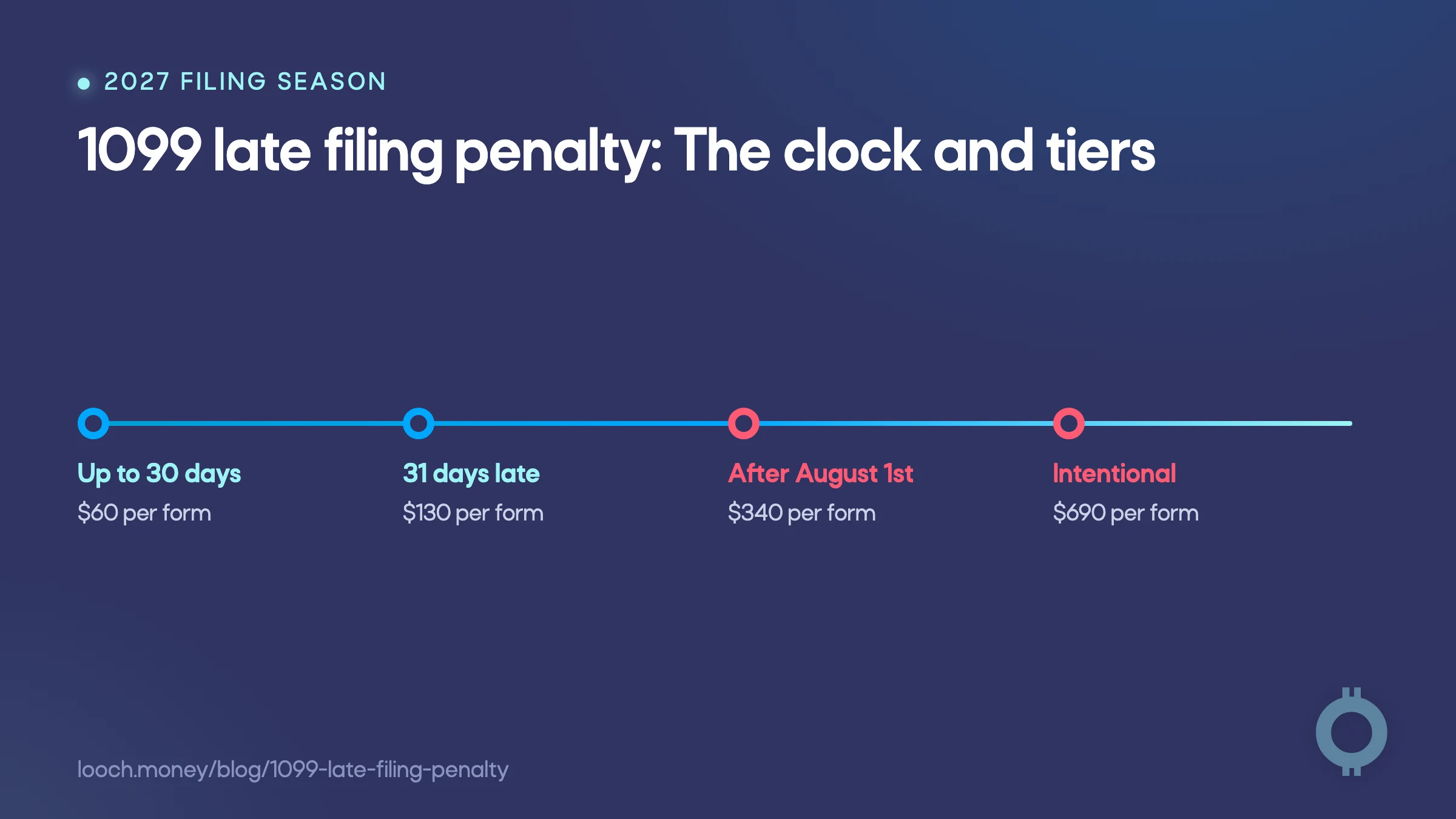
For tax year 2026 forms due in the 2027 season, the inflation-adjusted amounts in Rev. Proc. 2025-32 are:
| How late | Penalty per form | Small-business maximum |
|---|---|---|
| Up to 30 days | $60 | $244,500 |
| 31 days late through August 1 | $130 | $698,500 |
| After August 1, or not filed | $340 | $1,397,000 |
| Intentional disregard | $690 | No maximum |
The practical point is simple: File as soon as you find the problem. Ten contractors filed after August 1 creates $3,400 in filing-side penalties before the recipient-copy side is counted.
Last verified: August 26th, 2026.
For the filing rules and deadlines themselves, read our guide to filing 1099s. If the question is which form belongs with a payment, start with 1099-NEC vs 1099-MISC. This page’s about the cost of being late, and what to do next.
The return’s due year sets the penalty schedule
The IRS adjusts these penalties for inflation each year. The schedule follows the year the information return is due, not the year you made the payment.
Returns due in 2026, meaning tax year 2025 forms, carry $60, $130, and $340 tiers, with $680 for intentional disregard. Returns due in 2027, meaning tax year 2026 forms, carry the same $60, $130, and $340 tiers, while intentional disregard rises to $690. The 1099-NEC is among the forms due Monday, February 1st, 2027.
The IRS’s information return penalties page explains the return-due-in-2026 schedule and the general penalty rules. Its year-by-year table currently stops at returns due in 2026. The return-due-in-2027 figures come from Rev. Proc. 2025-32, the annual inflation adjustment.
The clock starts on the due date. Up to 30 days late is the $60 tier. Day 31 through August 1 is the $130 tier. After August 1, or when you do not file at all, the penalty is $340 per form.
A return can also be late for penalty purposes when it’s wrong and remains uncorrected. An incorrect taxpayer ID or reported amount can keep a filing on the same penalty schedule. That’s why a current W-9 is part of the filing workflow, not paperwork to chase after year-end.
One missed 1099 can create two separate penalties
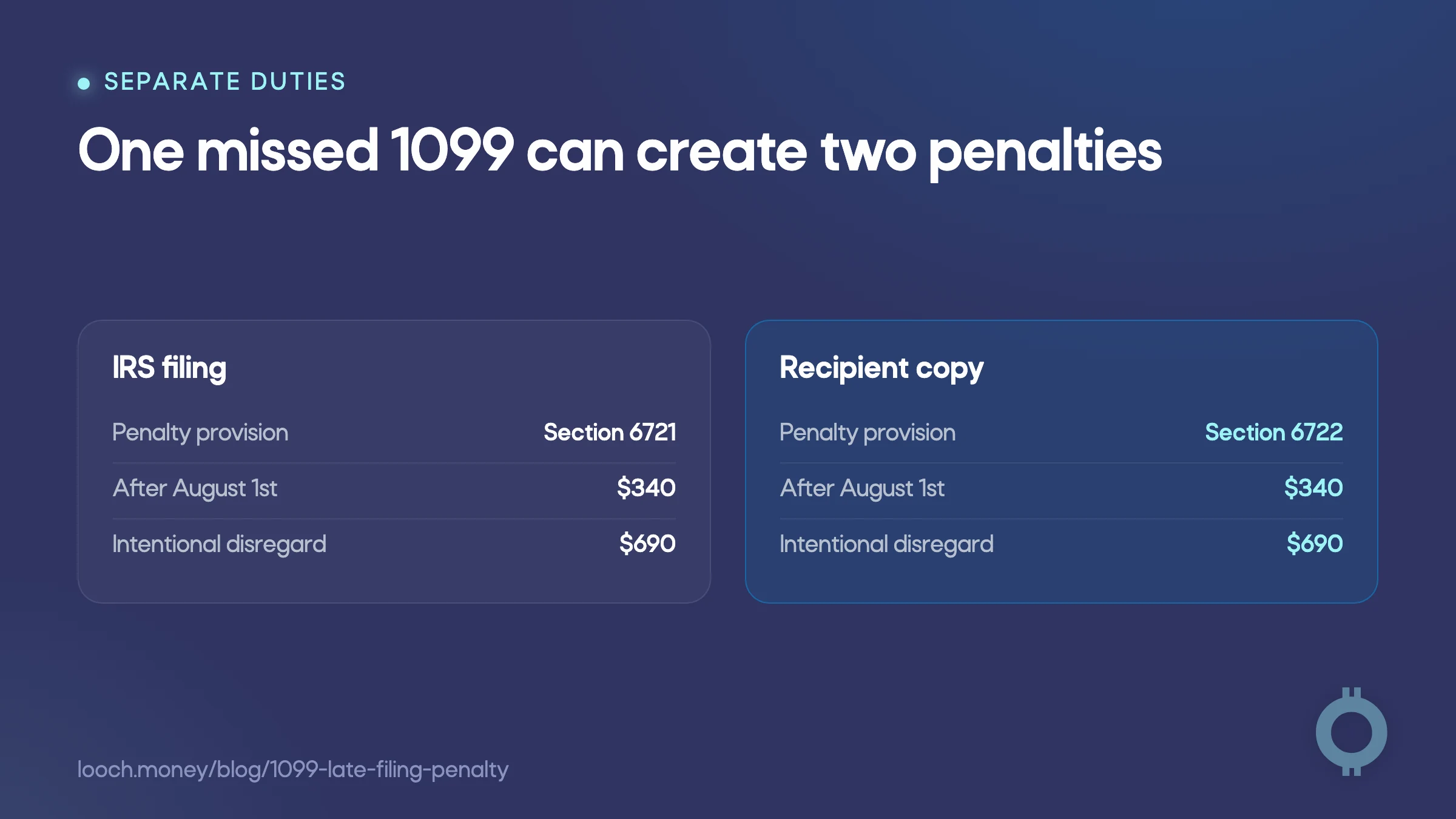
The IRS treats filing the return and furnishing the recipient statement as separate duties. Section 6721 covers the return filed with the IRS. Section 6722 covers the statement furnished to the payee. Both use the same late-filing schedule, and both can apply to one missed form.
| Missed duty | What the penalty covers | Why it matters |
|---|---|---|
| Filing with the IRS | The information return | A late or missing filing can trigger section 6721 |
| Furnishing the recipient copy | The payee statement | A late or missing statement can trigger section 6722 |
Take the common worst case: One contractor’s 1099-NEC is never filed and never furnished. That can mean $340 under section 6721 plus $340 under section 6722, or $680 for one form. If the IRS finds intentional disregard, it can mean $690 plus $690, or $1,380.
That distinction matters when you’re estimating exposure. Do not count forms alone. Count whether the IRS filing, the recipient copy, or both were missed.
Small-business caps limit ordinary penalties, not intentional disregard
The per-form amounts accumulate until they reach an annual cap. For the 2027 season, a business with average annual gross receipts of $5,000,000 or less over the most recent three tax years gets the small-business maximums shown in the first table: $244,500 at the $60 tier, $698,500 at the $130 tier, and $1,397,000 at the $340 tier.
Larger filers face caps of $698,500, $2,095,500, and $4,191,500. The recipient-statement penalty has its own corresponding caps. In other words, the cap on the IRS filing side doesn’t erase potential exposure for statements you failed to furnish.
Intentional disregard works differently. It has no maximum, and the penalty is the greater of $690 or 10% of the amounts that should have been reported. A business that deliberately ignores a large reporting obligation can therefore face a penalty above the stated per-form amount.
A reasonable-cause response needs facts, not a vague apology
A penalty isn’t always final. The IRS may remove or reduce it for reasonable cause when you acted in good faith, acted responsibly before and after the failure, and can show significant circumstances beyond your control.
The useful record’s specific. It might show that you pursued a missing W-9, dealt with a disaster or death, or faced a system failure outside your control. Forgetting the deadline is not the same kind of argument. Save the follow-ups, dates, correspondence, and corrective steps that show what happened and what you did once you found it.
Penalty assessments arrive on Notice 972CG. You have 45 days to respond, or 60 days if you’re a foreign filer, before the penalty is assessed. Respond within that window with the facts supporting reasonable cause. Do not assume paying first is the only way to keep the conversation open.
Interest runs monthly on assessed penalties until they’re paid. The IRS can’t remove interest unless it removes or reduces the penalty itself.
Filing now is cheaper than waiting for a notice
Every tier rewards speed. Filing 29 days late costs $60 per form instead of $340, an 82% discount for acting inside a month. If you find unfiled 1099s in February, file them now rather than waiting for a notice.
The better workflow starts before the deadline. looch AI uses your actual transactions and payment methods to identify which payments are reportable, then supports instant filing at tax season. Filing a 1099 costs $2. One form that reaches the after-August-1 tier costs 170 times that before the recipient-copy penalty is considered.
looch can help keep the filing work close to the payments and books that create it. It isn’t a substitute for professional advice on an assessed penalty, a Notice 972CG, or prior-year filings that were never made. Those are situations for a CPA or enrolled agent who can assess the facts and make the reasonable-cause argument.
Sources: IRS information return penalties for the returns-due-in-2026 amounts, separate filing and furnishing penalties, reasonable cause, and interest; Rev. Proc. 2025-32 sections 4.57 and 4.58 for returns-due-in-2027 figures. Verified August 26th, 2026.


