


Trademark monitoring services: Cost and how often they check
Amounts last verified on September 21st 2026
Michel Myara is co-founder and product designer at looch, where he designs the ecosystem small businesses use to get paid and manage spend while keeping penny-perfect books.
Updated August 2026
What trademark monitoring services cost in 2026

A US trademark watch runs $228/year to $500/year per mark, and the price does not buy what you would guess: The cheapest service in this table checks weekly, while more expensive services report monthly or quarterly. Prices and frequencies below were read from each provider’s own site, except where noted:
| Service | How often it checks | Price |
|---|---|---|
| looch business protection bundle | Weekly, every Tuesday | $249/year (the business protection bundle: Registered agent, virtual office, annual report filing, weekly trademark monitoring) |
| Trademark Factory TM Watch Silver | Weekly | $19/month per mark per country ($228/year) |
| LegalZoom | Monthly | $249/year |
| Gerben IP | Quarterly reports | $395/year |
| Trademarkia watch subscription | Not verified | From $500/year ($125/quarter, or $59/month) |
| Trademark Engine | “Periodic” reports, cadence not stated | Shown only at checkout |
| Corsearch, Clarivate CompuMark | Not published | Custom quote (enterprise) |
Last verified: August 27th, 2026. Per mark, per year, US federal coverage unless noted.
Trademarkia is the exception to that sourcing: Its site blocks automated reading, so its starting price was taken from the live site by hand on August 27th, 2026, and its check frequency is left unstated because we could not verify it.
One number in that table gets misquoted constantly: LegalZoom. Comparison articles still in circulation price its monitoring at $175/year, a figure that traces to early 2024. LegalZoom’s own page prices it at $249/year today, for a monthly check of federal databases and a monthly report with conflicts ranked by risk; talking to an attorney about a hit costs extra. And one service people search for doesn’t exist: Rocket Lawyer sells no conflict watch. Its “monitoring” tracks the status of your own application, not other people’s filings against your mark.
Check frequency is the number nobody prints next to the price
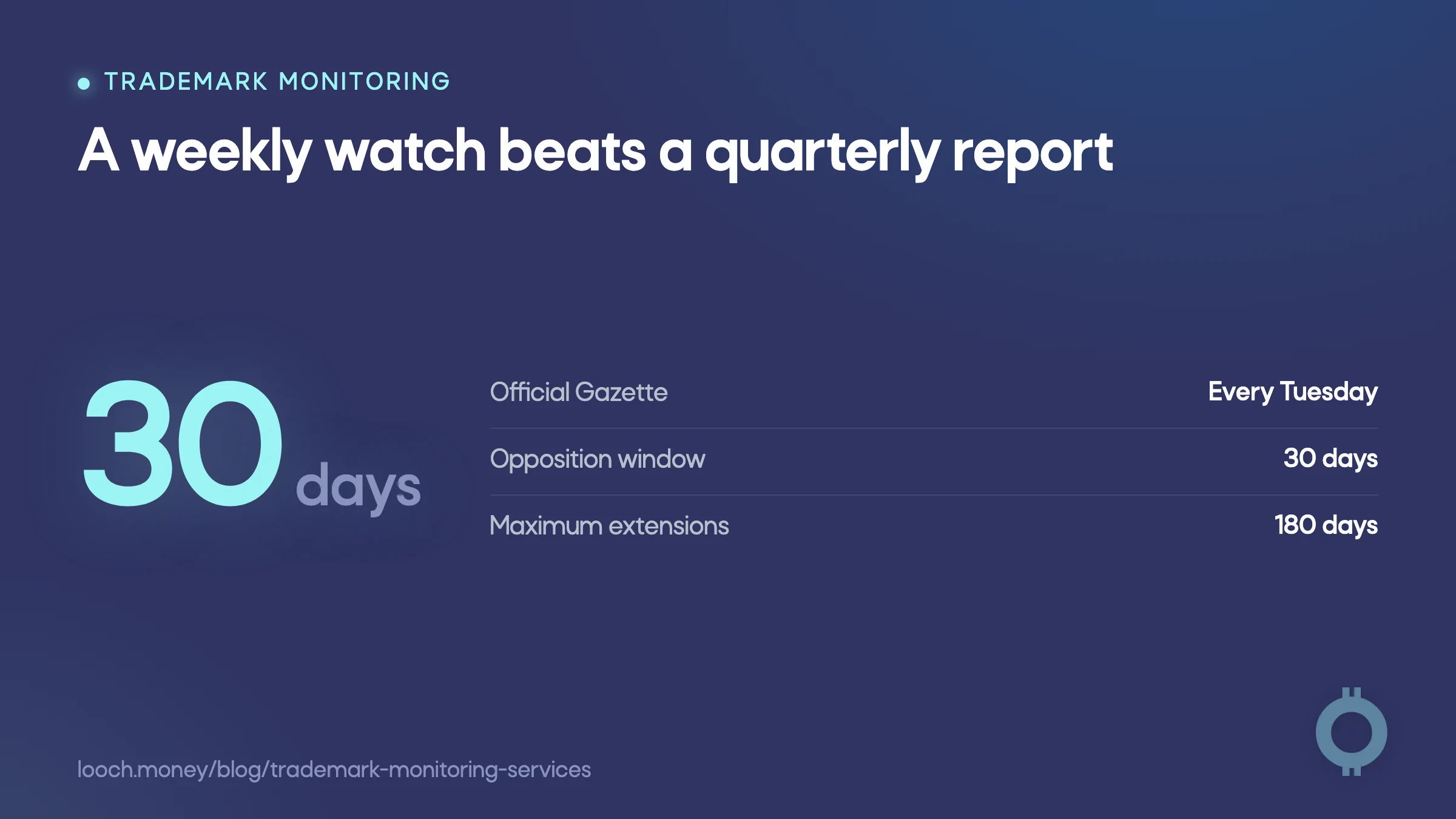
Frequency matters because the response deadline is short. When the USPTO approves an application similar to your mark, it publishes it in the Official Gazette on a Tuesday, and from that day you have 30 days to oppose or request more time, never more than 180 days even with every extension. A quarterly report can hand you a conflict whose window closed two months ago. A monthly report can surface one with days left. Against a 30-day clock, a weekly Tuesday check is the cadence that works: It reads every new Official Gazette publication the day it appears. A daily check re-reads an unchanged register six days out of seven.
So before buying any service, ask one question: When a conflicting mark is published, how many days later do I hear about it? If the answer is “in the next quarterly report,” the service documents your losses. It does not prevent them.
What the price actually buys
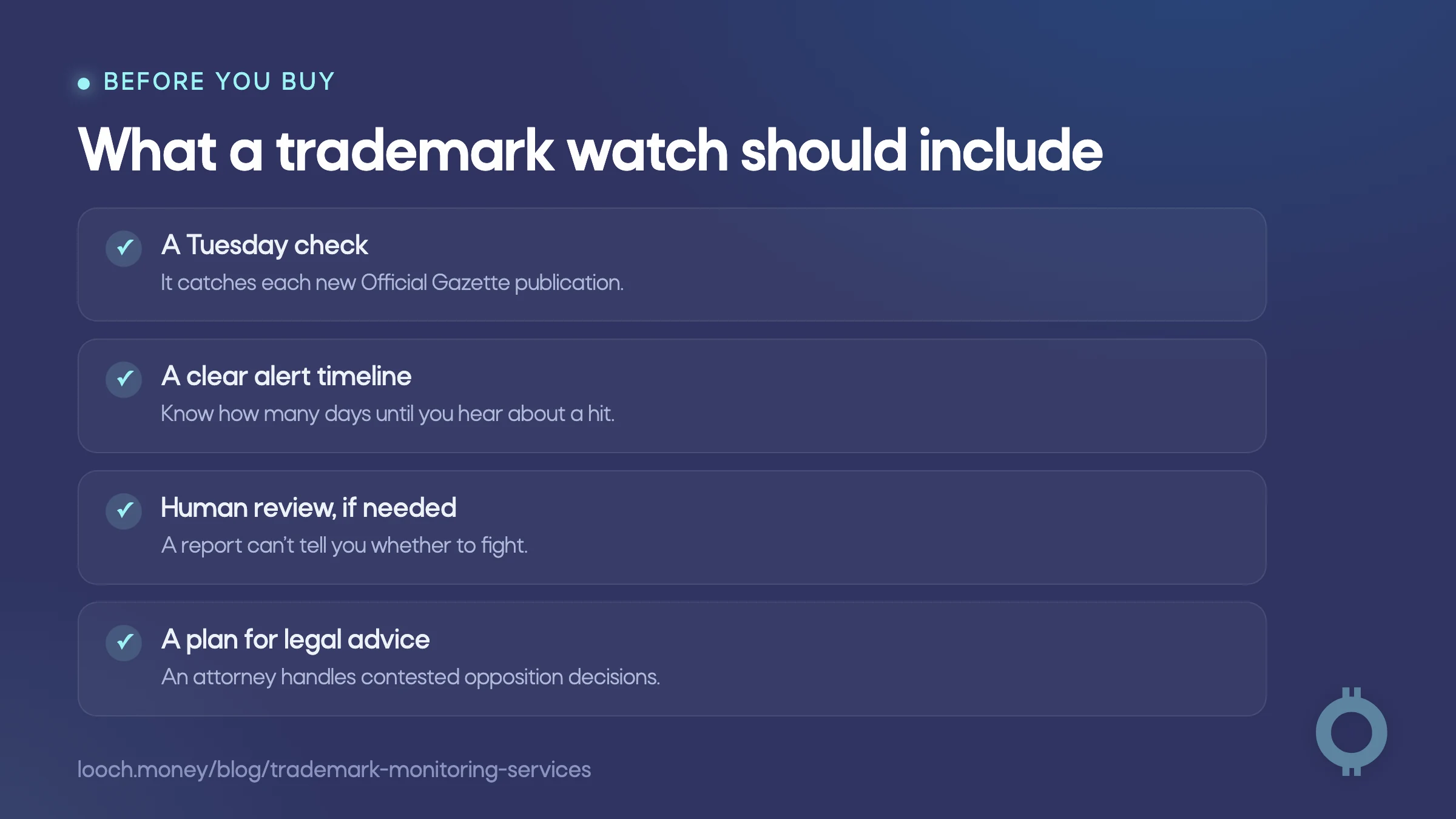
The search itself is a commodity, but more frequent checking is not automatically better. A weekly Tuesday watch reads each new Official Gazette publication when it appears, while a daily check re-reads an unchanged register six days out of seven. Higher-priced services can buy one of two human things: Someone who reads the report so you don’t stare at forty near-matches wondering which one matters, and someone who helps you respond when one does. That is what Gerben IP’s $395/year watch and Trademark Factory’s $47/month Gold tier are actually selling, and for a brand your whole business rides on, professional judgment is worth paying for. Price alone doesn’t tell you which one you’re buying: The priciest non-enterprise subscription in the table costs more than Gerben IP’s $395/year watch, so read what a tier includes rather than treating its price as a proxy for human judgment. The enterprise platforms (Corsearch, Clarivate CompuMark) sell global coverage across hundreds of registers with analyst review, at quote-only prices aimed at in-house legal teams, which is why no small-business list should send you there.
The honest limit of every automated watch, ours included: It tells you a filing happened. It does not tell you whether to fight. That decision is legal judgment, and for a contested or high-value mark it belongs with a trademark attorney.
The looch business protection bundle
looch’s business protection bundle is the looch Start renewal at $249/year and includes exactly four things: Registered agent service, the virtual office (a business address that keeps the owner’s address off public records, with mail scanning), the state annual report filing, and weekly trademark monitoring every Tuesday. One subscription, in the same app that formed your company and runs its accounts. Details are on the pricing page.
The two-sided version: The bundle watches every Tuesday, when the USPTO publishes the Official Gazette, and files your compliance paperwork, which is exactly the coverage most small marks need. It is not a law firm (Simplicity Fintech Inc does not provide legal advice), so when an alert turns into a fight, you hire counsel for the opposition itself, the same as with every non-attorney service in the table.
Budget for the alert, not just the watch
The subscription is the cheap half. What an alert triggers, per the USPTO fee schedule, is the half to budget for:
| Response | USPTO fee |
|---|---|
| Letter of protest (application still being examined) | $150 |
| First 30-day extension of time to oppose | $0 |
| 90-day or second 60-day extension | $200 |
| Final 60-day extension | $400 |
| Notice of opposition, per class | $600 |
| Petition to cancel a registration, per class | $600 |
Those are filing fees only; attorney time for a contested opposition is its own line. The pattern to notice: Everything gets more expensive as the application ages, which is the financial case for a frequent watch. The $150 letter of protest and the free extension only exist for owners who found out in time.
Can you just do it yourself?
Yes, and the tooling is free: The Trademark Official Gazette publishes every Tuesday, and the USPTO’s search covers every new application. The USPTO itself provides no monitoring or alert service, so free means you are the service: Every Tuesday, your name plus misspellings and soundalikes, logged, forever. Why the watching matters at all, and what happens to unwatched marks, is the subject of our trademark monitoring guide.
Common questions
Is trademark monitoring worth it for a small business?
Weigh a watch’s annual cost against what a missed conflict costs: A $600 per class opposition you can no longer file, narrowed protection each time a similar mark registers unopposed, and in the worst case a rebrand. If the brand is worth protecting at all, a watch at some price tier is the cheapest part of protecting it.
How does LegalZoom trademark monitoring work?
$249/year per mark. LegalZoom checks federal databases monthly for new applications similar to yours, including soundalikes and close spellings, and sends a monthly report with potential conflicts ranked by risk. Attorney consultation about a hit costs extra. The $175/year price you may see quoted elsewhere is out of date.
How much does it cost to oppose a trademark application?
The USPTO filing fee is $600 per class of goods or services, filed with the Trademark Trial and Appeal Board within 30 days of the mark’s publication (extensions can stretch that to at most 180 days: The first 30 days are free, later ones cost $200 to $400). Attorney fees for a contested opposition come on top.
This post covers general trademark considerations and is not legal advice. Fees and provider prices change. Confirm current figures at uspto.gov and on each provider’s site, and consult a trademark attorney for your specific situation.


