


Trademark monitoring: Why the USPTO won’t protect your mark
Amounts last verified on September 21st 2026
Michel Myara is co-founder and product designer at looch, where he designs the ecosystem small businesses use to get paid and manage spend while keeping penny-perfect books.
Updated August 2026
Nobody at the USPTO is watching your trademark

Registering a trademark and protecting one are two different jobs, and the USPTO only does the first. Its own warning to trademark owners says it plainly: “The USPTO does not provide trademark monitoring or any similar services.” When someone files an application confusingly close to your mark, no letter arrives. The numbers that govern what happens next:
- Every Tuesday: The USPTO publishes newly approved marks in the Trademark Official Gazette
- 30 days from publication: Your window to oppose, under 15 U.S.C. 1063, extendable to 180 days at the absolute most
- $600 per class: The fee to file an opposition, per the USPTO fee schedule
- $150: A letter of protest while the application is still being examined
- 5 years from registration: The window to petition to cancel a mark that got through
Last verified: August 27th, 2026.
What the watching itself costs, service by service, is in our comparison of trademark monitoring services. This page covers why monitoring is part of owning a mark at all.
Similar marks get approved all the time
When your mark registered, a USPTO examining attorney searched for conflicts. The same search runs against every new application, and it is narrower than most owners assume. The examining attorney compares the new mark against registered marks and earlier pending applications for a likelihood of confusion, the Section 2(d) test. Similarity is a judgment call, not a lookup. Marks that share a word, a sound, or an overall impression with yours get approved every week, because an examining attorney judged the goods different enough or the shared element weak enough. The system is built with that in mind: Approval is not the final word. Every approved application is published for opposition precisely so the people with something at stake, owners like you, can object before it registers. If nobody objects within 30 days, it registers.
Two more gaps make the point sharper. The examining attorney does not search state registrations or unregistered common-law marks at all (TMEP section 1207.03 excludes them from examination), so a business trading under a name close to yours without ever filing is invisible to the process. And the USPTO never contacts existing registrants about a new application. The only party expected to notice a conflicting filing is you.
Each mark that slips through makes the next one easier
Miss one similar mark and the damage is not one competitor. Trademark law weighs coexistence. When a later applicant is refused because their mark is close to yours, the standard comeback is to point at the similar marks already living side by side on the register: If those coexist with yours, why not one more? Under TMEP section 1207.01(d)(iii), applying the Federal Circuit’s Juice Generation and Jack Wolfskin decisions, evidence of extensive third-party registration and use of similar marks shows a mark is weak and “entitled to only a narrow scope of protection.”
So the pattern compounds. The first similar mark registers because nobody opposed it. The second cites the first as proof the field is shared. The third cites both. Lawyers call the end state a crowded field; the plain word is dilution. Your registration still exists, but every round shrinks what it can stop, and an opposition you would have won against the first filer becomes a coin flip against the fourth. Waiting carries its own penalty too: Sit on your rights for years while someone builds their brand, and the doctrine of laches can bar the remedy you finally ask for.
The 30-day window is why checking weekly on Tuesday works
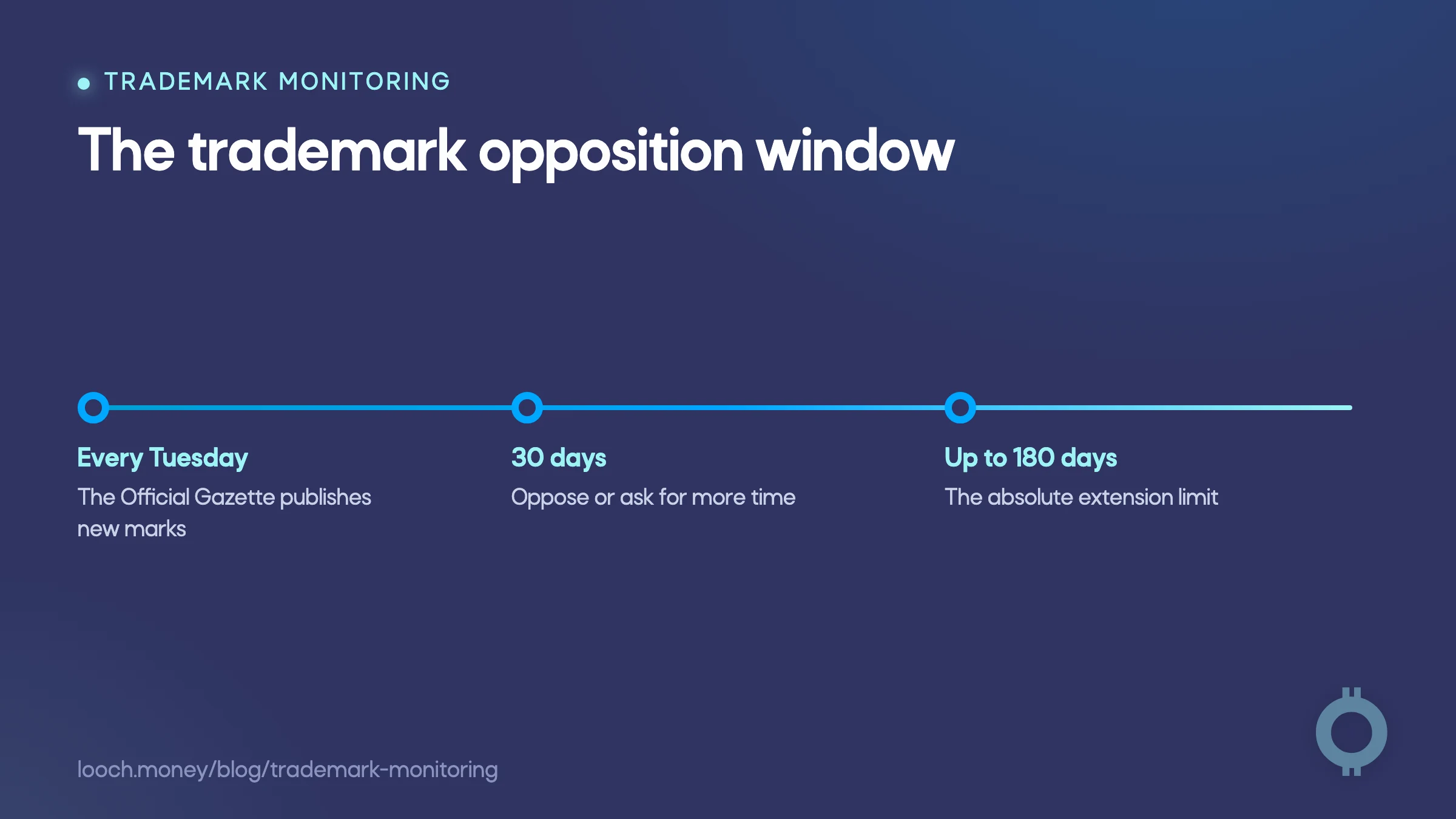
The clock is short and it does not announce itself. Approved applications publish in the Official Gazette each Tuesday. From publication you have 30 days to file an opposition or ask for more time. Under 37 CFR 2.102, a first 30-day extension is granted just for asking and costs nothing; a 90-day first request or a second 60-day request takes good cause and $200; a final 60-day extension takes the applicant’s consent or extraordinary circumstances and $400; and nothing extends the window past 180 days from publication.
Thirty days sounds like plenty until you put a checking cadence against it. A service that reports quarterly can hand you a conflict whose window closed two months ago. A monthly report can surface a publication with a few days left, or none. Weekly checking every Tuesday gives you the full opposition window because the USPTO publishes the Official Gazette that day. A mark can’t publish on a Wednesday, so a daily check re-reads an unchanged register six days out of seven.
What to do when a similar mark shows up
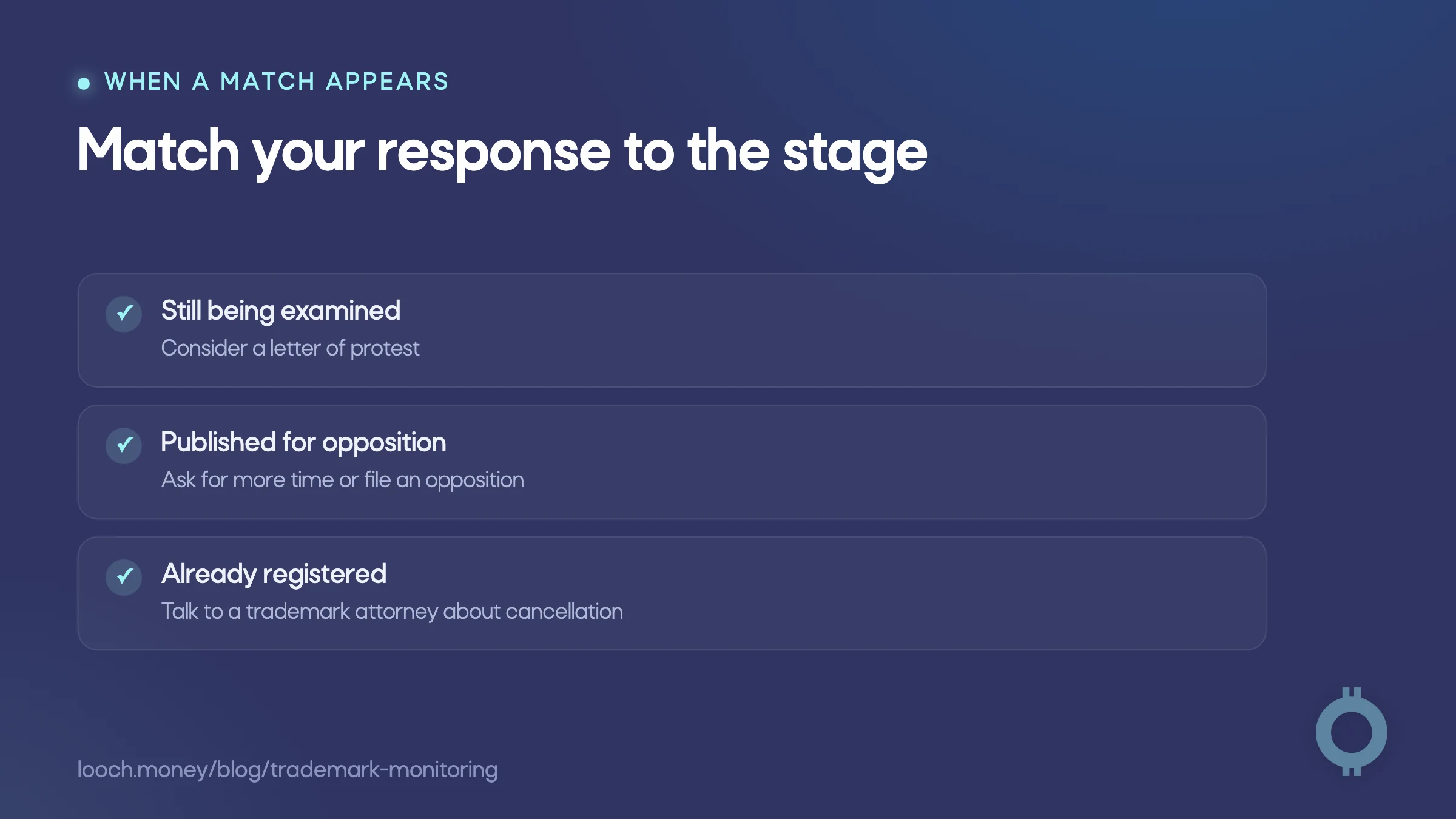
The right move depends on where the application is in its life:
- Still being examined: File a letter of protest, $150. Before publication the bar is low; your evidence just has to be relevant to a possible refusal, and your existing registration usually is.
- Published for opposition: The 30-day clock is running. The free first extension buys you 30 more days to get advice. An opposition itself is $600 per class at the Trademark Trial and Appeal Board.
- Already registered: You can petition to cancel within 5 years of registration on likelihood-of-confusion grounds, $600 per class, under 15 U.S.C. 1064. After five years of continuous use and a Section 15 filing, the registration can become incontestable, and that door mostly closes.
Each stage is more expensive than the one before it, which is the whole argument for finding conflicts early. For anything contested, or any mark your business genuinely depends on, bring in a trademark attorney.
Monitoring it yourself, and what that honestly takes
The do-it-yourself version is free: Read the Official Gazette every Tuesday, search new USPTO applications for your name plus the misspellings and soundalikes, and log what you find. The price is discipline. It is every week, forever, and the weeks you skip are the weeks the window runs. We hold registered trademarks ourselves (looch and the infinity-ring logo are registered trademarks of Simplicity Fintech Inc), so this is a chore we know first-hand.
That chore is why monitoring services exist, and why looch builds it into the business protection bundle: $249/year covers registered agent service, virtual office, your state annual report filing, and weekly trademark monitoring every Tuesday, alongside the company you formed with looch Start. Details are on the pricing page. And for what the rest of the market charges, and how often each service actually checks, read the trademark monitoring services comparison.
Common questions
Does the USPTO notify you when someone files a similar trademark?
No. The USPTO states outright that it provides no monitoring or similar services. Examination happens between the examining attorney and the applicant; existing registrants are not contacted at any point. The first official mention an owner gets is publication in the Official Gazette, and only if they are reading it.
How long is the trademark opposition period?
30 days from the mark’s publication in the Official Gazette. A first 30-day extension is free for the asking; further extensions need good cause or consent and carry $200 to $400 fees; 180 days from publication is the hard stop.
Can you lose your trademark by not monitoring it?
The registration does not vanish, but the protection erodes. Similar marks that register unopposed become evidence that your mark deserves only narrow protection, waiting years to enforce invites a laches defense, and after five years an infringing registration can become incontestable. You keep the certificate and lose the point of it.
This post covers general trademark considerations and is not legal advice. Fees and procedures change. Confirm current figures at uspto.gov and consult a trademark attorney for your specific situation.


