


How to reduce card processing fees: Two levers
Amounts last verified on September 21st 2026
Michel Myara is co-founder and product designer at looch, where he designs the ecosystem small businesses use to get paid and manage spend while keeping penny-perfect books.
A small business cuts card processing fees by moving payments off cards and by choosing who pays the card fee: Instant pay by bank costs 1%, capped at $10, against 3.3% + 30¢ for a card

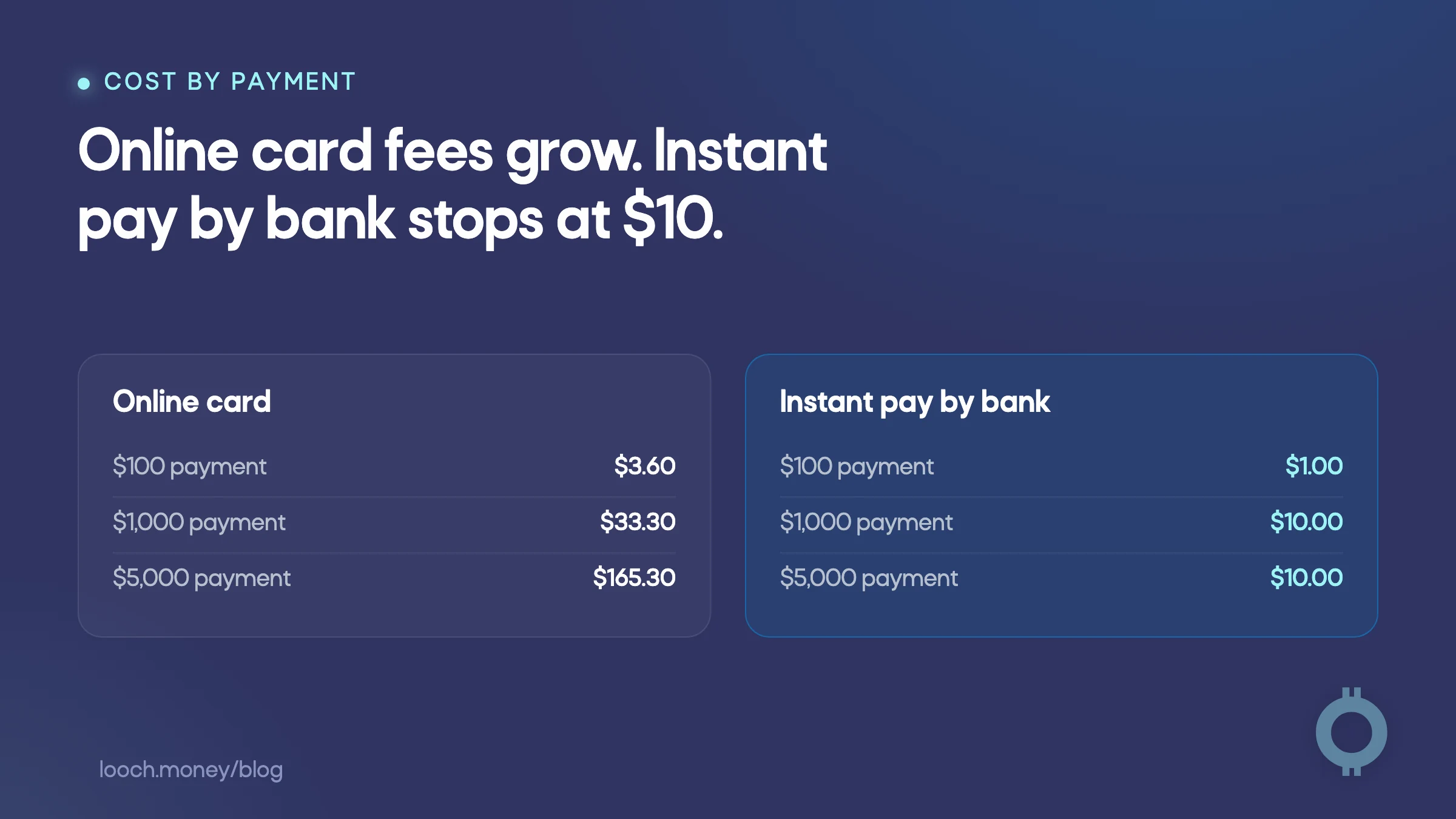
A small business can reduce card processing fees by offering a lower-cost payment method and deciding who covers each card fee. looch’s published rates are 3.3% + 30¢ for an online card and 1% (min $1, max $10) for instant pay by bank. On a $1,000 payment, that’s $33.30 by card against $10.00 by instant pay by bank. On $5,000, it’s $165.30 against the same $10.00. For context, Square publishes an online API card rate of 2.9% + 30¢, while the Federal Reserve’s regulated debit cap is $0.21 plus 0.05% of the transaction, plus a $0.01 fraud-prevention adjustment if eligible.
looch Pay, the payments product from looch, accepts cards, Apple Pay, Google Pay and instant pay by bank, and lets a business decide per payment whether it or the contact pays the card fee. That choice is available in the looch Pay savings calculator.
Last verified: September 28th, 2026.
| Method with looch Pay | Rate | Fee on $1,000 | When the money is final |
|---|---|---|---|
| Instant pay by bank | 1% (min $1, max $10) | $10.00 | Final on arrival. Money arrives in seconds from banks that support instant payments. No disputes, no chargebacks, no reserves. |
| Card, online | 3.3% + 30¢ | $33.30 | Settles, but a card payment can still be disputed afterward. A dispute costs $35, and countering it is free. |
| Card, in person with tap to pay | 3% + 15¢ | $30.15 | Same as a card online. |
| Card, fee passed to the contact | The contact pays the card fee | $0.00 to the business | Same as a card. The business keeps the full $1,000. |
A card fee is a percentage plus a fixed amount, and most of it is interchange you can’t negotiate
A card processing fee has three broad parts: Interchange, network assessment fees and processor markup. Interchange is set by the card networks and paid to the card-issuing bank. A processor can negotiate its own markup, but it can’t negotiate interchange away.
The Federal Reserve’s debit data shows why there’s a floor. In 2024, average debit interchange was $0.23 per transaction and 0.47% of transaction value for covered issuers. For exempt issuers, it was $0.51 and 1.21%.
Reviewing a statement can uncover added fees or a markup that has crept up. Negotiating that markup can help too. But neither changes the basic arithmetic: A percentage fee grows with every dollar collected.
That’s why moving a suitable payment off cards creates more room than shaving a small amount from the processor’s markup.
Published card rates are close together, so switching processors saves less than moving the payment
Card processors price transactions differently, but their published card rates tend to cluster within a narrow range. Here’s what their own pricing pages showed on September 28th, 2026.
| Processor | Online | In person | Fee on $1,000 online |
|---|---|---|---|
| Square | 3.3% + 30¢, or 2.9% + 30¢ by API | 2.6% + 15¢ | $33.30, or $29.30 by API |
| PayPal | 2.99% + $0.49 standard, or 3.49% + $0.49 for PayPal Checkout | 2.29% + $0.09 | $30.39 or $35.39 |
| looch Pay | 3.3% + 30¢ | 3% + 15¢ | $33.30 |
looch Pay’s online card rate is equal to Square’s standard online rate. Its in-person rate is higher than Square’s and PayPal’s.
The spread among these published online card fees is a few dollars on a $1,000 payment. The gap between those card fees and a capped $10 instant pay by bank fee is about $19 to $25. Switching card processors can save something. Switching the payment method can save more.
Lever one, take the payment off cards: Instant pay by bank is 1%, capped at $10, and the money is final when it lands
Instant pay by bank changes the economics because its fee stops growing after it reaches the cap.
| Payment amount | looch Pay card online | looch Pay instant pay by bank | Difference |
|---|---|---|---|
| $100 | $3.60 | $1.00 | Card costs more |
| $1,000 | $33.30 | $10.00 | Card costs more |
| $5,000 | $165.30 | $10.00 | Card costs more |
The customer approves the payment from their own bank. The money is pushed straight to the business, arrives instantly from banks that support instant payments and is final on arrival. No disputes. No chargebacks. No reserves.
The difference compounds across regular volume. At the looch Pay calculator’s published defaults, a $250 average transaction size and $25,000 in monthly volume produce 100 payments. Online cards cost $855.00/month, while instant pay by bank costs $250.00/month. That’s a difference of $605.00/month, or $7,260.00/year.
There’s one edge case in the arithmetic. Below about $21.21, the $1 minimum for instant pay by bank can make an online card cheaper. Above that point, the percentage and cap create more room to save as the payment grows.
Read the full comparison of pay by bank and cards for more on where each method fits.
Lever two, decide who pays the card fee: looch Pay lets you pass it to the contact on each payment
A business doesn’t always need to absorb the card fee. looch Pay lets it decide per payment whether it or the contact covers that fee.
When the contact pays the card fee, the business keeps the full $100, $1,000 or $5,000 payment amount. This is a card-only choice. Instant pay by bank is always free to the customer, and the business pays its 1% fee subject to the $1 minimum and $10 maximum.
That makes the decision practical rather than all-or-nothing. A business can absorb the fee when it helps close a sale, pass it along where permitted, or offer instant pay by bank when speed, finality and a capped fee matter most.
Surcharging has rules, and they come from the card networks and your state
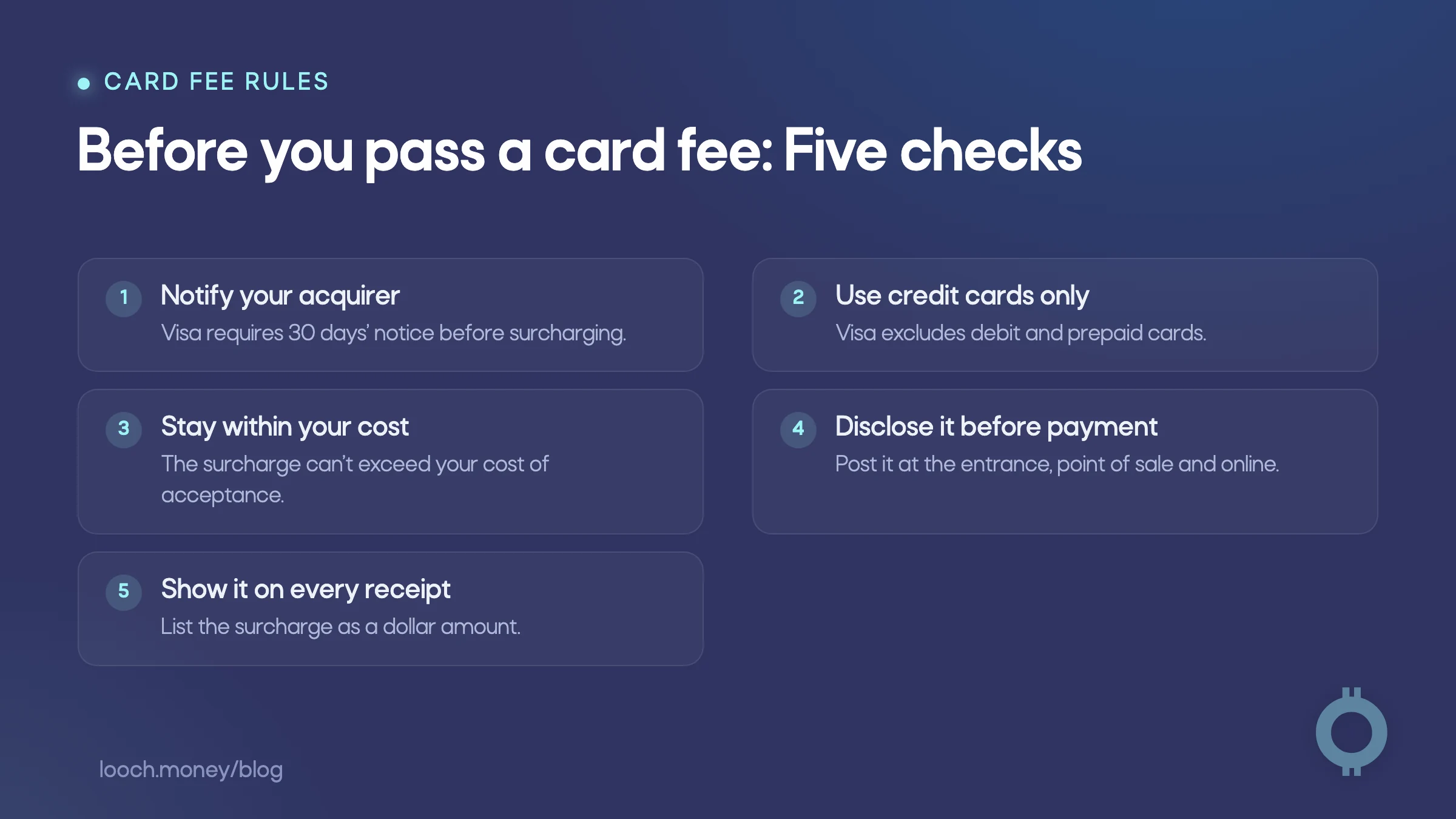
Passing a card fee requires attention to the card network’s rules and the law where the transaction happens.
Visa says a merchant must notify its acquirer 30 days before beginning to surcharge. Its merchant surcharge FAQ says surcharges apply only to credit cards, never debit or prepaid cards. A surcharge can’t exceed the cost of acceptance, and it must be disclosed at the entrance, at the point of sale, online and as a dollar amount on every receipt.
State rules aren’t uniform:
| State | Verified rule |
|---|---|
| Massachusetts | Credit card surcharges are prohibited, but cash discounts are allowed. |
| Maine | Credit and debit card surcharges are prohibited. A discount from the regular price isn’t treated as a surcharge. |
| New York | A surcharge is allowed only when the total credit card price is clearly posted, and it can’t exceed what the card company charges the business. A violation can carry a civil penalty of up to $500. Two-tier pricing is allowed. |
These rules change. Check the current law in every state where you plan to pass a credit card fee. Cash discounts and two-tier pricing may be available where a surcharge isn’t.
Smaller levers still count, and each one has a measurable value
The standard card-cost tactics are real. They’re simply smaller than moving an eligible payment off cards or choosing who pays the fee.
Read the statement. Look for processor markup, added monthly charges and a rate that no longer matches the plan you accepted. Interchange itself can’t be negotiated, but processor markup may be flexible.
Avoid manual entry when the card is present. Square publishes 3.5% + 15¢ for manual entry or a card on file, against 2.6% + 15¢ when a card is tapped, dipped or swiped.
Prefer in-person acceptance when it fits the sale. looch Pay charges 3% + 15¢ in person, compared with 3.3% + 30¢ online. On a $1,000 payment, that’s $30.15 instead of $33.30.
Watch foreign card costs. looch Pay adds 1.5% for foreign cards. PayPal also adds 1.50% for qualifying international transactions.
Keep card disputes in the comparison. looch charges $35 for a card dispute and makes countering it free. PayPal publishes a $15.00 dispute fee and a $20.00 chargeback fee. Instant pay by bank has no disputes or chargebacks, which is part of the value of money that arrives done.
A card processor alone is the better fit in several cases
Cards can be the better fit for tickets below about $21, where the $1 minimum for instant pay by bank changes the comparison. They can also win whenever the contact strongly prefers a familiar card checkout. Saving a fee isn’t useful if it costs the sale.
A counter business with heavy in-person volume may prefer Square’s 2.6% + 15¢ rate or PayPal’s 2.29% + $0.09 rate over looch Pay’s 3% + 15¢. An online store may prefer Square’s 2.9% + 30¢ online API pricing.
PayPal can also be a better fit when its familiar checkout and consumer protection experience matter more than an integrated business account. Read the honest comparison of PayPal and looch for that case.
Square publishes a capped invoice payment option too. Square lists ACH bank transfer through an invoice at 1%, with a $1 minimum and $10 cap. A business already committed to the platform should compare the cap, checkout flow and accounting work, not only the headline percentage.
A card-focused processor may also be the better fit for international sales, currency conversion or a business whose contacts will only pay by card. looch isn’t built as an international card-acquiring platform.
For the broader product decision, see where an all-in-one financial platform fits.
FAQ
How can a small business reduce card processing fees?
Move suitable payments from a card priced at 3.3% + 30¢ to instant pay by bank at 1% (min $1, max $10), especially for larger invoices. A business can also use looch Pay’s per-payment choice to decide whether it or the contact pays the card fee.
Can a small business pass credit card fees to customers?
Yes, where card network rules and state law permit it. looch Pay lets the business make that choice per payment, but credit card surcharges require notice and clear disclosure, and they can’t be applied to debit or prepaid cards under Visa’s rules.
Is it legal to add a credit card surcharge?
It depends on the state. Massachusetts and Maine prohibit the surcharges covered by their statutes, while New York permits one when the total card price is posted and the surcharge doesn’t exceed the business’ card cost. Visa also requires 30 days’ notice to the acquirer and prohibits surcharges on debit and prepaid cards.
What is the cheapest way to accept a $1,000 payment?
Among the looch Pay methods compared here, instant pay by bank costs $10.00 on a $1,000 payment. The published online card fees in this comparison range from $29.30 to $35.39.
Is pay by bank cheaper than a card for a small business?
Above about $21.21 under looch Pay’s published rates, instant pay by bank is generally cheaper than an online card because it costs 1% and stops at $10. Card fees keep growing with the payment amount, while instant pay by bank money is final on arrival.
Sources
- looch pricing
- looch Pay
- Square payment fees
- PayPal merchant fees
- Federal Reserve Regulation II average interchange fees
- Visa surcharging rules
- Visa’s merchant surcharge FAQ
- Massachusetts General Laws, Chapter 140D, Section 28A
- Maine Revised Statutes, Title 9-A, Section 8-509
- New York General Business Law, Section 518
Last verified: September 28th, 2026.
looch gives you both payment methods and the choice on every payment
looch Pay accepts cards and instant pay by bank in one checkout. The business can choose who covers the card fee per payment, while instant pay by bank delivers money that’s final on arrival at 1% (min $1, max $10).
The payment lands in a looch profile, and real-time accounting keeps it entered and categorized as it happens. Explore looch Pay and its savings calculator, then review looch’s published rates.


