


Subscription payment recovery: Stop failed renewals
Amounts last verified on September 23rd 2026
Michel Myara is co-founder and product designer at looch, where he designs the ecosystem small businesses use to get paid and manage spend while keeping penny-perfect books.
How do I recover failed subscription payments?

Subscription payment recovery saves a renewal after the first card charge fails. A good system reads the decline, decides whether and when to retry, tells the customer what happened, and gives them a clear place to pay when they need to act.
The first failure shouldn’t automatically end the subscription. Many failed subscription payments can still be collected without forcing the customer to sign up again or asking your team to chase them manually.
The practical recovery sequence looks like this:
- Read why the card was declined and what the card network says to do next.
- Separate declines that may succeed later from cards that shouldn’t be retried.
- Retry only when the available signals support another attempt.
- Tell the customer that the renewal failed in plain language.
- Send the customer somewhere secure to pay when their action is required.
- Keep access open long enough to give a willing customer a fair chance to fix the payment.
- Stop when the card can’t succeed or the network rules prohibit another attempt.
That’s more than a retry button. It’s a recovery process that treats each decline according to what actually happened.
What is involuntary churn, and how do I reduce it?
Involuntary churn is the loss of a subscription because payment failed, not because the customer chose to leave. Reducing it means recovering willing customers before a payment problem becomes a cancellation.
A useful formula is:
Involuntary churn rate = subscriptions lost to failed payments ÷ subscriptions due to renew × 100
Track voluntary and involuntary churn separately. A product problem, a pricing objection, and a declined card need different fixes.
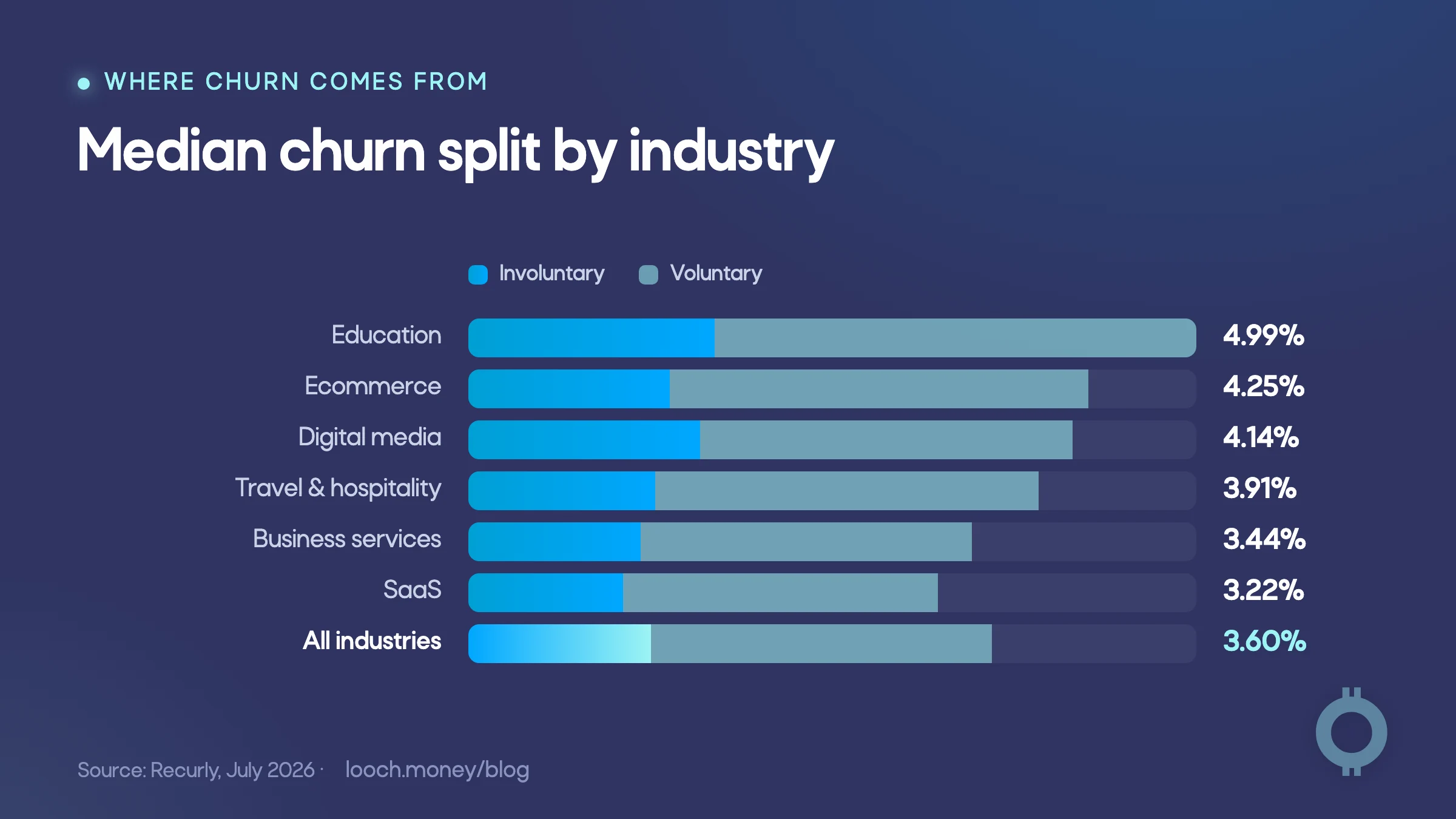
Recurly’s July 2026 network data reports an all-industries median churn rate of 3.60%, split between 2.34% voluntary churn and 1.25% involuntary churn. In that dataset, involuntary churn is 34.7% of the overall rate, roughly a third of all churn.
| Industry | Total | Voluntary | Involuntary |
|---|---|---|---|
| Education | 4.99% | 3.30% | 1.69% |
| Ecommerce | 4.25% | 2.87% | 1.38% |
| Digital media & entertainment | 4.14% | 2.55% | 1.59% |
| Travel, hospitality & entertainment | 3.91% | 2.63% | 1.28% |
| Business & professional services | 3.44% | 2.27% | 1.18% |
| SaaS | 3.22% | 2.16% | 1.06% |
| All industries | 3.60% | 2.34% | 1.25% |
Paddle estimates that 20% to 40% of churn is typically involuntary, particularly for businesses that accept card payments. That’s Paddle’s estimate, based in part on one sample seller whose involuntary share averaged about 30%.
Why do subscription card payments fail?
A failed renewal doesn’t tell you that the customer wants to cancel. It tells you that this particular authorization didn’t complete.
The reason may be temporary, such as insufficient funds. It may require the customer to approve or replace something. It may also be final because the card is closed, lost, stolen, or otherwise unusable.
Recurly reports that credit cards had a 6.0% recurring transaction decline rate in its 2022 data, compared with 13.1% for debit cards. The difference matters because a subscription business with many debit-card customers may see a different failure pattern from one with mostly credit-card customers.
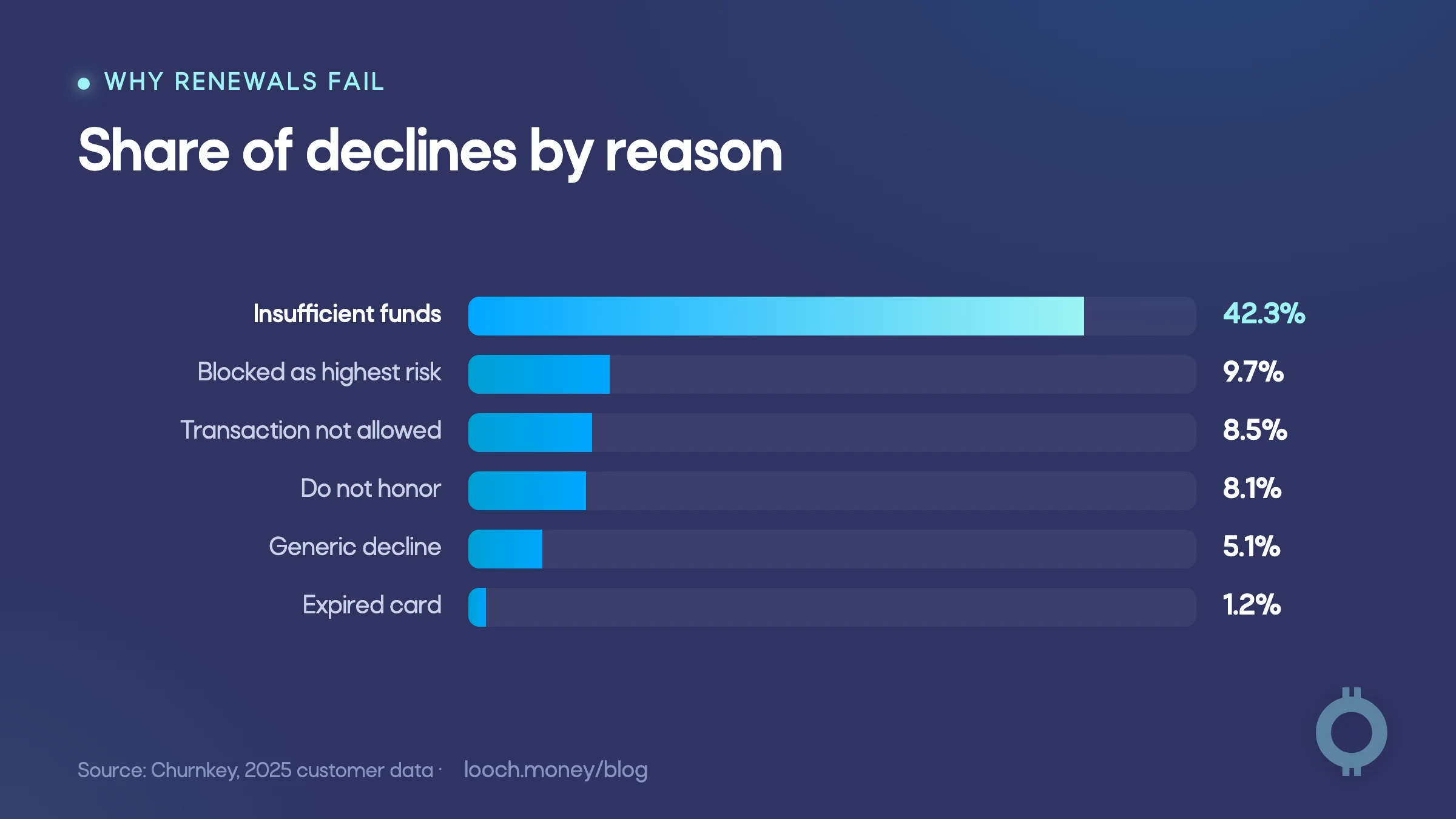
Churnkey analyzed 6 million failed payments from its customers using 2024 data. Churnkey reports that insufficient funds caused 42.3% of declines, making it the largest named reason in its dataset.
| Decline reason | Share of declines | What it suggests |
|---|---|---|
| Insufficient funds | 42.3% | The card may work later, so a considered retry can make sense. |
| Blocked as highest risk | 9.7% | Don’t treat this like a routine temporary failure. Read the advice returned with it. |
| Transaction not allowed | 8.5% | The customer or card issuer may need to act. |
| Do not honor | 8.1% | The message is broad, so use the other available signals before deciding. |
| Generic decline | 5.1% | The reason alone isn’t enough to justify a blind retry schedule. |
| Expired card | 1.2% | Ask the customer to use a current payment method. |
The lesson isn’t that every insufficient-funds decline should be retried in the same way. It’s that decline reasons contain useful direction, and a recovery system should read that direction before it acts.
Soft decline vs hard decline: Which should be retried?
A soft decline may be temporary, so another carefully chosen attempt can be appropriate. A hard decline means the same card details shouldn’t be submitted again for that transaction.
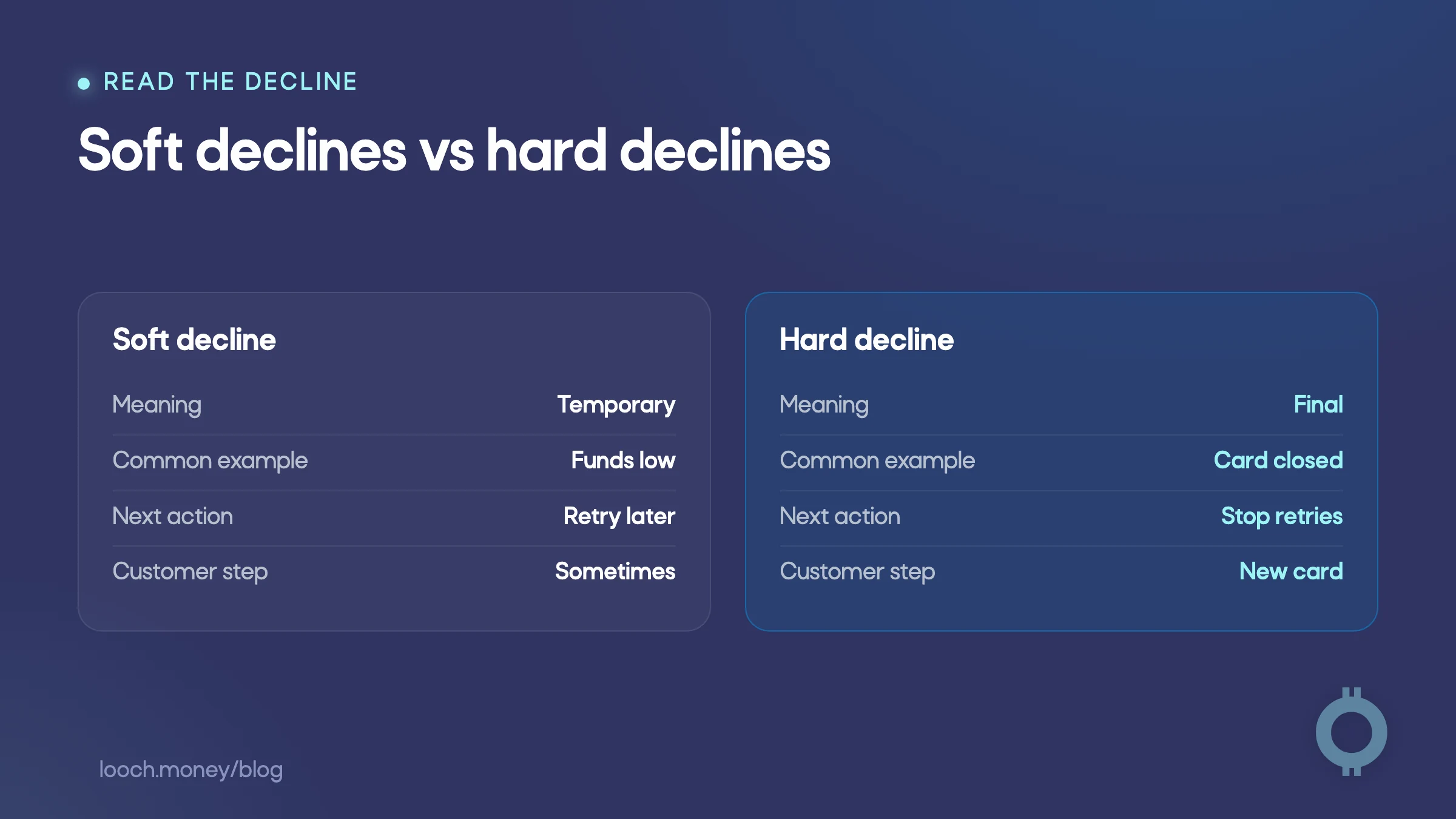
The words soft and hard are useful shorthand, but the action matters more than the label.
For a soft decline, read the decline reason, the issuer’s advice, and the card’s recent history. Retry only when those signals support it. If the customer needs to act, tell them and give them a direct route to pay.
For a hard decline, stop retrying the same card. Repeatedly sending a card that can’t work creates noise for the customer, wastes attempts, and may break card retry rules.
Don’t make the customer guess which kind of failure occurred. Your message should explain what they need to do, without exposing payment jargon or blaming them.
How do smart retries work?
Smart retries choose the next action from the information returned with a decline. They don’t apply one calendar to every failed payment.
A capable system considers:
- The reason the renewal was declined.
- The advice returned by the card’s bank and network.
- Whether another attempt is permitted.
- The card’s recent payment history.
- Whether the customer needs to take action.
- Whether continuing to retry would be pointless.
That context matters because two failed renewals may need opposite responses. One may justify another attempt. The other may require an immediate stop and a request for a new payment method.
A fixed schedule ignores that distinction. PayPal Subscriptions, for example, says it retries a failed payment every 5 days, with up to two retry attempts per billing cycle. That’s a clear published schedule, but it shows the limitation of treating different decline types alike.
The best time to retry a declined subscription payment therefore isn’t one universal hour or day. It’s the point supported by the decline reason, issuer advice, network rules, and relevant payment history.
Sources: PayPal.
What are the Visa and Mastercard card retry rules?
Card retry rules limit how often a declined authorization can be sent again. They also distinguish retryable declines from final ones that mustn’t be resubmitted.
Visa’s Core Rules dated April 18th, 2026 allow up to 20 attempts in 30 days for declines Visa groups as retryable. For final declines involving lost, stolen, closed, or similar cards, Visa says a merchant must never resubmit the same card.
Visa’s limit was 15 attempts in 30 days from April 2021, which is why some processor pages still show the older number. The current rulebook is the authority.
PayPal reports the following Mastercard limits: Allow 10 retries in a 24-hour period and allow 35 retries in a 30-day period. Mastercard’s Transaction Processing Rules also say that after a hard decline, a merchant mustn’t send another authorization request for the same transaction using the same card number and expiration date.
Going past retry limits can cost money. PayPal reports Visa excessive-reattempt fees of $0.10 for domestic attempts and $0.25 for cross-border attempts over the limit. PayPal reports a Mastercard US fee of $0.50 per attempt past the limit.
These are ceilings, not targets. A good recovery system stops as soon as the signals say a card won’t go through, even if more attempts would technically fit under a network maximum.
Sources: Visa Core Rules, PayPal.
What is dunning, and what should dunning emails say?
Dunning is the process of telling a customer that a recurring payment failed and helping them fix it. The best dunning feels like useful service, not debt collection.
A good failed-payment email should:
- Say which subscription needs attention.
- Explain that the latest renewal didn’t complete.
- State whether the customer needs to act.
- Provide one clear route to pay or update their payment method.
- Explain what happens to the subscription while recovery is in progress.
- Avoid technical decline codes, blame, and vague threats.
The customer also needs a trusted place to pay. Sending them to a portal is better than asking them to reply with card details or hunt through account settings.
Dunning shouldn’t begin only after a charge fails. When you know a saved card is approaching expiration, an advance reminder gives the customer a chance to update it before renewal. That protects the customer’s continuity and reduces work for your team.
Keep the tone calm. The customer already chose the subscription. Your job is to remove the payment obstacle without making them buy again.
What percentage of failed subscription payments can be recovered?
There’s no single recovery percentage that applies to every subscription business. Vendors use different denominators, customer samples, and definitions, so compare reported recovery rates carefully.
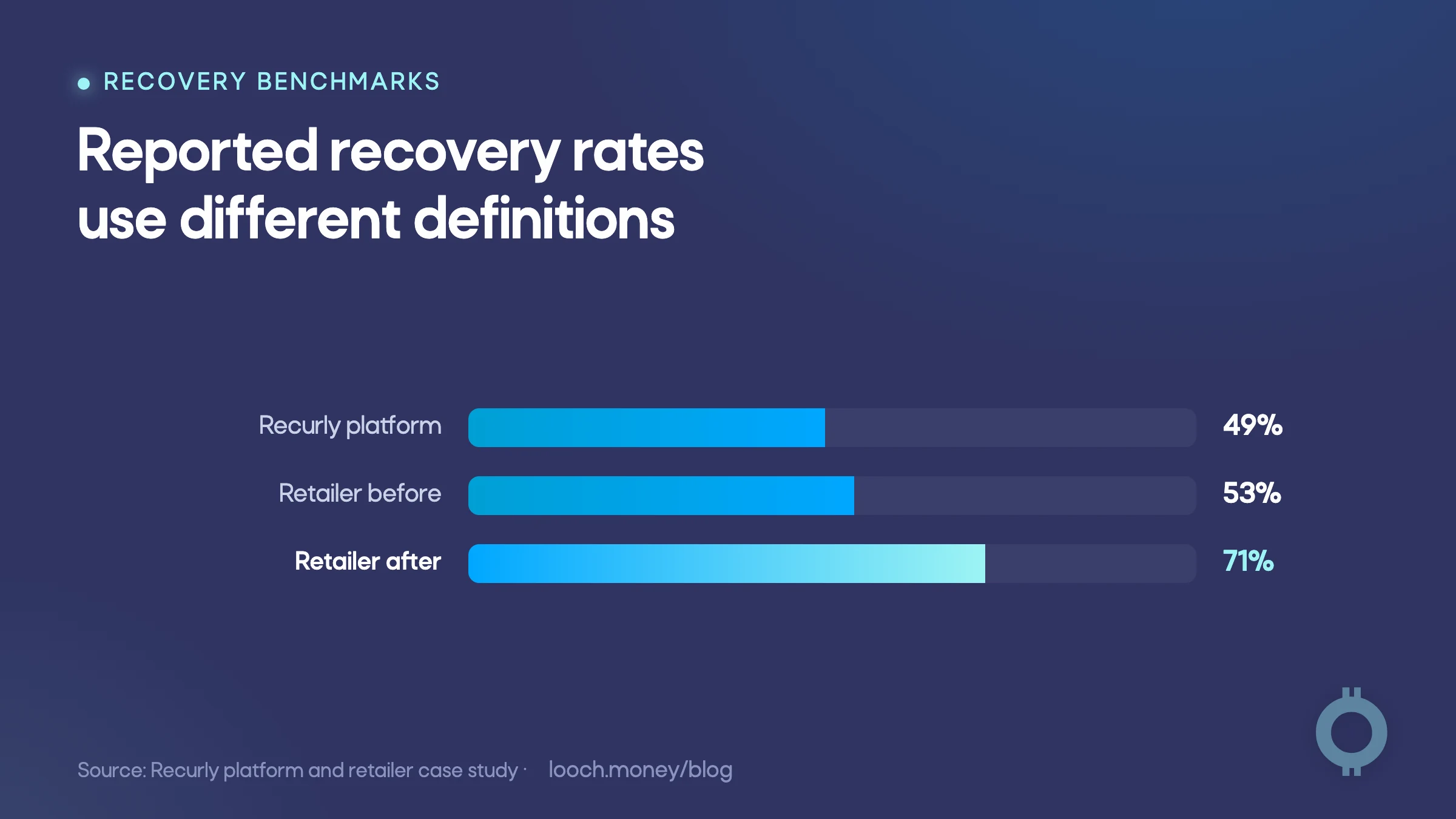
Recurly claims a 49% annual dunning recovery rate on its platform, where recovery means invoices recovered after entering dunning. In an April 2026 case study, Recurly says one enterprise retailer improved failed-payment recovery from approximately 53% to 71% after optimizing its retry strategies.
Baremetrics reports a median attempted recovery rate of 12.7% across 119 US B2B SaaS companies using its Recover product. Baremetrics defines that figure as recovered payments divided by recovery attempts, so it measures each attempt rather than each failed invoice.
That distinction explains why an individual retry can have a modest success rate while a full recovery sequence performs better. Timing, persistence, customer communication, and knowing when to stop all contribute to the final invoice-level result.
Sources: Recurly, Recurly case study, Baremetrics.
What does subscription payment recovery software cost?
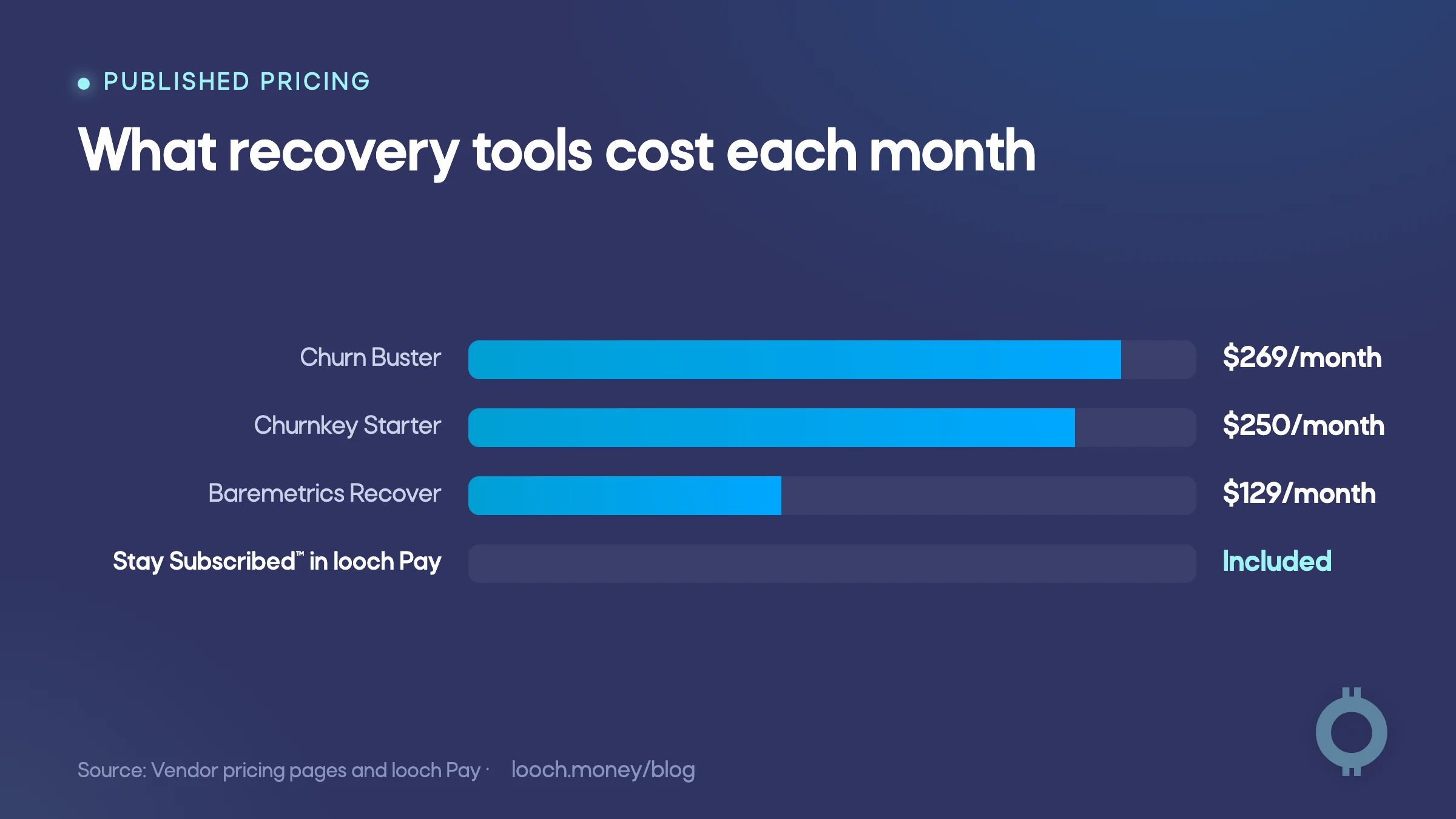
Dedicated recovery products can add another recurring software bill before they recover anything. Compare the price with the recovery features, your failed-renewal volume, and whether the tool requires another integration.
| Recovery product | Published price |
|---|---|
| Churn Buster | $269/month for Dunning Only, with a starting price based on MRR |
| Churnkey Starter | $250/month billed yearly, for teams with less than $5k/month of churn volume |
| Baremetrics Recover add-on | $129/month on top of a Baremetrics plan |
| Stay Subscribed™ in looch Pay | Included |
A higher price doesn’t prove that a tool will recover more for your business. Ask how it distinguishes decline types, chooses retries, follows network rules, communicates with customers, and measures recovery.
Sources: Churn Buster, Churnkey, Baremetrics, looch Pay.
What does good subscription payment recovery look like?
Good recovery protects the customer relationship while collecting revenue that would otherwise disappear. It should work without your team reviewing every decline.
Use this checklist when evaluating software:
- Decline-aware: It reads why the payment failed instead of treating every decline alike.
- Action-aware: It knows when to retry, when to ask the customer to act, and when to stop.
- Rule-aware: It stays inside Visa and Mastercard retry requirements.
- Customer-friendly: It explains the problem plainly and gives the customer a trusted place to pay.
- Continuity-minded: It doesn’t cancel access the instant one renewal fails.
- Consent-respecting: It doesn’t charge another saved card unless the customer chooses it.
- Preventive: It can warn customers before a known card expiration becomes a failed renewal.
- Measurable: It separates attempted recovery from recovered failed invoices, so the reported rate means something.
- Low-lift: It doesn’t require your team to build retry logic, email sequences, or a payment portal.
Also check the ordinary customer experience. Recovery software can have sophisticated logic and still fail if its email is confusing, its payment route looks unfamiliar, or it ends a subscription before the customer can respond.
How Stay Subscribed™ recovers renewals for you
Stay Subscribed™, built into looch Pay, reads every signal looch Pay has about a declined renewal. That includes the decline reason, the advice the card’s bank and card network send back, and the card’s recent history.
Stay Subscribed™ decides the next step from those signals. It retries when the card is most likely to go through rather than following one fixed calendar, stays within card network retry rules, and stops retrying a card that will never work.
When a renewal fails, Stay Subscribed™ emails your customer so they know what happened and can fix it. If their bank needs them to act, they’re sent to pay in the portal.
Stay Subscribed™ doesn’t cut off a subscription the moment a card fails. It gives the customer a fair chance to pay first, and it never charges a different saved card unless the customer chooses it.
It’s included in looch Pay. Nothing to set up. No developer. No code. See how Stay Subscribed™ works in looch Pay.
Subscription payment recovery FAQ
When is the best time to retry a declined subscription payment?
There isn’t one best time for every decline. The right response depends on the decline reason, issuer advice, network rules, and the card’s recent history.
How many times can you retry a declined card?
Visa permits up to 20 attempts in 30 days for declines it groups as retryable, while final declines must never be resubmitted. PayPal reports that Mastercard allows 10 retries in a 24-hour period and 35 retries in a 30-day period, but a hard decline mustn’t be retried with the same card details for the same transaction.
Should a small business build its own dunning system?
Usually, the better question is whether building it creates a real advantage. A small business needs decline interpretation, compliant retries, customer emails, and a place to pay, so an included system can remove substantial operational work.
What’s the best software for recovering failed subscription payments?
The best fit reads decline signals, follows card retry rules, communicates clearly, and doesn’t require manual work after every failure. Compare how each product defines recovery, what it costs, and whether it adds another integration to maintain.
Sources: Visa Core Rules, PayPal.


