


Foreign qualification cost by state: The real price
Amounts last verified on September 21st 2026
Michel Myara is co-founder and product designer at looch, where he designs the ecosystem small businesses use to get paid and manage spend while keeping penny-perfect books.
Foreign qualification costs more than the filing fee

Foreign qualification cost by state starts at $70 in California, $250 in New York, $750 in Texas, $125 in Florida, $180 in Washington, and $235 in Georgia. But the state filing is usually the easy part. Annual taxes, publication rules, late penalties, and a registered agent in every state can cost more than the first form.
A company formed in one state becomes a foreign LLC when it registers to do business in another. A Wyoming LLC operating in Texas, for example, is a foreign LLC in Texas. It isn’t an international company. It’s a domestic US company with a second state registration.
That distinction matters when founders compare formation states. A low annual fee in the state where you formed doesn’t erase the obligations in the state where you actually operate. The expensive decision often isn’t where you formed. It is whether you budgeted for the second state at all.
looch provides registered agent service in all 50 states through looch Start. Its $249 all-in price includes the state filing fee, an EIN with or without an SSN, and the first year of registered agent service and virtual office in the state where looch forms your company. The registered agent and virtual office renew at $249/year as the business protection bundle, which includes registered agent service, the virtual office with its business address and mail scanning, the state annual report filing, and weekly trademark monitoring. Additional states are $249/year per state.
Last verified: September 28th, 2026.
Yes, you usually have to register in the state where you actually do business, not only where you formed
An LLC formed in one state usually has to register as a foreign LLC when it transacts business in another. The state where you regularly live and work for the company, hire employees, or maintain an office is often the state that matters, not only the state printed on the formation documents.
States write that rule differently. Texas law, as summarized by the Texas Secretary of State, requires foreign entities to apply for registration if they’re “transacting business” in Texas. Florida law says a foreign LLC “may not transact business in this state until it obtains a certificate of authority.” New York LLC Law Section 802 says: “Before doing business in this state, a foreign limited liability company shall apply for authority”.
Each state decides what counts. Texas says outright that its statutes don’t define “transacting business.” It instead points businesses to a statutory list of activities that don’t count, which means the answer depends on the company’s actual conduct.
California applies its own tax test. FTB Publication 3556 defines doing business as “actively engaging in any transaction for the purpose of financial or pecuniary gain or profit.” It also says an LLC is doing business when any member, manager, or agent performs activities in California on its behalf, regardless of where the company otherwise operates.
The Franchise Tax Board’s broader doing-business guidance considers transactions for financial gain, commercial domicile, and California sales, property, or payroll. Its dollar amounts are revised every year, so an older threshold copied from another page shouldn’t be treated as current.
Waiting can make the filing more expensive. Texas assesses a late filing fee when a foreign entity has transacted business there for more than 90 days before registering. The state calculates that fee by multiplying each whole or partial calendar year of delinquency by the $750 registration fee.
Simplicity Fintech Inc is not a law firm and does not provide legal advice. If it’s unclear whether your company’s activity requires foreign qualification, ask a business attorney in that state before relying on a fee table.
Sources: Texas foreign and out-of-state entities, Florida Statutes Section 605.0902, New York LLC Law Section 802, FTB Publication 3556, and Doing business in California. Verified 9/28/2026.
The state filing is only the first line item
| State | Registration fee | Recurring state filing | Registered agent required | The cost people miss |
|---|---|---|---|---|
| California | $70 | $800 annual tax | Yes | The $800 is owed whether or not the LLC profits |
| New York | $250 | $9 biennial statement | Yes | Newspaper publication, then a $50 certificate |
| Texas | $750 | Public Information Report each year | Yes | The largest registration fee in this table |
| Florida | $125 | $138.75 annual report | Yes | A $400 late penalty |
| Washington | $180 | $70 annual report | Yes | The annual report fee rose to $70 |
| Georgia | $235 total | $60 total per year | Yes | Both totals include a $10 service charge |
Every state above requires a registered agent with a physical address in that state. That’s separate from the state’s filing fee. It’s also the cost that repeats as a business adds states.
The table is a planning tool, not a legal conclusion about whether your business must register. States apply their own rules to what counts as doing business or transacting business. Selling to a customer in a state isn’t necessarily the same thing as operating there. If the answer is unclear for your business, get advice from a business attorney in that state before you rely on a table, including this one.
California turns a low filing fee into an annual obligation
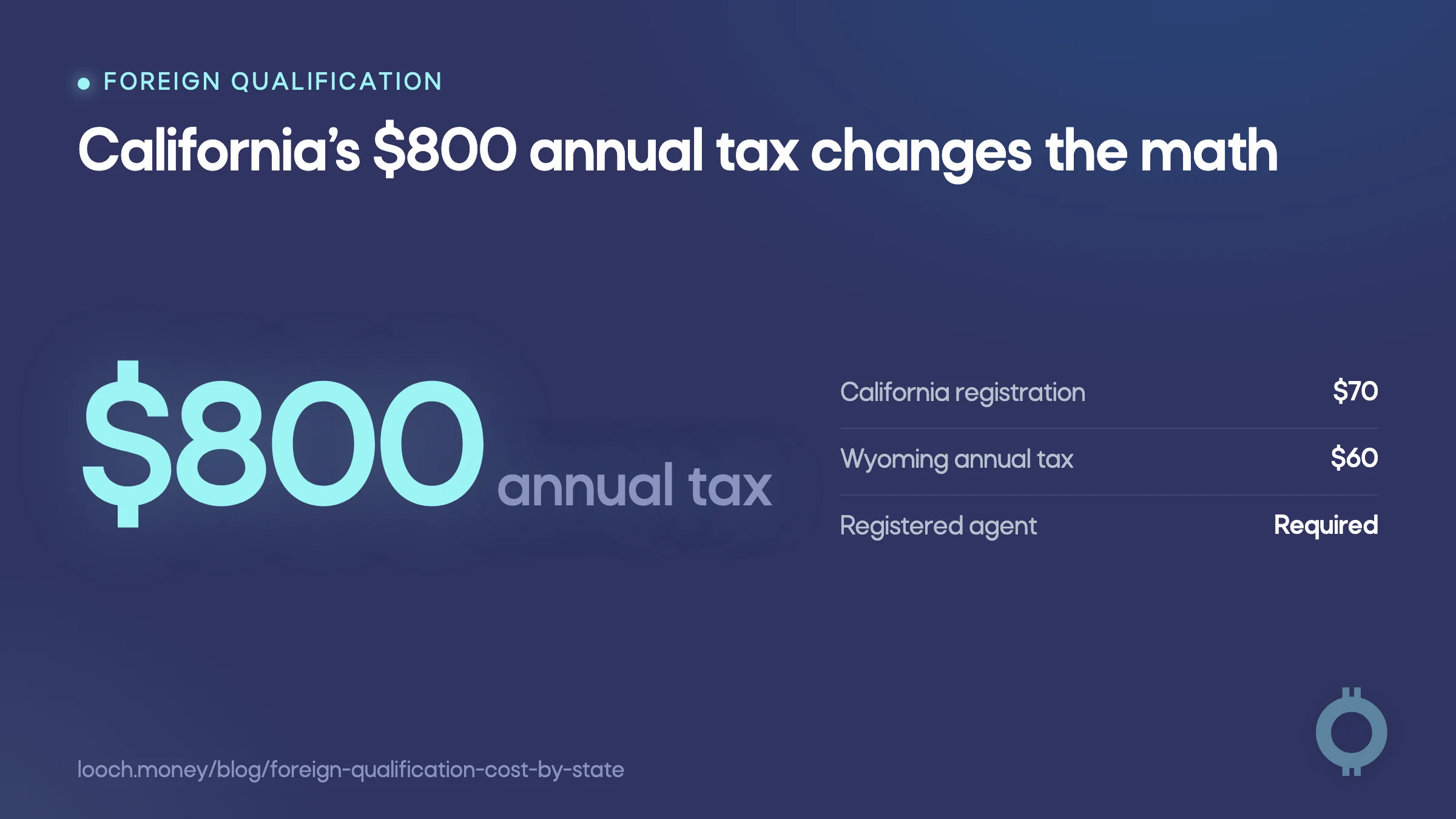
California’s foreign LLC filing fee is $70 on Form LLC-5. That looks modest next to Texas. It isn’t the figure that should drive the decision.
Every LLC doing business in or registered in California owes an annual tax of $800 to the Franchise Tax Board. The tax is owed whether or not the LLC made a profit, and it continues each year until the LLC is formally canceled. A founder who formed in Wyoming to keep annual state costs low can lose that expected saving quickly after registering in California.
California is the clearest example of why the formation-state comparison alone fails. The question is not only what Wyoming costs. It is what Wyoming costs plus California, plus the registered agent obligation in both states.
California’s first-year exception has ended. The Franchise Tax Board limited it to tax years beginning on or after January 1st, 2021 and before January 1st, 2024, so an LLC registering now owes the $800 annual tax for its first year. The first payment is due by the 15th day of the 4th month after filing with the Secretary of State. For an existing foreign LLC that registers or begins doing business after that point in its tax year, payment is due immediately when it begins business or when it registers, whichever happens first.
California can also charge an LLC fee when California income reaches $250,000. The Franchise Tax Board’s LLC fee schedule sets the fee at $900 for $250,000 to $499,999, $2,500 for $500,000 to $999,999, $6,000 for $1,000,000 to $4,999,999, and $11,790 for $5,000,000 or more. The LLC estimates and pays that fee by the 15th day of the 6th month using FTB 3536.
A registered foreign LLC must also file a $20 Statement of Information within 90 days of registering and every two years afterward. The Franchise Tax Board says the Secretary of State imposes a $250 penalty when the Statement of Information isn’t filed.
Sources: California Secretary of State, Form LLC-5 and California Franchise Tax Board, Limited liability company. Verified 9/28/2026.
Also: FTB Publication 3556, Doing business in California and Form LLC-12. Verified 9/28/2026.
A Wyoming LLC operating in California pays both states: The itemized cost
A Wyoming LLC operating in California keeps its Wyoming obligations and adds California’s registration, tax, reporting, and registered agent requirements. Here’s the state-level arithmetic before any professional service cost.
| Line | Amount | When | Source |
|---|---|---|---|
| Wyoming annual report license tax | $60 minimum, or $.0002 on Wyoming assets, whichever is greater | Every year | Wyoming Secretary of State fee schedule, effective July 1st, 2026 |
| California Form LLC-5 registration | $70 | Once | California Secretary of State, Form LLC-5 |
| California Statement of Information | $20 | Within 90 days of registering, then every two years | California Secretary of State, Form LLC-12 |
| California annual tax | $800 | Every year, including the first because the exception ended for tax years beginning January 1st, 2024 | California Franchise Tax Board |
| California LLC fee | $900 to $11,790 | Only if California income is $250,000 or more | California Franchise Tax Board |
| Registered agent in Wyoming | Already required for the Wyoming LLC | Every year | Included in the first year when the company is formed with looch Start |
| Registered agent in California | Required on Form LLC-5 at a California street address | Every year | California Secretary of State, Form LLC-5 |
The first-year state charges before registered agent service and before the California LLC fee are $60 plus $70 plus $20 plus $800, for a total of $950. Each later year starts with $60 to Wyoming and $800 to California, for $860, plus $20 every second year for the Statement of Information. The LLC fee applies once California income reaches $250,000.
The $800 annual tax is the line that changes the Wyoming arithmetic. The Wyoming registered agent isn’t a new cost created by California because the Wyoming LLC already needed one, but California requires a separate agent at a California street address.
Choosing Wyoming can still make sense when the company genuinely operates there. Our Delaware LLC vs Wyoming LLC comparison explains how to evaluate the formation-state choice before adding the states where the company will actually operate.
New York makes publication the unpredictable cost
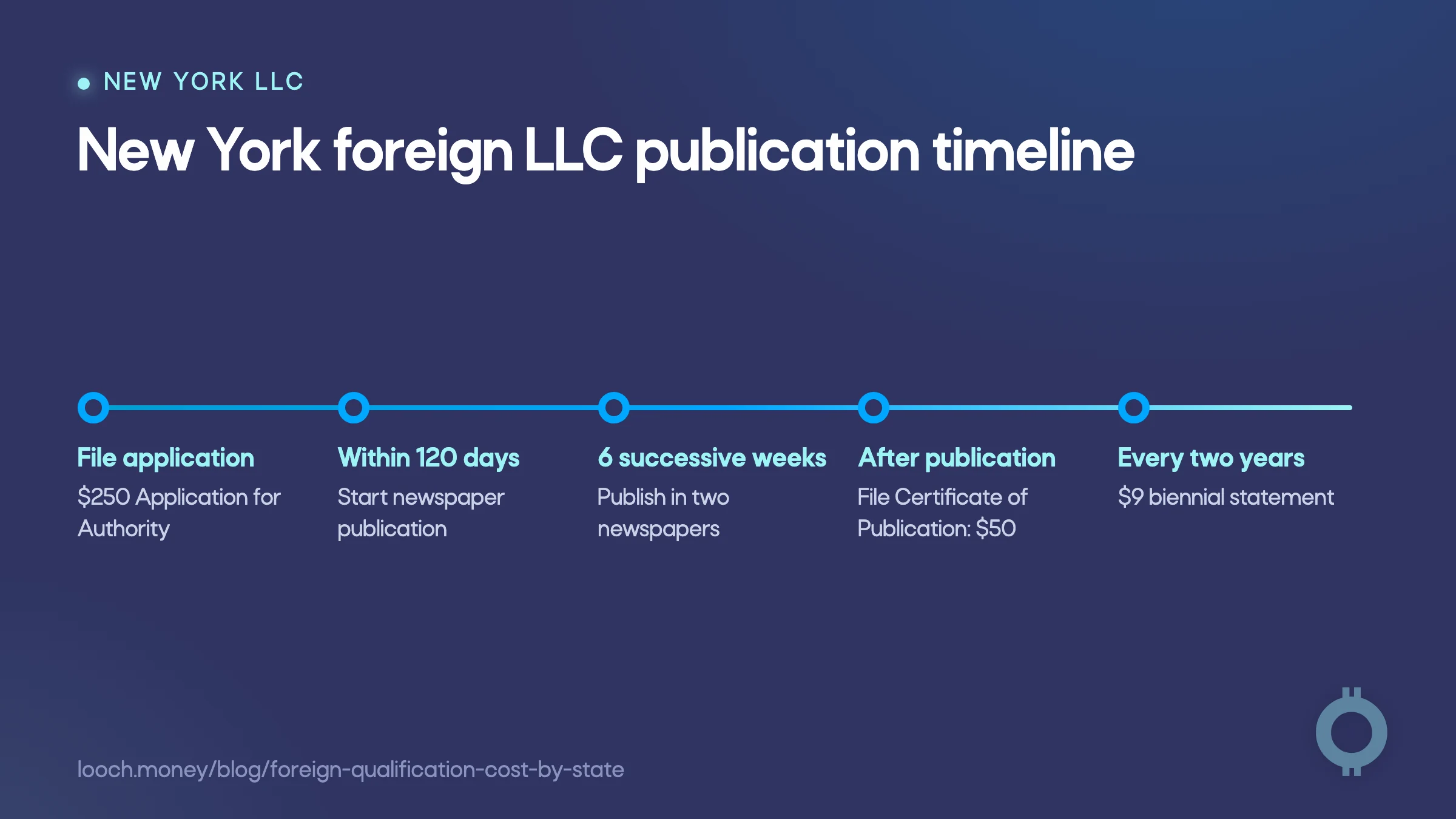
New York charges $250 for an Application for Authority. The filing fee is fixed. The publication requirement isn’t.
Within 120 days of filing, a foreign LLC must publish a copy of its application, or a notice containing its substance, once a week for six successive weeks in two newspapers in the county where the LLC’s office is located. After publication, the LLC files a Certificate of Publication with a $50 fee.
The ongoing filing is comparatively small. New York requires a biennial statement with a $9 fee, due every two years in the calendar month the Application for Authority was filed.
Newspaper charges come from the newspapers, not the state, and they vary by county. That’s why this page doesn’t give a generic publication range. A range copied from another blog isn’t a budget. Get quotes from the designated newspapers in the county where your LLC will be listed before you commit.
Sources: New York Department of State, Application for Authority, Certificate of Publication, and Biennial Statements. Verified 9/28/2026.
Texas has the highest up-front filing cost in this table
Texas charges $750 to file Form 304, the Application for Registration of a Foreign Limited Liability Company. That makes Texas the highest initial filing cost among the states covered here.
The Texas franchise tax itself will often be zero. The no tax due threshold for the 2026 report is $2.65 million in annualized total revenue. But a zero tax amount doesn’t remove the reporting obligation. An entity at or below the threshold still has to file a Public Information Report or Ownership Information Report.
That distinction is easy to miss. A founder can reasonably focus on whether tax is due, then overlook the report that remains due. Failure to file can cost an entity its right to transact business in Texas.
Texas also calls out a late registration consequence. A foreign entity that has transacted business in Texas for more than 90 days without registering can be charged a late fee equal to the registration fee for each year, or part of a year, it operated without registration.
Sources: Texas Secretary of State, Form 304 instructions and Texas Comptroller, PIR and OIR filing requirements. Verified 9/28/2026.
Florida, Washington, and Georgia are simpler, not cost-free
The remaining states have more direct fee structures. That doesn’t mean the deadlines are optional or the annual filings can be ignored.
| State | Initial filing | Ongoing obligation | What to plan for |
|---|---|---|---|
| Florida | $125 | $138.75 annual report | The report becomes $538.75 after May 1st |
| Washington | $180 | $70 annual report | The annual report is due every year |
| Georgia | $235 total | $60 total per year | The state adds a $10 service charge to each total |
Florida adds a fixed late penalty
Registering a foreign LLC in Florida costs $125. The state’s schedule lists that as a filing fee plus a required registered agent designation fee. The annual report costs $138.75 and is due between January 1 and May 1.
Miss that deadline and the annual report becomes $538.75 because Florida adds a $400 penalty. That’s a deadline to put in the same system that tracks tax filings, payroll obligations, and annual renewals.
If Florida is where you are forming rather than qualifying, see our guide to starting an LLC in Florida. It covers the formation process and what becomes public record on Sunbiz.
Source: Florida Division of Corporations fee schedule. Verified 9/28/2026.
Washington’s annual report is a recurring state cost
Registering a foreign LLC in Washington costs $180. The annual report costs $70. That fee increased under WAC 434-112-085(7), which is exactly why a cost page needs a verification date instead of a publication date alone.
A filing guide that stays online after a fee changes can look current while giving a founder the wrong budget. The source matters. So does when it was checked.
Source: Washington Secretary of State, foreign entity registration. Also: WAC 434-112-085. Verified 9/28/2026.
Georgia combines the filing fee and service charge
Georgia’s Certificate of Authority for a foreign LLC is $225 plus a $10 service charge, or $235 in practice. The annual registration is $50 plus the same $10 service charge, or $60, and is due between January 1 and April 1.
An entity that doesn’t file its annual registration can have its certificate of authority revoked. The useful budgeting number is the total paid, not the base state fee shown without the service charge.
Source: Georgia Secretary of State, Corporations Division filing fees, schedule effective 9/6/2025. Verified 8/16/2026.
Form where it fits, then count every state where you operate
The usual formation-state debate compares Delaware and Wyoming as if those are the only state fees a founder will ever pay. That’s incomplete if the company operates somewhere else.
Our Delaware LLC vs Wyoming LLC comparison explains why the better formation state depends on where you operate. This page supplies the part that is often left out: Foreign qualification can create a second registration fee, a second annual filing, a second registered agent requirement, and sometimes a tax that changes the entire calculation.
Put concretely: Wyoming’s minimum annual report license tax is $60. A Wyoming LLC that has to register in California doesn’t pay $60/year. It pays $60 to Wyoming, plus $70 once to California, plus $800 to California every year, plus a registered agent in each state.
Three practical conclusions follow:
- Where you operate usually matters more than where you form. The second registration is easy to overlook and expensive to fix later.
- Late registration has its own cost. Texas describes a late fee tied to unregistered operation, while Florida’s $400 report penalty is fixed.
- Each new state adds administration. State filings, annual deadlines, and registered agents don’t disappear because the company already exists elsewhere.
That doesn’t mean every founder should form in their home state. Delaware can make sense for a company with specific investor or governance needs. Wyoming can make sense for a business that is genuinely operating there. The point is narrower: Do not treat a formation-state fee as the total cost of the structure.
looch can consolidate the registered agent work, not the state’s fees
looch Start forms a Delaware LLC, Wyoming LLC, Florida LLC, or Delaware corporation and files it with the state in 1 business day. The $249 all-in looch Start price includes the LLC or corporation, the state filing fee, an EIN with or without an SSN, and the first year of registered agent service and virtual office in the formation state. looch provides registered agent service in all 50 states, and the registered agent and virtual office renew at $249/year as the business protection bundle, which includes registered agent service, the virtual office with its business address and mail scanning, the state annual report filing, and weekly trademark monitoring. Additional states are $249/year per state.
That gives a founder one place to manage the registered agent requirement as the business grows into additional states. It doesn’t remove the foreign qualification fees, annual reports, annual taxes, publication requirements, or state deadlines described above. Those are separate obligations owed to the state where you qualify.
looch also doesn’t decide whether your facts require foreign qualification. That’s a legal question. What looch can do is make the formation and registered agent side less fragmented once you know the states you need to cover. Current product details are available on the looch Start page and looch pricing page.
A business attorney is the better fit when the facts are unclear
A state fee table can show what filing costs after you know registration is required. It can’t decide whether remote work, hiring, property, contracts, or occasional transactions make your LLC subject to a particular state’s law.
A business attorney licensed in that state is the better fit when the facts are unclear, when activity began before registration, or when the company may owe past filings. looch can handle formation and registered agent work, but it doesn’t replace state-specific legal advice or remove any state charge.
Four questions founders ask about foreign qualification
What does foreign qualification cost by state for an LLC?
The registration fees covered here are $70 in California, $250 in New York, $750 in Texas, $125 in Florida, $180 in Washington, and $235 in Georgia. Recurring state obligations include California’s $800 annual tax, New York’s $9 biennial statement, Florida’s $138.75 annual report, Washington’s $70 annual report, and Georgia’s $60 total annual registration. You’ll also need a registered agent in every state where the LLC qualifies.
Do I need to register my out-of-state LLC in the state where I actually work?
Usually, yes, if the LLC transacts business there. Texas requires qualifying foreign entities to register when they transact business, Florida bars a foreign LLC from transacting business before it obtains authority, and New York requires authority before doing business. Each state defines the boundary differently, so ask a business attorney in that state when your facts are unclear.
If I form an LLC in Wyoming but operate in California, what do I have to pay?
Before registered agent service and any income-based LLC fee, the first-year state charges are $950: Wyoming’s $60 minimum annual report license tax, California’s $70 registration, California’s $20 Statement of Information, and California’s $800 annual tax. Later years start at $860, plus $20 every second year and the California LLC fee if California income reaches $250,000. You’ll also need registered agents in Wyoming and California.
What is California’s $800 franchise tax and does it apply to my out-of-state LLC?
The Franchise Tax Board calls it an annual tax, and it applies to every LLC doing business in or registered in California. A foreign LLC owes it when the Secretary of State accepts Form LLC-5 or when the LLC is doing business in California under the Franchise Tax Board’s test, and it remains due even without activity until the registration is canceled. The first-year exception applied only to tax years beginning on or after January 1st, 2021 and before January 1st, 2024, and the first payment is generally due by the 15th day of the 4th month.
This page is useful only while the sources stay current
Last verified: September 28th, 2026. Every figure on this page was checked against the issuing state agency on that date, except Georgia’s figures, which were last verified on 8/16/2026 and remain linked to the issuing agency’s fee schedule.
This page is rechecked quarterly and after state fee changes we become aware of. State fees move: Washington’s annual report fee increased to $70, and Georgia’s schedule took effect 9/6/2025. A cost page without a verification date may be telling you what was true when it was written, not what is true when you need to file.
Six states are covered because six states were verified. That is more useful than a longer table built from uncited summaries. For filing-fee and deadline changes across US business filings, see our LLC filing fee and deadline tracker.
Sources
- California Secretary of State, Form LLC-5
- California Secretary of State, Form LLC-12
- California Franchise Tax Board, Limited liability company
- California Franchise Tax Board, Publication 3556
- California Franchise Tax Board, Doing business in California
- New York Department of State, Application for Authority
- New York Department of State, Certificate of Publication
- New York Department of State, Biennial Statements
- New York LLC Law Section 802
- Texas Secretary of State, Form 304 instructions
- Texas Secretary of State, foreign and out-of-state entities
- Texas Comptroller, PIR and OIR filing requirements
- Florida Division of Corporations fee schedule
- Florida Statutes Section 605.0902
- Washington Secretary of State, foreign entity registration
- Washington Administrative Code 434-112-085
- Georgia Secretary of State, Corporations Division filing fees
- Wyoming Secretary of State fee schedule
- looch Start


